BLIND SPOT MONITOR SYSTEM SYSTEM DESCRIPTION

-
GENERAL
-
The blind spot monitor function is a function that assists the driver in making the decision to change lanes. The function uses quasi-millimeter wave radar to detect vehicles that are traveling in an adjacent lane in the area that is not reflected in the outer rear view mirror assembly. The function advises the driver of the existence of a vehicle by illuminating the outer rear view mirror indicator on the outer rear view mirror assembly.
-
If the turn signal switch is operated while the outer rear view mirror indicator on an outer rear view mirror assembly is illuminated, the indicator starts blinking to give additional warning to the driver.
-
-
FUNCTION OF COMPONENTS
Component Function Blind Spot Monitor Sensor
-
Consists of a 24 GHz radar module and an integrated processing module.
-
Illuminates or blinks the outer rear view mirror indicator on the outer rear view mirror assembly.
-
Changes the outer rear view mirror indicator on the outer rear view mirror assembly from illuminated to blinking when a turn signal switch operation signal is received from the windshield wiper switch assembly with the blind spot monitor function operating.
-
Dims the outer rear view mirror indicator on the outer rear view mirror assembly and blind spot monitor indicator on the blind spot monitor main switch (outer mirror switch assembly).
-
Turns on the blind spot monitor indicator on the blind spot monitor main switch (outer mirror switch assembly) when the blind spot monitor main switch (outer mirror switch assembly) is on.
Outer Rear View Mirror Assembly
-
Outer Rear View Mirror (Outer Rear View Mirror Indicator)
Turns on or blinks the indicator based on a signal from the blind spot monitor sensor.
-
Front Multiplex Network Door ECU LH
-
Front Multiplex Network Door ECU RH
Receives a signal from the blind spot monitor sensor and sends the signal to the outer rear view mirror indicator on the outer rear view mirror assembly. Blind Spot Monitor Main Switch (Outer Mirror Switch Assembly)
-
Blind Spot Monitor Indicator
-
Turns the blind spot monitor system on or off via CAN communication.
-
Informs the state of the blind spot monitor system by illuminating the blind spot monitor indicator.
No. 1 Meter ECU Sub-assembly
-
Multi-information Display
Displays an error message on the multi-information display if the blind spot monitor detects a malfunction while it is operating. Main Body ECU (Driver Side Junction Block) Sends the destination information and the dimmer signal to the blind spot monitor sensor via CAN communication. Skid Control ECU Assembly Transmits a vehicle speed signal to the blind spot monitor sensor via CAN communication. ECM Sends a shift position signal (R) to the blind spot monitor sensor via CAN communication. Steering Sensor Detects the angle of the steering wheel and sends the resulting signals to the blind spot monitor sensor via CAN communication. Windshield Wiper Switch Assembly
-
Receives a turn signal from the headlight dimmer switch assembly.
-
Sends a turn signal to the blind spot monitor sensor via CAN communication.
-
-
OPERATION DESCRIPTION
-
Operation description of the blind spot monitor function
-
Operation conditions
-
The blind spot monitor main switch (outer mirror switch assembly) is on.
-
Vehicle speed is more than approximately 16 km/h (10 mph).
-
-
Conditions in which a sensor can detect a vehicle
The blind spot monitor function indicates detection of a vehicle in the detection area when either condition is met:
-
When a vehicle is detected in an adjacent lane overtaking this vehicle.
-
When a vehicle is detected entering the detection area because it changed lanes.
-
-
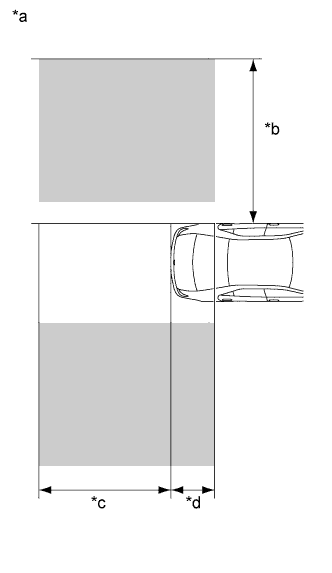
Text in Illustration *a Vehicles in the following areas can be detected: *b Within approximately 3.5 m (11.49 ft) from the side of the vehicle *c Within approximately 3 m (9.85 ft) behind the rear bumper *d Within approximately 1 m (3.29 ft) forward of the rear bumper Detection area
Vehicles in the following areas can be detected:
-
-
-
OPERATION OF OUTER REAR VIEW MIRROR INDICATOR
-
Initial check
-
When the blind spot monitor main switch (outer mirror switch assembly) is turned on with the engine switch on (IG), the outer rear view mirror indicator on each outer rear view mirror assembly illuminates for 3 seconds.
-
When the engine switch is turned from off to on (IG) with the blind spot monitor main switch (outer mirror switch assembly) on, the outer rear view mirror indicator on each outer rear view mirror assembly illuminates for 3 seconds.
-
-
Operation for each function
-
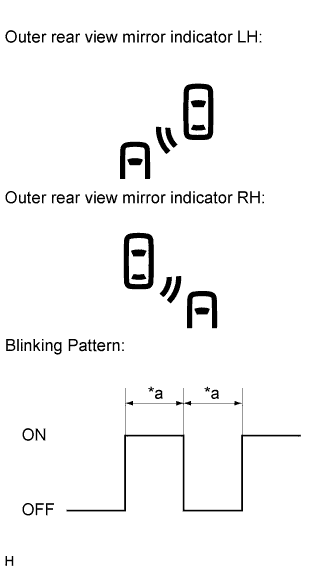
Text in Illustration *a 0.125 seconds Operation for blind spot monitor function
-
When a sensor detects a vehicle in the blind spot area, the outer rear view mirror indicator on the outer rear view mirror assembly illuminates.
-
While the sensor is detecting a vehicle in the detection area and the indicator is illuminated, if the turn signal switch is operated, the outer rear view mirror indicator on the outer rear view mirror assembly starts blinking as shown in the illustration.
-
-
-