TIRE PRESSURE WARNING VALVE AND TRANSMITTER INSTALLATION

Note
-
Always use a new grommet and valve core when installing the tire pressure warning valve and transmitter.
-
Check that the washer and nut are not damaged, and replace them if necessary.
-
Make sure not to damage the urethane covered backside of the tire pressure warning valve and transmitter (the surface opposite to the side with the ID code) with anything sharp.
-
If installing a new tire pressure warning valve and transmitter, write down the ID number before installation.
-
Check that there is no oil, water or lubricant around the rim hole, tire pressure warning valve and transmitter, washer and nut. Failing to do so may result in improper installation.
-
Use only a specified cap. If an unspecified cap is used, it may seize to the tire pressure warning valve and transmitter.
-
INSTALL TIRE PRESSURE WARNING VALVE AND TRANSMITTER
-
Install a new grommet to the tire pressure warning valve and transmitter.
Note
Do not install a grommet to a new tire pressure warning valve and transmitter, as a new tire pressure warning valve and transmitter has a grommet already installed.
-
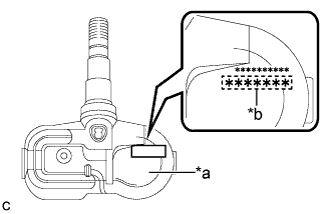
Text in Illustration *a Printed Surface *b 7-digit Number Transmitter ID Record the 7-digit number transmitter ID printed on the tire pressure warning valve and transmitter at the position shown in the illustration.
-
Insert the tire pressure warning valve and transmitter into the valve installation hole from the inside of the rim so that the printed surface can be seen.
Note
-
Check that there is no visible deformation, damage, or other abnormalities on the tire pressure warning valve and transmitter.
-
Check that there is no foreign matter on the grommet and around the rim hole.
-
If the tire pressure warning valve and transmitter is installed upside down, it may be damaged or fail to transmit signals when driving at high speeds.
-
-
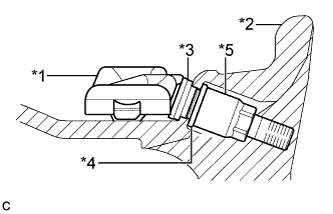
Text in Illustration *1 Tire Pressure Warning Valve and Transmitter *2 Rim *3 Grommet *4 Washer *5 Nut From the outside of the rim, install the washer to the tire pressure warning valve and transmitter, which has the grommet installed. Afterward, using an 11 mm deep socket wrench, tighten the nut.
- Torque:
- 4.0 N*m { 41 kgf*cm, 35 in.*lbf }
Note
-
No further tightening is required once the nut is tightened to the specified torque.
-
Check that there is no foreign matter on the washer and nut.
-
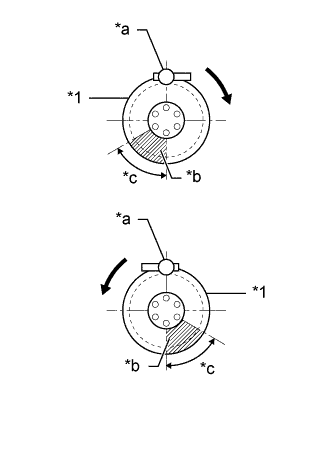
Text in Illustration *1 Rim *a Mount Tool of the Mounting Machine *b Area for Tire Pressure Warning Valve and Transmitter *c 60° 
Rim Rotation Direction Set the tire and disc wheel onto the mounting machine.
Note
-
Make sure the tire pressure warning valve and transmitter is positioned in the area shown in the illustration when set to the mounting machine. Otherwise, the tire pressure warning valve and transmitter may interfere with the tire bead and become damaged.
-
Position the main body of the tire pressure warning valve and transmitter in the area shown in the illustration.
-
-
Apply a sufficient coat of soapy water or equivalent to the tire bead and rim.
Note
Do not apply soapy water or equivalent directly to the tire pressure warning valve and transmitter.
-
Using a mounting machine, install the tire to the disc wheel.
Note
-
Make sure that the tire bead and mount tool do not interfere with the tire pressure warning valve and transmitter.
-
Make sure that the tire pressure warning valve and transmitter is not clamped by the bead and rim.
-
-
Install a new valve core.
-
Adjust the tire pressure to the standard tire pressure.
-
After the tire is inflated, the valve nut may be loose. Using an 11 mm deep socket wrench, retighten the nut to the specified torque.
- Torque:
- 4.0 N*m { 41 kgf*cm, 35 in.*lbf }
Note
No further tightening is required once the nut is tightened to the specified torque.
-
Check for air leaks with soapy water.
If there is air leakage, push the valve core 2 or 3 times to remove any dirt attached to the valve core. If air continues to leak, replace the grommet, washer and nut.
-
Install the valve cap.
-
-
INSTALL FRONT WHEEL
- Torque:
- 140 N*m { 1428 kgf*cm, 103 ft.*lbf }
-
INSTALL REAR WHEEL
- Torque:
- 140 N*m { 1428 kgf*cm, 103 ft.*lbf }
-
INSTALL SPARE TIRE (w/ Spare Tire)
-
INSPECT TIRES
-
Check the tires for wear and proper inflation pressure.
Specified Pressure (When Tire is Cool) for Europe Tire Size Up to 4 People 5 People or More Front
kPa (kgf/cm2, psi)
Rear
kPa (kgf/cm2, psi)
Front
kPa (kgf/cm2, psi)
Rear
kPa (kgf/cm2, psi)
235/50R18 97W For driving at over 210 km/h (131 mph) 300 (3.0, 44) 320 (3.2, 46) 330 (3.3, 48) 330 (3.3, 48) For driving at 160 km/h (100 mph) to 210 km/h (131 mph) 250 (2.5, 36) 260 (2.6, 38) 280 (2.8, 41) 280 (2.8, 41) For driving at under 160 km/h (100 mph) 230 (2.3, 33) 230 (2.3, 33) 250 (2.5, 36) 240 (2.4, 35) 245/45R19 98Y For driving at over 210 km/h (131 mph) 260 (2.6, 38) 260 (2.6, 38) 280 (2.8, 41) 300 (3.0, 44) For driving at 160 km/h (100 mph) to 210 km/h (131 mph) 230 (2.3, 33) 230 (2.3, 33) 250 (2.5, 36) 270 (2.7, 39) For driving at under 160 km/h (100 mph) 230 (2.3, 33) 230 (2.3, 33) 240 (2.4, 35) 240 (2.4, 35) For driving at under 160 km/h (100 mph)
w/ ECO tire pressure label
250 (2.5, 36) 250 (2.5, 36) 250 (2.5, 36) 250 (2.5, 36) Specified Pressure (When Tire is Cool) for Australia Tire Size Up to 4 People 5 People or More Front
kPa (kgf/cm2, psi)
Rear
kPa (kgf/cm2, psi)
Front
kPa (kgf/cm2, psi)
Rear
kPa (kgf/cm2, psi)
235/50R18 97W For driving at over 160 km/h (100 mph) 290 (2.9, 42) 320 (3.2, 46) 320 (3.2, 46) 330 (3.3, 48) For driving at under 160 km/h (100 mph) 230 (2.3, 33) 230 (2.3, 33) 240 (2.4, 35) 240 (2.4, 35) 245/45R19 98Y For driving at over 160 km/h (100 mph) 250 (2.5, 36) 260 (2.6, 38) 280 (2.8, 41) 300 (3.0, 44) For driving at under 160 km/h (100 mph) 230 (2.3, 33) 230 (2.3, 33) 240 (2.4, 35) 240 (2.4, 35) Specified Pressure (When Tire is Cool) for Middle East and General Export Tire Size Up to 4 People 5 People or More Front
kPa (kgf/cm2, psi)
Rear
kPa (kgf/cm2, psi)
Front
kPa (kgf/cm2, psi)
Rear
kPa (kgf/cm2, psi)
235/50R18 97W For driving at over 210 km/h (131 mph) 300 (3.0, 44) 320 (3.2, 46) 330 (3.3, 48) 330 (3.3, 48) For driving at 160 km/h (100 mph) to 210 km/h (131 mph) 250 (2.5, 36) 260 (2.6, 38) 280 (2.8, 41) 280 (2.8, 41) For driving at under 160 km/h (100 mph) 230 (2.3, 33) 230 (2.3, 33) 250 (2.5, 36) 240 (2.4, 35) 245/45R19 98Y For driving at over 210 km/h (131 mph) 260 (2.6, 38) 260 (2.6, 38) 280 (2.8, 41) 300 (3.0, 44) For driving at 160 km/h (100 mph) to 210 km/h (131 mph) 230 (2.3, 33) 230 (2.3, 33) 250 (2.5, 36) 270 (2.7, 39) For driving at under 160 km/h (100 mph) 230 (2.3, 33) 230 (2.3, 33) 240 (2.4, 35) 240 (2.4, 35) Specified Pressure (When Tire is Cool) for China Tire Size Front
kPa (kgf/cm2, psi)
Rear
kPa (kgf/cm2, psi)
235/50R18 97W For driving at over 160 km/h (100 mph) 330 (3.3, 48) 330 (3.3, 48) For driving at under 160 km/h (100 mph) 240 (2.4, 35) 240 (2.4, 35) 245/45R19 98Y For driving at over 160 km/h (100 mph) 260 (2.6, 38) 280 (2.8, 41) For driving at under 160 km/h (100 mph) 230 (2.3, 33) 230 (2.3, 33) -
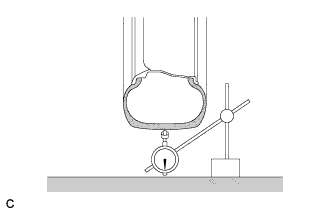
Using a dial indicator, check the runout of the tires.
Tire runout 1.0 mm (0.0394 in.) or less Tech Tips
Remove the wheel assembly from the vehicle, and measure the wheel assembly alone.
-
-
REGISTER TRANSMITTER ID
-
INSPECT TIRE PRESSURE WARNING SYSTEM
-
PERFORM INITIALIZATION