SFI SYSTEM, Diagnostic DTC:P0031, P0032, P0051, P0052

| DTC Code | DTC Name |
|---|---|
| P0031 | Oxygen (A/F) Sensor Heater Control Circuit Low (Bank 1 Sensor 1) |
| P0032 | Oxygen (A/F) Sensor Heater Control Circuit High (Bank 1 Sensor 1) |
| P0051 | Oxygen (A/F) Sensor Heater Control Circuit Low (Bank 2 Sensor 1) |
| P0052 | Oxygen (A/F) Sensor Heater Control Circuit High (Bank 2 Sensor 1) |
DESCRIPTION
Tech Tips
-
Although the DTC titles include oxygen sensor, these DTCs relate to the Air-Fuel Ratio (A/F) sensor.
-
Sensor 1 refers to the sensor mounted in front of the Three-Way Catalytic Converter (TWC) and located near the engine assembly.
The A/F sensor generates voltage* that corresponds to the actual air-fuel ratio. This sensor voltage is used to provide the ECM with feedback so that it can control the air-fuel ratio. The ECM determines the deviation from the stoichiometric air-fuel ratio level, and regulates the fuel injection time. If the A/F sensor malfunctions, the ECM is unable to control the air-fuel ratio accurately.
The A/F sensor is the planar type and is integrated with the heater, which heats the solid electrolyte (zirconia element). This heater is controlled by the ECM. When the intake air volume is low (the exhaust gas temperature is low), a current flows into the heater to heat the sensor, in order to facilitate accurate oxygen concentration detection. In addition, the sensor and heater portions are narrower than the conventional type. The heat generated by the heater is conducted to the solid electrolyte though the alumina, and therefore the sensor activation is accelerated.
In order to obtain a high purification rate of the carbon monoxide (CO), hydrocarbon (HC) and nitrogen oxide (NOx) components in the exhaust gas, a TWC is used. For the most efficient use of the TWC, the air-fuel ratio must be precisely controlled so that it is always close to the stoichiometric level.
*: Value changes inside the ECM. Since the A/F sensor is the current output element, a current is converted to a voltage inside the ECM. Any measurements taken at the A/F sensor or ECM connectors will show a constant voltage.
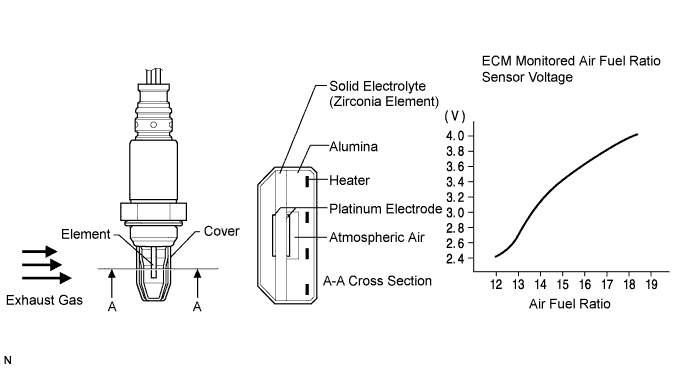
Tech Tips
-
When any of these DTCs are set, the ECM enters fail-safe mode. The ECM turns off the A/F sensor heater in fail-safe mode. Fail-safe mode continues until the engine switch is turned off.
-
The ECM provides a pulse width modulated control circuit to adjust the current through the heater. The A/F sensor heater circuit uses a relay on the +B side of the circuit.
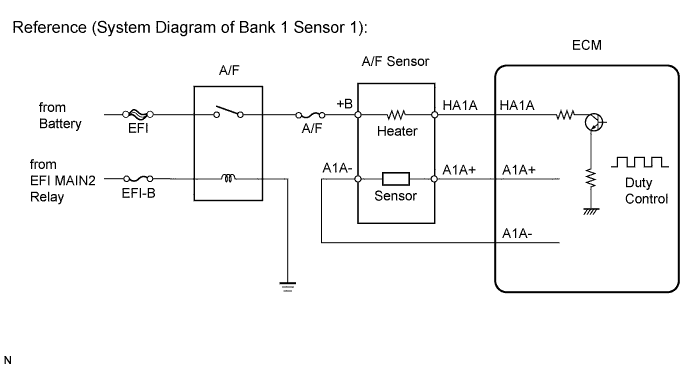
| DTC No. | DTC Detection Condition | Trouble Area |
|---|---|---|
| P0031 P0051 |
Air-Fuel Ratio (A/F) sensor heater current less than 0.8 A (1 trip detection logic) |
|
| P0032 P0052 |
Air-Fuel Ratio (A/F) sensor heater current failure (1 trip detection logic) |
|
Tech Tips
-
Bank 1 refers to the bank that includes No. 1 cylinder.
-
Bank 2 refers to the bank that does not include No. 1 cylinder.
-
Sensor 1 refers to the sensor closest to the engine assembly.
-
Sensor 2 refers to the sensor farthest away from the engine assembly.
MONITOR DESCRIPTION
-
The ECM uses information from the Air-Fuel Ratio (A/F) sensor to regulate the air-fuel ratio and keep it close to the stoichiometric level. This maximizes the ability of the Three-Way Catalytic Converter (TWC) to purify the exhaust gases.
-
The A/F sensor detects oxygen levels in the exhaust gas and transmits the information to the ECM. The inner surface of the sensor element is exposed to the outside air. The outer surface of the sensor element is exposed to the exhaust gas. The sensor element is made of platinum coated zirconia and includes an integrated heating element.
-
The zirconia element generates a small voltage when there is a large difference in the oxygen concentrations between the exhaust gas and outside air. The platinum coating amplifies this voltage generation.
-
The A/F sensor is more efficient when heated. When the exhaust gas temperature is low, the sensor cannot generate useful voltage signals without supplementary heating. The ECM regulates the supplementary heating using a duty-cycle approach to adjust the average current in the sensor heater element. If the heater current is outside the normal range, the signal transmitted by the A/F sensor will be inaccurate, as a result, the ECM will be unable to regulate air-fuel ratio properly.
-
When the current in the A/F sensor heater is outside the normal operating range, the ECM interprets this as a malfunction in the sensor heater and sets a DTC.
WIRING DIAGRAM
Refer to DTC P2195 Click here.
INSPECTION PROCEDURE
Tech Tips
Read freeze frame data using the intelligent tester. Freeze frame data records the engine condition when malfunctions are detected. When troubleshooting, freeze frame data can help determine if the vehicle was moving or stationary, if the engine was warmed up or not, if the air-fuel ratio was lean or rich, and other data from the time the malfunction occurred.
PROCEDURE
-
INSPECT AIR FUEL RATIO SENSOR (HEATER RESISTANCE)
-
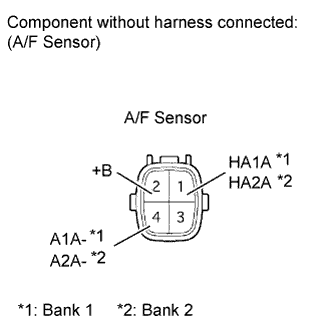
Disconnect the E47*1 or E48*2 A/F sensor connector.
Tech Tips
*1: Bank 1 Sensor 1
*2: Bank 2 Sensor 1
-
Measure the resistance according to the value(s) in the table below.
Standard resistance (Bank 1 Sensor 1) Tester Connection Condition Specified Condition 1 (HA1A) - 2 (+B) 20°C (68°F) 1.8 to 3.4 Ω 1 (HA1A) - 4 (A1A-) Always 10 kΩ or higher Standard resistance (Bank 2 Sensor 1) Tester Connection Condition Specified Condition 1 (HA2A) - 2 (+B) 20°C (68°F) 1.8 to 3.4 Ω 1 (HA2A) - 4 (A2A-) Always 10 kΩ or higher Result Result Proceed to OK A NG (for 2WD) B NG (for AWD) C
B 
REPLACE AIR FUEL RATIO SENSOR Click here
C
REPLACE AIR FUEL RATIO SENSOR Click here
A 
-
-
CHECK TERMINAL VOLTAGE (+B OF A/F SENSOR)
-
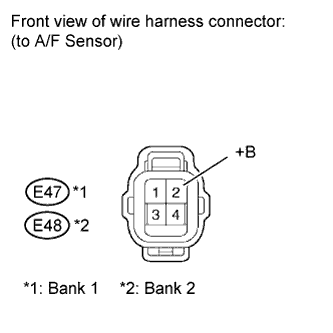
Disconnect the E47*1 or E48*2 A/F sensor connector.
Tech Tips
*1: Bank 1 Sensor 1
*2: Bank 2 Sensor 1
-
Turn the engine switch on (IG).
-
Measure the voltage according to the value(s) in the table below.
Standard voltage (Bank 1 Sensor 1) Tester Connection Switch Condition Specified Condition E47-2 (+B) - Body ground Engine switch on (IG) 11 to 14 V Standard voltage (Bank 2 Sensor 1) Tester Connection Switch Condition Specified Condition E48-2 (+B) - Body ground Engine switch on (IG) 11 to 14 V
NG 
INSPECT A/F FUSE Click here
OK
-
-
CHECK HARNESS AND CONNECTOR (A/F SENSOR - ECM)
-
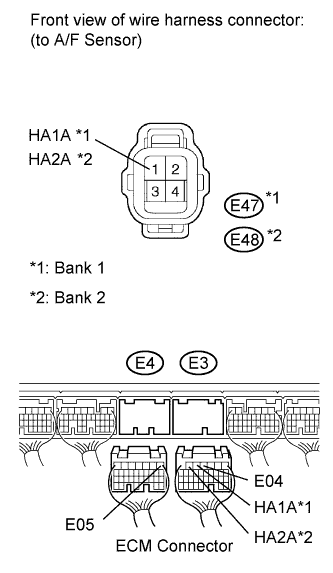
Check the wire harness and the connector between the ECM and the A/F sensor.
-
Disconnect the E47*1 or E48*2 A/F sensor connector.
Tech Tips
*1: Bank 1 Sensor 1
*2: Bank 2 Sensor 1
-
Disconnect the E3 and E4 ECM connector.
-
Measure the resistance according to the value(s) in the table below.
Standard resistance (Check for open) Tester Connection Condition Specified Condition E47-1 (HA1A) - E3-5 (HA1A) Always Below 1 Ω E48-1 (HA2A) - E3-6 (HA2A) Always Below 1 Ω E3-4 (E04) - Body ground Always Below 1 Ω E4-1 (E05) - Body ground Always Below 1 Ω Standard resistance (Check for short) Tester Connection Condition Specified Condition E47-1 (HA1A) or E3-5 (HA1A) - Body ground Always 10 kΩ or higher E48-1 (HA2A) or E3-6 (HA2A) - Body ground Always 10 kΩ or higher
-
NG
REPAIR OR REPLACE HARNESS OR CONNECTOR
OK 
REPLACE ECM Click here
-
-
INSPECT A/F FUSE
-
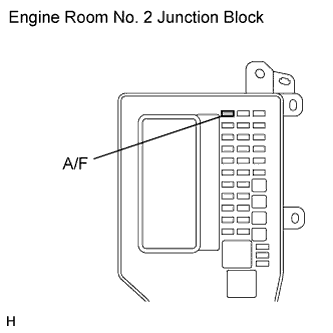
Remove the A/F fuse from the engine room No. 2 junction block.
-
Measure the resistance according to the value(s) in the table below.
Standard resistance Tester Connection Condition Specified Condition A/F fuse Always Below 1 Ω
NG
CHECK FOR SHORT IN ALL HARNESSES AND CONNECTORS CONNECTED TO FUSE AND REPLACE FUSE
OK
-
-
INSPECT ENGINE ROOM NO. 2 JUNCTION BLOCK (A/F RELAY)
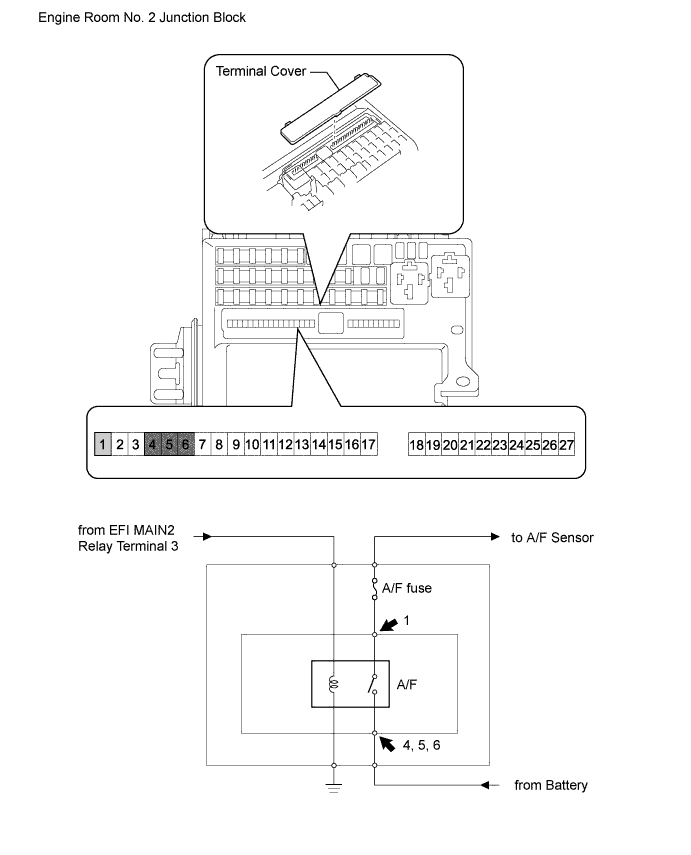
Tech Tips
A/F relay cannot be removed and inspected, as it is part of the engine room No. 2 junction block internal circuit.
-
Remove the terminal cover.
-
Measure the voltage according to the value(s) in the table below.
Standard voltage Tester Connection Switch Condition Specified Condition 4 - Body ground Always 11 to 14 V 5 - Body ground Always 11 to 14 V 6 - Body ground Always 11 to 14 V 1 - Body ground Engine switch on (IG) 11 to 14 V
NG
REPLACE ENGINE ROOM NO. 2 JUNCTION BLOCK
OK
-
-
CHECK HARNESS AND CONNECTOR (A/F FUSE - A/F SENSOR)
-
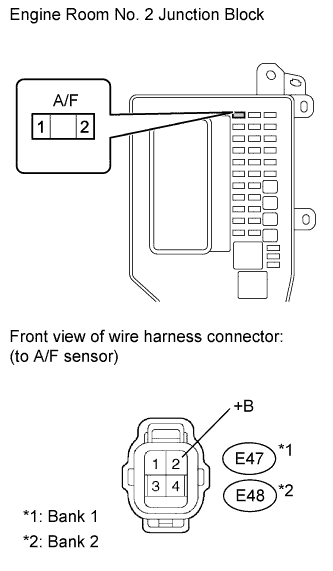
Disconnect the A/F fuse from the engine room No. 2 junction block.
-
Disconnect the E47*1 or E48*2 A/F sensor connector.
Tech Tips
*1: Bank 1 Sensor 1
*2: Bank 2 Sensor 1
-
Measure the resistance according to the value(s) in the table below.
Standard resistance (Check for open) Tester Connection Condition Specified Condition A/F fuse (2) - E47-2 (+B) Always Below 1 Ω A/F fuse (2) - E48-2 (+B) Always Below 1 Ω Standard resistance (Check for short) Tester Connection Condition Specified Condition A/F fuse (2) or E47-2 (+B) - Body ground Always 10 kΩ or higher A/F fuse (2) or E48-2 (+B) - Body ground Always 10 kΩ or higher
NG
REPAIR OR REPLACE HARNESS OR CONNECTOR
OK
REPAIR OR REPLACE ENGINE ROOM NO. 2 JUNCTION BLOCK
-