BODY GENERAL MAINTENANCE
-
TIGHTEN BOLTS AND NUTS ON CHASSIS AND BODY
-
Tighten the bolts and nuts on the chassis parts listed below, if necessary.
-
Front axle and suspension
-
Drivetrain
-
Rear axle and suspension
-
Brake system
-
Engine mounting
-
Other chassis parts
-
-
Tighten the bolts and nuts on the body parts listed below, if necessary.
-
Seat belt system
-
Seats
-
Doors and hood
-
Body mountings
-
Fuel tank
-
Exhaust pipe system
-
Other body parts
-
-
-
INSPECT TIRE AND INFLATION PRESSURE
-
Check the tires for wear and proper inflation pressure.
Standard Cold Tire Inflation Pressure (for Europe) Tire Size Front
kPa (kgf/cm2, psi)
Rear
kPa (kgf/cm2, psi)
235/50R18 97W 330 (3.3, 48)*1 330 (3.3, 48)*1 280 (2.8, 41)*2 280 (2.8, 41)*2 250 (2.5, 36)*3 240 (2.4, 35)*3 245/45R19 98Y 280 (2.8, 41)*1 300 (3.0, 44)*1 250 (2.5, 36)*2 270 (2.7, 39)*2 240 (2.4, 35)*3 240 (2.4, 35)*3 *1: For driving at over 210 km/h (131 mph)
*2: For driving at 160 km/h (100 mph) to 210 km/h (131 mph)
*3: For driving at under 160 km/h (100 mph)
Standard Cold Tire Inflation Pressure (for Australia) Tire Size Front
kPa (kgf/cm2, psi)
Rear
kPa (kgf/cm2, psi)
235/50R18 97W 320 (3.2, 46)*1 330 (3.3, 48)*1 240 (2.4, 35)*2 240 (2.4, 35)*2 245/45R19 98Y 280 (2.8, 41)*1 300 (3.0, 44)*1 240 (2.4, 35)*2 240 (2.4, 35)*2 *1: For driving at over 160 km/h (100 mph)
*2: For driving at under 160 km/h (100 mph)
Standard Cold Tire Inflation Pressure (for Middle East and General Export) Tire Size Front
kPa (kgf/cm2, psi)
Rear
kPa (kgf/cm2, psi)
235/50R18 97W 330 (3.3, 48)*1 330 (3.3, 48)*1 280 (2.8, 41)*2 280 (2.8, 41)*2 250 (2.5, 36)*3 240 (2.4, 35)*3 245/45R19 98Y 280 (2.8, 41)*1 300 (3.0, 44)*1 250 (2.5, 36)*2 270 (2.7, 39)*2 240 (2.4, 35)*3 240 (2.4, 35)*3 *1: For driving at over 210 km/h (131 mph)
*2: For driving at 160 km/h (100 mph) to 210 km/h (131 mph)
*3: For driving at under 160 km/h (100 mph)
Standard Cold Tire Inflation Pressure (for China) Tire Size Front
kPa (kgf/cm2, psi)
Rear
kPa (kgf/cm2, psi)
235/50R18 97W 330 (3.3, 48)*1 330 (3.3, 48)*1 240 (2.4, 35)*2 240 (2.4, 35)*2 245/45R19 98Y 260 (2.6, 38)*1 280 (2.8, 41)*1 230 (2.3, 33)*2 230 (2.3, 33)*2 *1: For driving at over 160 km/h (100 mph)
*2: For driving at under 160 km/h (100 mph)
-
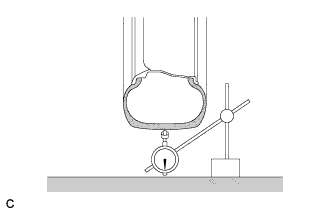
Using a dial indicator, check the runout of the tires.
Tire runout 1.0 mm (0.0394 in.) or less
-
-
INSPECT LIGHT, HORNS, WIPERS AND WASHERS
-
CLEAN OR REPLACE AIR CONDITIONING FILTER
-
Remove the air conditioning filter Click here.
Note
Before removing the air conditioning filter, turn the engine switch off and set the air conditioner to recirculation mode.
-
Visually inspect the surface of the air conditioning filter.
-
If the air conditioning filter is contaminated with foreign matter, clean or replace it according to the maintenance schedule.
Note
Some filters are not able to be cleaned.
-
-
CORROSION INSPECTION
-
ROAD TEST
-
Check the engine and chassis for abnormal noises.
-
Check that the brakes work properly and do not drag.
-
Set the parking brake shoes and drums.
-
-
INSPECT REFRIGERANT AMOUNT OF AIR CONDITIONER
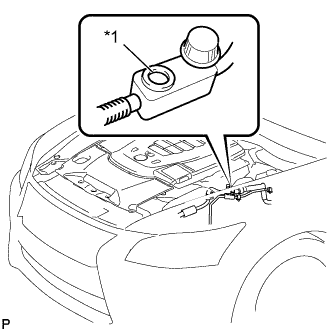
Text in Illustration *1 Sight Glass
-
Check the sight glass on the cooler refrigerant liquid pipe A.
Test conditions:
-
Temperature at the air inlet is 30 to 35°C (86 to 95°F).
-
Engine is running at 1500 rpm.
-
Blower speed control switch is at HI.
-
A/C switch is ON.
-
Temperature control switch is at the MAX. COOL position.
-
Doors are fully open.
Item Symptom Amount of Refrigerant Corrective Procedures 1 Bubbles visible Insufficient* (1) Check for gas leakage and repair if necessary
(2) Add refrigerant until bubbles disappear
2 No bubbles visible Empty, insufficient or too much Refer to items 3 and 4 3 No temperature difference between compressor inlet and outlet Empty or nearly empty (1) Check for gas leakage with halogen gas leak detector and repair if necessary
(2) Add refrigerant until bubbles disappear
4 Considerable temperature difference between compressor inlet and outlet Correct or too much Refer to items 5 and 6 5 Immediately after air conditioning is turned OFF, refrigerant becomes clear Too much (1) Drain or discharge refrigerant
(2) Bleed air and supply proper amount of purified refrigerant
6 Immediately after air conditioning is turned OFF, refrigerant foams and then becomes clear Correct - Tech Tips
*: If the ambient temperature is higher than usual but cooling is sufficient, bubbles in the sight glass are permissible.
-
-