СИСТЕМА SFI, Diagnostic DTC:P2A00
| DTC Code | DTC Name |
|---|---|
| P2A00 | A/F Sensor Circuit Slow Response (Bank 1 Sensor 1) |
DESCRIPTION
Tech Tips
-
Refer to DTC P2195 Click here.
-
Sensor 1 refers to the sensor mounted in front of the three-way catalytic converter and located near the engine assembly.
| DTC No. | DTC Detection Condition | Trouble Area |
|---|---|---|
| P2A00 | Calculated value for air fuel ratio sensor response rate deterioration level is less than threshold (2 trip detection logic) |
|
WIRING DIAGRAM
Refer to DTC P2195 Click here.
CONFIRMATION DRIVING PATTERN
Tech Tips
Performing this confirmation pattern will activate the air fuel ratio sensor response monitor.
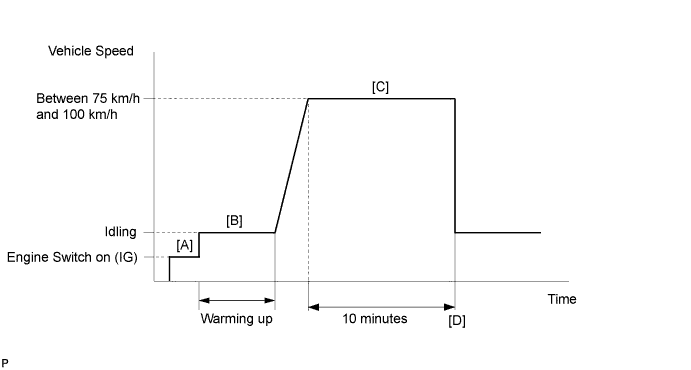
-
Connect the intelligent tester to the DLC3.
-
Turn the engine switch on (IG).
-
Turn the tester on.
-
Clear the DTCs Click here (Step "A").
-
Start the engine and warm it up (Step "B").
-
Drive the vehicle at between 75 km/h and 100 km/h (47 mph and 62 mph) for 10 minutes. However, the vehicle should be driven at a constant speed (Step "C").
-
Enter the following menu: Powertrain / Engine and ECT / DTC / Pending.
-
Check if any DTCs (any pending DTCs) are set (Step "D").
INSPECTION PROCEDURE
Tech Tips
Malfunctioning areas can be identified by performing the Control the Injection Volume for A/F Sensor function provided in the Active Test. The Control the Injection Volume for A/F Sensor function can help to determine whether the air fuel ratio sensor, heated oxygen sensor and other potential trouble areas are malfunctioning.
The following instructions describe how to conduct the Control the Injection Volume for A/F Sensor operation using the intelligent tester.
-
Connect the intelligent tester to the DLC3.
-
Start the engine.
-
Turn the tester on.
-
Warm up the engine at an engine speed of 2500 rpm for approximately 90 seconds.
-
Enter the following menus: Powertrain / Engine and ECT / Active Test / Control the Injection Volume for A/F Sensor.
-
Perform the Active Test operation with the engine in an idling condition (press the RIGHT or LEFT button to change the fuel injection volume).
-
Monitor the output voltages of the air fuel ratio and heated oxygen sensors (AFS Voltage B1S1 and O2S B1S2) displayed on the tester.
Tech Tips
-
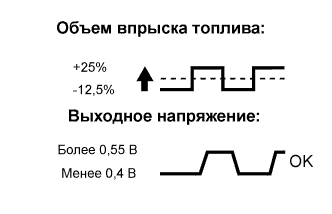
The Control the Injection Volume for A/F Sensor operation lowers the fuel injection volume by 12.5% or increases the injection volume by 25%.
-
Each sensor reacts in accordance with increases and decreases in the fuel injection volume.
| Tester Display (Sensor) | Injection Volume | Status | Voltage |
|---|---|---|---|
| AFS Voltage B1S1 (Air fuel ratio) |
+25% | Rich | Less than 3.1 V |
| -12.5% | Lean | More than 3.4 V | |
| O2S B1S2 (Heated oxygen) |
+25% | Rich | More than 0.55 V |
| -12.5% | Lean | Less than 0.4 V |
Note
The air fuel ratio sensor has an output delay of a few seconds and the heated oxygen sensor has a maximum output delay of approximately 20 seconds.
| Case | Air Fuel Ratio Sensor (Sensor 1) Output Voltage |
Heated Oxygen Sensor (Sensor 2) Output Voltage |
Main Suspected Trouble Area |
|---|---|---|---|
| 1 | 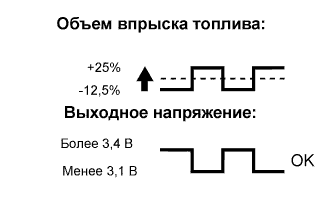 |
 |
- |
| 2 | 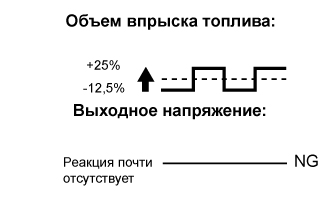 |
|
|
| 3 | |
|
|
| 4 | |
|
|
-
Following the Control the Injection Volume for A/F Sensor procedure enables technicians to check and graph the voltage outputs of both the air fuel ratio and heated oxygen sensors.
-
To display the graph, enter the following menus: Powertrain / Engine and ECT / Active Test / Control the Injection Volume for A/F Sensor / AFS Voltage B1S1 and O2S B1S2; then press the graph button on the Data List screen.
Note
Inspect the fuses for circuits related to this system before performing the following inspection procedure.
Tech Tips
-
DTC P2A00 may be also set, when the air fuel ratio is stuck rich or lean.
-
A low air fuel ratio sensor voltage could be caused by a rich air fuel mixture. Check for conditions that would cause the engine to run rich.
-
A high air fuel ratio sensor voltage could be caused by a lean air fuel mixture. Check for conditions that would cause the engine to run lean.
-
Read freeze frame data using the intelligent tester. The ECM records vehicle and driving condition information as freeze frame data the moment a DTC is stored. When troubleshooting, freeze frame data can be helpful in determining whether the vehicle was running or stopped, whether the engine was warmed up or not, whether the air fuel ratio was lean or rich, as well as other data recorded at the time of a malfunction.
PROCEDURE
-
CHECK ANY OTHER DTCS OUTPUT (IN ADDITION TO DTC P2A00)
-
Connect the intelligent tester to the DLC3.
-
Turn the engine switch on (IG).
-
Turn the tester on.
-
Enter the following menus: Powertrain / Engine and ECT / DTC.
-
Read the DTCs.
Result Result Proceed to DTC P2A00 is output A DTC P2A00 and other DTCs are output B Tech Tips
If any DTCs other than P2A00 are output, troubleshoot those DTCs first.
B 
GO TO DTC CHART Click here
A 
-
-
INSPECT AIR FUEL RATIO SENSOR (HEATER RESISTANCE)
-
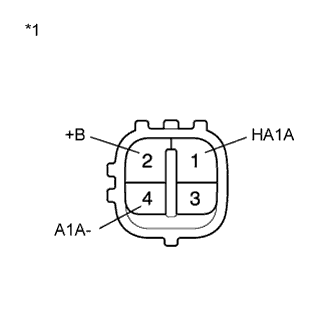
Text in Illustration *1 Component without harness connected
(Air Fuel Ratio Sensor)
Disconnect the air fuel ratio sensor connector.
-
Measure the resistance according to the value(s) in the table below.
Standard Resistance Tester Connection Condition Specified Condition 1 (HA1A) - 2 (+B) 20°C (68°F) 1.8 to 3.4 Ω 1 (HA1A) - 4 (A1A-) Always 10 kΩ or higher -
Reconnect the air fuel ratio sensor connector.
NG
REPLACE AIR FUEL RATIO SENSOR Click here
OK
-
-
CHECK HARNESS AND CONNECTOR (AIR FUEL RATIO SENSOR - ECM)
-
Disconnect the air fuel ratio sensor connector.
-
Disconnect the ECM connector.
-
Measure the resistance according to the value(s) in the table below.
Standard Resistance (Check for Open) Tester Connection Condition Specified Condition D54-1 (HA1A) - D41-109 (HA1A) Always Below 1 Ω D54-3 (A1A+) - D41-112 (A1A+) Always Below 1 Ω D54-4 (A1A-) - D41-113 (A1A-) Always Below 1 Ω Standard Resistance (Check for Short) Tester Connection Condition Specified Condition D54-1 (HA1A) or D41-109 (HA1A) - Body ground Always 10 kΩ or higher D54-3 (A1A+) or D41-112 (A1A+) - Body ground Always 10 kΩ or higher D54-4 (A1A-) or D41-113 (A1A-) - Body ground Always 10 kΩ or higher -
Reconnect the air fuel ratio sensor connector.
-
Reconnect the ECM connector.
NG
REPAIR OR REPLACE HARNESS OR CONNECTOR (AIR FUEL RATIO SENSOR - ECM)
OK
-
-
PERFORM CONFIRMATION DRIVING PATTERN
-
Connect the intelligent tester to the DLC3.
-
Turn the engine switch on (IG).
-
Turn the tester on.
-
Clear the DTCs Click here.
-
Drive the vehicle referring to the Confirmation Driving Pattern.
NEXT
-
-
CHECK WHETHER DTC OUTPUT RECURS (DTC P2A00)
-
Connect the intelligent tester to the DLC3.
-
Turn the engine switch on (IG).
-
Turn the tester on.
-
Enter the following menu: Powertrain / Engine and ECT / DTC / Pending.
-
Read the pending DTCs.
Result Result Proceed to DTC P2A00 is output A DTC is not output B
B
CHECK FOR INTERMITTENT PROBLEMS Click here
A
-
-
REPLACE AIR FUEL RATIO SENSOR
-
Replace the air fuel ratio sensor Click here.
NEXT
-
-
PERFORM CONFIRMATION DRIVING PATTERN
-
Connect the intelligent tester to the DLC3.
-
Turn the engine switch on (IG).
-
Turn the tester on.
-
Clear the DTCs Click here.
-
Drive the vehicle referring to the Confirmation Driving Pattern.
NEXT
-
-
CHECK WHETHER DTC OUTPUT RECURS (DTC P2A00)
-
Connect the intelligent tester to the DLC3.
-
Turn the engine switch on (IG).
-
Turn the tester on.
-
Enter the following menu: Powertrain / Engine and ECT / DTC / Pending.
-
Read the pending DTCs.
Result Result Proceed to DTC P2A00 is output A DTC is not output B
B
END
A 
REPLACE ECM Click here
-