AUDIO AND VISUAL SYSTEM (w/o Microphone) Speaker Circuit
DESCRIPTION
If there is a short in a speaker circuit, the radio receiver assembly detects it and stops output to the speakers.
Thus sound cannot be heard from the speakers even if there is no malfunction in the radio receiver assembly or speakers.
If a short is detected in a speaker circuit, no sound can be heard from the speakers.
WIRING DIAGRAM
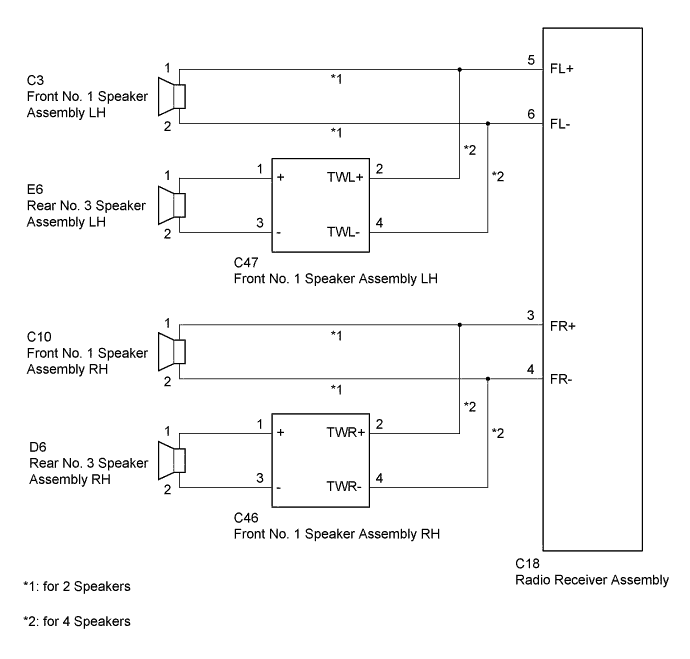
INSPECTION PROCEDURE
PROCEDURE
-
CONFIRM MODEL
-
Choose the model to be inspected.
Result Result Proceed to for 2 Speakers A for 4 Speakers B
B 
CHECK HARNESS AND CONNECTOR Click here
A 
-
-
CHECK HARNESS AND CONNECTOR
-
Disconnect the C18 radio receiver assembly connector.
-
Disconnect the C3 and C10 front No. 1 speaker assembly connectors.
-
Measure the resistance between each of the radio receiver assembly and the front No. 1 speaker assembly to check for an open circuit in the wire harness.
Standard Resistance Tester Connection Condition Specified Condition C18-5 (FL+) - C3-1 Always Below 1 Ω C18-6 (FL-) - C3-2 Always Below 1 Ω C18-3 (FR+) - C10-1 Always Below 1 Ω C18-4 (FR-) - C10-2 Always Below 1 Ω -
Measure the resistance between each speaker assembly and body ground to check for a short circuit in the wire harness.
Standard Resistance Tester Connection Condition Specified Condition C3-1 - Body ground Always 10 kΩ or higher C3-2 - Body ground Always 10 kΩ or higher C10-1 - Body ground Always 10 kΩ or higher C10-2 - Body ground Always 10 kΩ or higher
NG 
REPAIR OR REPLACE HARNESS OR CONNECTOR
OK
-
-
INSPECT FRONT NO. 1 SPEAKER ASSEMBLY
-
Inspect the front No. 1 speaker assembly Click here.
Tech Tips
The speaker should not be removed to check resistance.
NG
REPLACE FRONT NO. 1 SPEAKER ASSEMBLY Click here
OK 
PROCEED TO NEXT SUSPECTED AREA SHOWN IN PROBLEM SYMPTOMS TABLE Click here
-
-
CHECK HARNESS AND CONNECTOR
-
Disconnect the C18 radio receiver assembly connector.
-
Disconnect the C47 and C46 front No. 1 speaker assembly connectors.
-
Disconnect the E6 and D6 rear No. 3 speaker assembly connectors.
-
Measure the resistance between each of the radio receiver assembly and the front No. 1 speaker assembly to check for an open circuit in the wire harness.
Standard Resistance Tester Connection Condition Specified Condition C18-5 (FL+) - C47-2 (TWL+) Always Below 1 Ω C18-6 (FL-) - C47-4 (TWL-) Always Below 1 Ω C18-3 (FR+) - C46-2 (TWR+) Always Below 1 Ω C18-4 (FR-) - C46-4 (TWR-) Always Below 1 Ω -
Measure the resistance between each of the front No. 1 speaker assembly and rear No. 3 speaker assembly to check for an open circuit in the wire harness.
Standard Resistance Tester Connection Condition Specified Condition C47-1 (+) - E6-1 Always Below 1 Ω C47-3 (-) - E6-2 Always Below 1 Ω C46-1 (+) - D6-1 Always Below 1 Ω C46-3 (-) - D6-2 Always Below 1 Ω -
Measure the resistance between each speaker assembly and body ground to check for a short circuit in the wire harness.
Standard Resistance Tester Connection Condition Specified Condition C47-2 (TWL+) - Body ground Always 10 kΩ or higher C47-4 (TWL-) - Body ground Always 10 kΩ or higher C46-2 (TWR+) - Body ground Always 10 kΩ or higher C46-4 (TWR-) - Body ground Always 10 kΩ or higher E6-1 - Body ground Always 10 kΩ or higher E6-2 - Body ground Always 10 kΩ or higher D6-1 - Body ground Always 10 kΩ or higher D6-2 - Body ground Always 10 kΩ or higher
NG
REPAIR OR REPLACE HARNESS OR CONNECTOR
OK
-
-
INSPECT FRONT NO. 1 SPEAKER ASSEMBLY
-
Inspect the front No. 1 speaker assembly Click here.
NG
REPLACE FRONT NO. 1 SPEAKER ASSEMBLY Click here
OK
-
-
INSPECT REAR NO. 3 SPEAKER ASSEMBLY
-
Inspect the rear No. 3 speaker assembly Click here.
NG
REPLACE REAR NO. 3 SPEAKER ASSEMBLY Click here
OK
PROCEED TO NEXT SUSPECTED AREA SHOWN IN PROBLEM SYMPTOMS TABLE Click here
-