AUDIO AND VISUAL SYSTEM (w/o Microphone) IDENTIFICATION OF NOISE SOURCE

-
Radio Description
-
Radio frequency bands
-
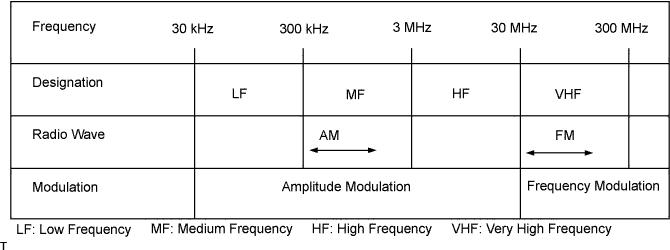
Radio broadcasts use the radio frequency bands shown in the table below.
-
-
Service areas
-
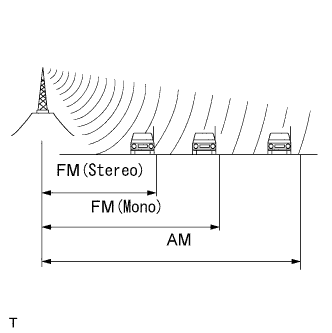
The service areas of the AM and FM broadcasts are vastly different. Even if an AM broadcast has clear reception, an FM broadcast originating in the same location may not be received at all. The service area of FM stereo broadcasts is small, and static as well as interference (noise) easily affect the signal.
-
-
Radio reception problems
Tech Tips
In addition to static, other problems such as "phasing", "multi-path", and "fade out" exist. These problems are not caused by electrical noise, but by the radio signal propagation method itself.
-
Phasing
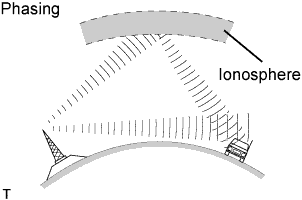
The AM frequency band reflects off the earth's ionosphere at night. When this occurs, the reflected signal may interfere with the direct signal sent by the same transmitter. This phenomenon is known as "Phasing".
-
Multi-path
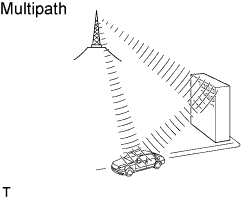
A radio signal can sometimes be reflected by an obstruction in its path. When this occurs, the reflected signal may interfere with the direct signal sent from the transmitter. This phenomenon is known as "Multi-path".
-
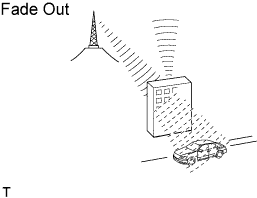
Fade out
FM radio frequency is higher than AM. Therefore, it is more likely to be reflected by large obstructions such as tall buildings or mountains. For this reason, the FM signal will gradually weaken or disappear when the vehicle is behind such obstructions. This phenomenon is known as "fade out".
-
-
Noise problem
It is very important for a technician to understand the specifics of the noise problem. To diagnose the symptom, use the table below.
Radio Frequency Noise Occurrence Condition Probable Cause AM Noise occurs in a specified area Foreign noise AM Noise occurs when listening to an intermittent broadcast An identical program transmitted from multiple towers can cause noise where the signals overlap AM Noise occurs only at night Music beat from a far-off broadcast FM Noise occurs while driving in a specified area Multi-path or phasing noise resulting from a change in FM frequency
Tech Tips
If the noise does not fall into any category in the table above, determine the cause by referring to "Radio reception problems" above. Refer to the multi-path and phasing sections.
-