CONDENSER INSTALLATION

-
INSTALL CONDENSER ASSEMBLY
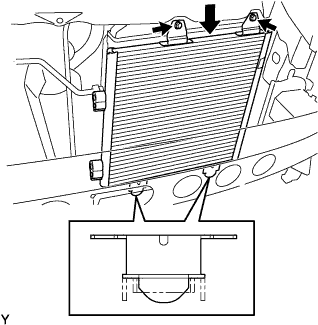
-
Insert the plate of the condenser into the hole in the radiator.
Note
Do not damage the condenser fins or the radiator when installing.
-
Install the condenser assembly with the 2 bolts.
- Torque:
- 9.8 N*m { 100 kgf*cm, 8.7 in.*lbf }
-
-
INSTALL AIR CONDITIONING TUBE ASSEMBLY
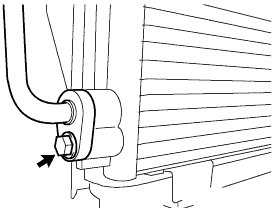
-
Remove the attached vinyl tape from the pipe and the connecting part of the cooler condenser assembly.
-
Apply sufficient compressor oil to 2 new O-rings and the fitting surface of the pipe joint.
Compressor oil ZXL 200PG or equivalent -
Install the 2 O-rings onto the air conditioning tube assembly.
-
Install the air conditioning tube onto the condenser assembly with the bolt.
- Torque:
- 9.8 N*m { 100 kgf*cm, 8.7 in.*lbf }
-
-
INSTALL DISCHARGE HOSE SUB-ASSEMBLY
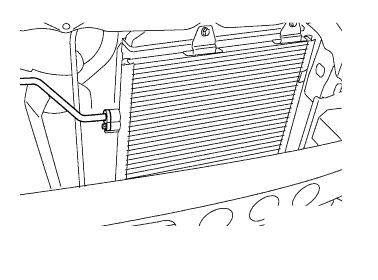
-
Remove the attached vinyl tape from the hose and the connecting part of the cooler condenser assembly.
-
Apply sufficient compressor oil to 2 new O-rings and the fitting surface of the hose joint.
Compressor oil ZXL 200PG or equivalent -
Install the 2 O-rings onto the discharge hose sub-assembly.
-
Install the discharge hose sub-assembly onto the condenser assembly with the bolt.
- Torque:
- 9.8 N*m { 100 kgf*cm, 8.7 in.*lbf }
-
-
INSTALL RADIATOR SIDE AIR SEAL NO.2
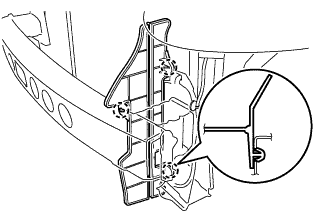
-
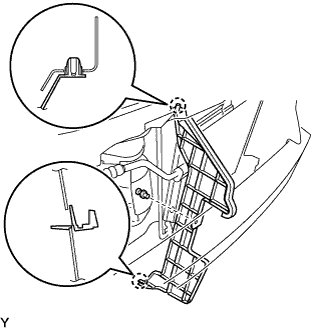
Engage the 3 claws and install radiator side air seal No. 2.
-
-
INSTALL RADIATOR SIDE AIR SEAL NO.1
-
Engage the 2 claws and install radiator side air seal No. 1.
-
Install the clip.
-
-
INSTALL FRONT BUMPER COVER
-
Install the 2 clips.
-
Connect the connectors.
Tech Tips
If the vehicle is equipped with fog light and daytime running lights, connect the connectors.
-
Engage the 10 claws and install the front bumper cover.
-
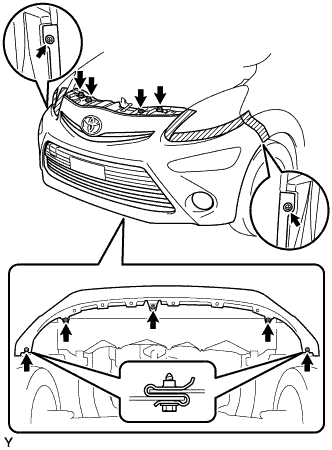
Tighten the 3 bolts and 5 screws.
-
Install the 3 clips.
-
Remove the protective tape.
-
-
INSTALL FRONT SPOILER (w/ Front Spoiler)
-
CHARGE REFRIGERANT
- SST
- 07110-58060 ( 07117-58080, 07117-58090, 07117-78050, 07117-88060, 07117-88070, 07117-88080 )
Note
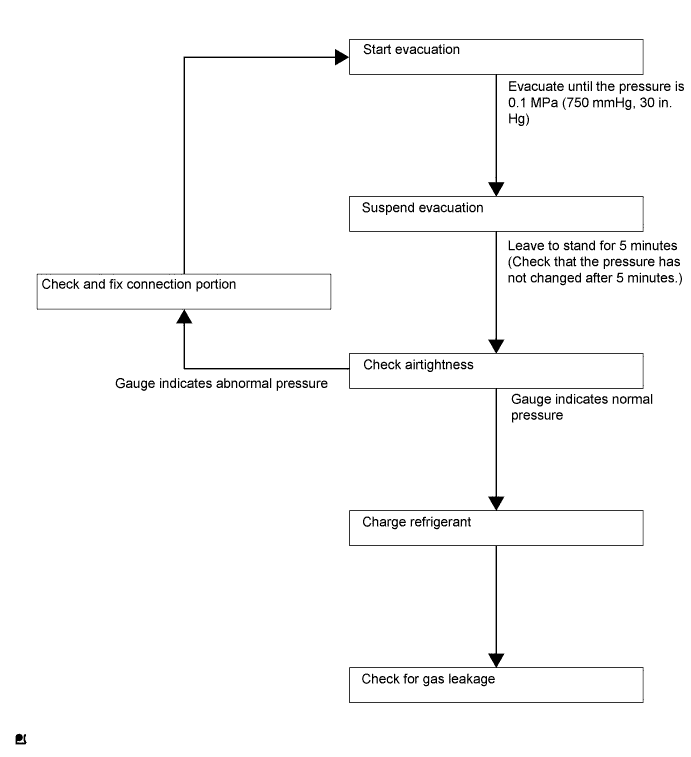
Be sure to charge refrigerant in accordance with equipment manual.
-
Perform vacuum purging using a vacuum pump.
-
Charge refrigerant HFC-134a (R134a).
Standard 420 to 480g (14.81 to 16.93oz.) for IKR-FE 470 to 530g (16.58 to 18.69oz.) for 2WZ-TV Note
Do not start the engine before charging it with refrigerant as the cooler compressor doesn't work properly without sufficient refrigerant. This could cause the compressor to overheat.
Tech Tips
-
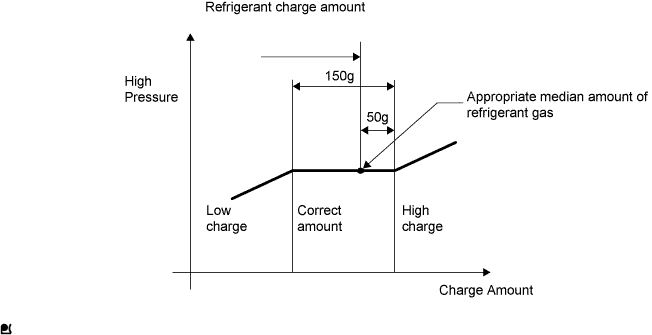
The relationship between refrigerant charge amount and pressure is as follows.
-
Correct charging amount is approximately 450g.
-
High Charge Range:
If refrigerant is overcharged, pressure rises on the high-pressure side. High-pressure cut off frequently occurs. This causes insufficient cooling performance and also insufficient compressor lubrication.
-
Low Charge Range:
Shortage of refrigerant causes insufficient cooling performance and low circulation of refrigerant oil, which shortens compressor life. Operation with insufficient coolant raises refrigerant temperature and causes heat deterioration of rubber seals and hoses. Cracking and thus refrigerant leakage may occur.
-
Install the caps onto the service valves on the refrigerant line.
-
-
WARM UP ENGINE
Note
Warm up the engine at less than 2,000 rpm for 1 minute or more after charging it with refrigerant.
-
INSPECT FOR REFRIGERANT LEAKS
-
After recharging the refrigerant gas, check for refrigerant gas leakage using a halogen leak detector.
-
Perform the operation as follows:
-
Stop the engine.
-
Secure good ventilation (the gas leak detector may react to volatile gases other than refrigerant, such as evaporated gasoline or exhaust gas).
-
Repeat the test 2 or 3 times.
-
Make sure that some refrigerant remains in the refrigeration system.
When compressor is off: approximately 392 to 588 kPa (4 to 6 kgf*cm2, 57 to 85 psi)
Tech Tips
It is impossible for the above pressure to be maintained if there is leakage.
-
-
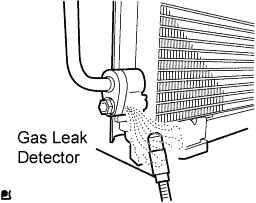
Using a gas leak detector, check the refrigerant line, especially the connecting points, for leakage.
-
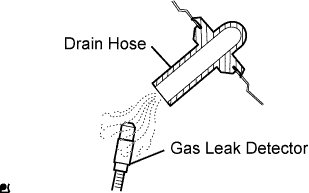
Bring the gas leak detector close to the drain hose before performing the test.
Tech Tips
-
After the blower motor has stopped, leave the cooling unit for at least 15 minutes.
-
Place the gas leak detector sensor under the drain hose.
-
When bringing the gas leak detector close to the drain hose, make sure that the gas leak detector does not react to the volatile gases.
If such a reaction is unavoidable, the vehicle must be lifted up.
-
-
If a gas leak is not detected from the drain hose, remove the blower motor from the cooling unit. Insert the gas leak detector sensor into the unit and perform the test.
-
Disconnect the pressure switch connector and leave it for approximately 20 minutes. Bring the gas leak detector close to the pressure switch and perform the test.
-