MULTI-MODE MANUAL TRANSAXLE SYSTEM, Diagnostic DTC:P0810

| DTC Code | DTC Name |
|---|---|
| P0810 | Clutch Position Control Error |
DESCRIPTION
In the multi-mode manual transaxle system, the clutch is engaged and disengaged by the transmission control ECU using a clutch actuator. The clutch actuator consists of an electric motor which moves the clutch master cylinder, a clutch stroke sensor which detects the clutch master cylinder position, and a worm gear which engages the pull rod with the motor.
| DTC No. | DTC Detection Condition | Trouble Area |
|---|---|---|
| P0810 | The transmission control ECU detects the following conditions simultaneously: (1-trip detection logic)
|
|
Tech Tips
The monitor runs when the vehicle is driven at a vehicle speed of 20 km/h (12.4 mph) or more.
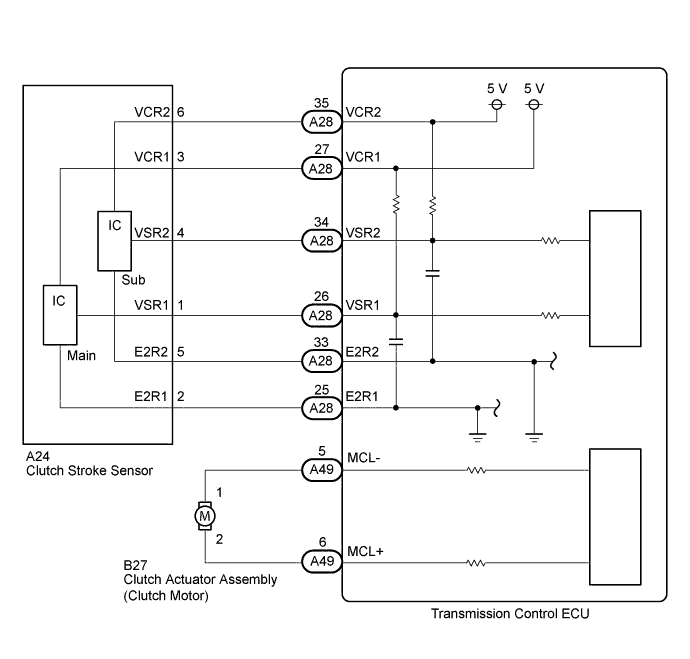
WIRING DIAGRAM
MONITOR DESCRIPTION
This DTC is set in accordance with the stroke speed of the clutch actuator or the difference between the target clutch position and the actual clutch position. Therefore, if malfunctions occur in the clutch stroke sensor or the clutch motor circuit, the DTCs relating to the sensor or motor circuit open/short (DTC P0806, P0807, P0808, and/or P0900) are set before this DTC is set.
INSPECTION PROCEDURE
Note
-
In new clutch actuator assembly installation, perform Clamp Position Adjustment before installing the actuator. The push rods of new clutch actuator assemblies (service supply parts) are not set to the clutch clamp position.
-
In clutch stroke sensor or clutch actuator assembly replacement, perform Initialization and Learning of the multi-mode manual transaxle system after installing the sensor or actuator Click here. If the sensor or actuator is installed without the initialization and learning, it may cause driving performance degradation or system component breakage.
Tech Tips
If the symptom still occurs even after checking the following parts for dirt, wear, or any defects and replacing the defective parts, replace the transmission control ECU.
-
Clutch disc and clutch cover
-
Release bearing
-
Clutch release fork
PROCEDURE
-
PERFORM ACTIVE TEST USING INTELLIGENT TESTER (TARGET CLUTCH CONTROL)
-
Remove the clutch actuator Click here.
-
Connect the clutch stroke sensor connector and the clutch actuator connector.
-
Connect the intelligent tester to the DLC3.
-
Turn the ignition switch to ON.
-
Turn the tester on.
-
Enter the following menus: Powertrain / Multi-Mode M/T / Active Test / Target Clutch Control.
-
Perform the Active Test.
OK Clutch actuator moves smoothly in accordance with the tester operation.
NG 
REPLACE CLUTCH ACTUATOR ASSEMBLY Click here
OK 
-
-
INSPECT CLUTCH STROKE SENSOR
-
Remove the clutch stroke sensor.
-
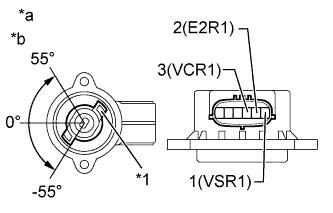
Text in Illustration *1 Sensor Arm *a Component without harness connected
(Clutch Stroke Sensor)
*b Main Measure the voltage between the terminals of the clutch stroke sensor connector (Main).
-
Prepare 3 dry cell batteries (1.5 V) and 2 leads for connecting the batteries and the sensor.
-
Connect the batteries in series.
-
Connect the positive battery terminal to sensor terminal 3 (VCR1), and the negative battery terminal to sensor terminal 2 (E2R1).
-
Measure the voltage according to the value(s) in the table below.
Standard Voltage (combined dry cell battery voltage of 4.5 V) Tester Connection Condition
(Sensor Angle)
Specified Condition 1 (VSR1) - 2 (E2R1) 55° Approximately 4.05 V 0° Approximately 2.25 V -55° Approximately 0.45 V Reference Voltage (combined dry cell battery voltage of 5.0 +/- 0.3 V) Tester Connection Condition
(Sensor Angle)
Specified Condition 1 (VSR1) - 2 (E2R1) 55° Approximately 4.5 V 0° Approximately 2.5 V -55° Approximately 0.5 V
-
-
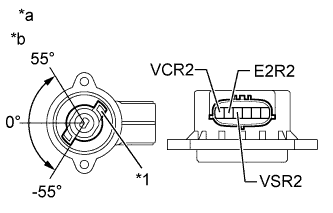
Text in Illustration *1 Sensor Arm *a Component without harness connected
(Clutch Stroke Sensor)
*b Sub Measure the voltage between the terminals of the clutch stroke sensor connector (sub).
-
Connect the positive battery terminal to sensor terminal 6 (VCR2), and the negative battery terminal to sensor terminal 5 (E2R2).
-
Measure the voltage according to the value(s) in the table below.
Standard Voltage (combined dry cell battery voltage of 4.5 V) Tester Connection Condition
(Sensor Angle)
Specified Condition 4 (VSR2) - 5 (E2R2) 55° Approximately 4.05 V 0° Approximately 2.25 V -55° Approximately 0.45 V Reference Voltage (combined dry cell battery voltage of 5.0 +/- 0.3 V) Tester Connection Condition
(Sensor Angle)
Specified Condition 4 (VSR2) - 5 (E2R2) 55° Approximately 4.5 V 0° Approximately 2.5 V -55° Approximately 0.5 V Note
-
Do not apply more than 6 V
-
Do not use a sensor which has been dropped.
-
-
NG
OK
-
-
INSPECT TRANSMISSION CONTROL ECU (MCL TERMINAL VOLTAGE)
-
Turn the ignition switch to ON.
-
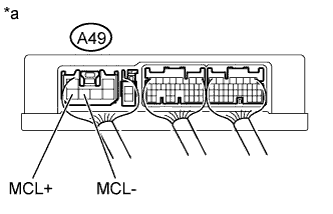
Text in Illustration *a Component with harness connected
(Transmission Control ECU)
Measure the voltage according to the value(s) in the table below.
Standard Voltage Tester Connection Switch Condition Specified Condition A49-6 (MCL+) - Body ground Ignition switch ON 4.0 to 7.0 V A49-5 (MCL-) - Body ground Ignition switch ON 4.0 to 7.0 V -
Turn the ignition switch off.
NG
CHECK TERMINAL CONDITION (TRANSMISSION CONTROL ECU) Click here
OK
-
-
CHECK CLUTCH SYSTEM (CLUTCH MECHANICAL OPERATION)
-
Remove the transaxle assembly Click here.
-
Check for dirt, wear and defects in the clutch system parts (clutch disc, clutch cover, clutch release with bearing cylinder assembly).
OK No defective parts in the clutch mechanical system.
NG 
REPAIR OR REPLACE DEFECTIVE PART IN CLUTCH SYSTEM
OK
-
-
REPLACE TRANSMISSION CONTROL ECU
-
Replace the transmission control ECU Click here.
NEXT
-
-
PERFORM INITIALIZATION
-
Perform the initialization and learning for multi-mode manual transaxle system Click here.
NEXT 
END
-
-
CHECK TERMINAL CONDITION (TRANSMISSION CONTROL ECU)
-
Disconnect the A49 transmission control ECU connector.
-
Check the connections of the transmission control ECU connector.
OK The transmission control ECU and wire harness connectors and connector terminals are connected securely and are not bent, rusted, or damaged.
NG
CONNECT CORRECTLY
OK
-
-
INSPECT CLUTCH ACTUATOR CIRCUIT
-
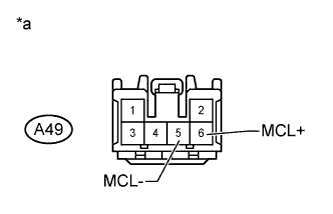
Text in Illustration *a Front view of wire harness connector
(to Transmission Control ECU)
Measure the resistance according to the value(s) in the table below.
Standard Resistance Tester Connection Switch Condition Specified Condition A49-6 (MCL+) - A49-5 (MCL-) Always 0.1 to 100 Ω A49-6 (MCL+) - Body ground Always 10 kΩ or higher A49-5 (MCL-) - Body ground Always 10 kΩ or higher
NG
CHECK TERMINAL CONDITION (CLUTCH ACTUATOR) Click here
OK
-
-
REPLACE TRANSMISSION CONTROL ECU
-
Replace the transmission control ECU Click here.
NEXT
-
-
PERFORM INITIALIZATION
-
Perform the initialization and learning for multi-mode manual transaxle system Click here.
NEXT
END
-
-
CHECK TERMINAL CONDITION (CLUTCH ACTUATOR)
-
Disconnect the B27 clutch actuator assembly connector.
-
Check the connections of the clutch actuator connector.
OK The clutch actuator and wire harness connectors and connector terminals are connected securely and are not bent, rusted, or damaged.
NG
CONNECT CORRECTLY
OK
-
-
CHECK HARNESS AND CONNECTOR (TRANSMISSION CONTROL ECU - CLUTCH ACTUATOR)
-
Measure the resistance according to the value(s) in the table below.
Standard Resistance Tester Connection Switch Condition Specified Condition A49-6 (MCL+) - B27-2 Always Below 1 Ω A49-5 (MCL-) - B27-1 Always Below 1 Ω A49-6 (MCL+) or B27-2 - Body ground Always 10 kΩ or higher A49-5 (MCL-) or B27-1 - Body ground Always 10 kΩ or higher
NG
REPAIR OR REPLACE HARNESS OR CONNECTOR
OK
-
-
INSPECT CLUTCH ACTUATOR ASSEMBLY
-
Disconnect the B27 clutch motor connector.
-
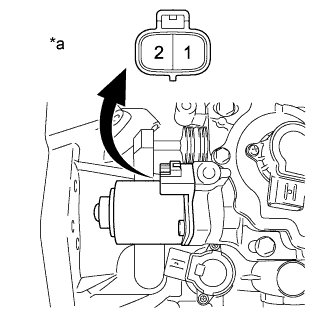
Text in Illustration *a Component without harness connected
(Clutch Actuator Assembly)
Measure the resistance according to the value(s) in the table below.
Standard Resistance Tester Connection Switch Condition Specified Condition 1 - 2 Always 0.1 to 100 Ω 1 - Body ground Always 10 kΩ or higher 2 - Body ground Always 10 kΩ or higher
NG
REPLACE CLUTCH ACTUATOR ASSEMBLY Click here
OK
CHECK INTERMITTENT PROBLEMS Click here
-
-
REPLACE CLUTCH ACTUATOR ASSEMBLY
-
Replace the clutch actuator assembly Click here.
NEXT
-
-
PERFORM INITIALIZATION
-
Perform the initialization and learning for multi-mode manual transaxle system Click here.
NEXT
END
-
-
REPLACE CLUTCH STROKE SENSOR
-
Replace the clutch stroke sensor Click here.
NEXT
-
-
PERFORM INITIALIZATION
-
Perform the initialization and learning for multi-mode manual transaxle system Click here.
NEXT
END
-