RADIATOR REASSEMBLY

-
INSTALL RADIATOR TANK UPPER AND TANK LOWER
-
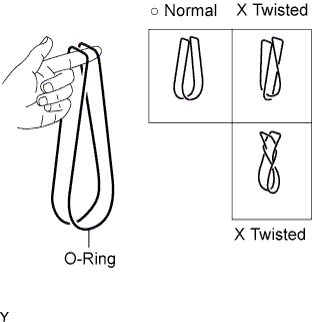
Check that there are no foreign objects in the lock plate groove, and install a new O-ring. Make sure the O-ring is not twisted.
Tech Tips
When cleaning the lock plate groove, lightly rub it with sandpaper without scratching it.
-
Tap the lock plate with a plastic hammer so that there is no gap between the lock plate and tank.
-
-
ASSEMBLE SST
- SST
- 09230-01010
- 09231-14010
-
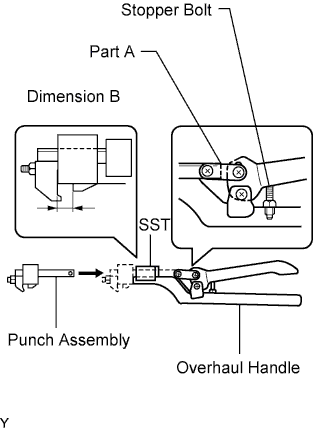
Install the punch assembly to the overhaul handle, inserting it in the hole in part A as shown in the illustration.
-
While gripping the handle, adjust the stopper bolt so that dimension B is as shown in the illustration.
Dimension B 8.4 mm (0.331 in.)
-
CAULK LOCK PLATE
- SST
- 09230-01010
-
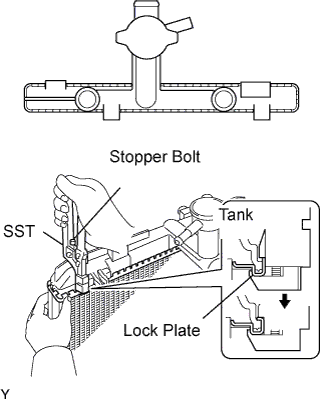
Lightly press SST against the lock plate in the order shown in the illustration. After repeating this a few times, fully caulk the lock plate by gripping the handle until it is stopped by the stopper bolt.
-
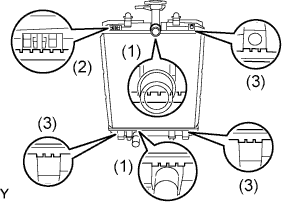
Do not tap the areas protruding around the ports (1), claws (2) and grooves (3).
-
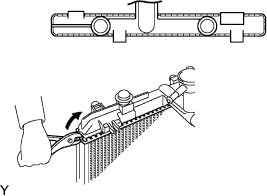
The points shown in the illustration cannot be tapped with SST. Use pliers and be careful not to damage the core plates.
-
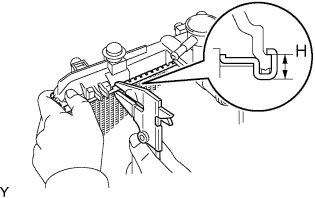
Check the lock plate height (H) after completing the caulking.
-
INSPECT FOR WATER LEAKS
- SST
- 09230-01010
-
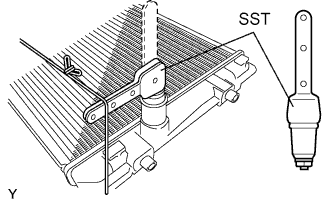
Plug the inlet and outlet pipes of the radiator with SST.
-
Using a radiator cap tester, apply pressure to the radiator.
Test pressure 177 kPa (1.8 kgf*cm2, 26 psi) Note
Do not put more than 177 kpa (1.8 kgf*cm2, 26 psi) to radiator.
-
Submerge the radiator in water.
-
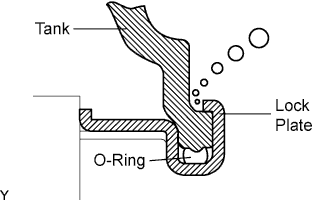
Inspect for leaks.
Tech Tips
On radiators with resin tanks, there is a clearance between the tank and lock plate where a minute amount of air will remain, giving the appearance of an air leak when the radiator is submerged in water. Before doing the water leak test, first shake the radiator in the water until air bubbles disappear.