INTAKE SYSTEM ON-VEHICLE INSPECTION

-
CHECK INTAKE AIR SYSTEM
-
Check for leakage or clogging between the air cleaner housing and turbocharger inlet, and between the turbocharger outlet and cylinder head.
Condition Operation Clogged air cleaner Clean or replace Collapsed or deformed hoses Repair or replace Leakage from connections Check each connection and repair Cracks in components Check and replace
-
-
CHECK EXHAUST SYSTEM
-
Check for leakage or clogging between the cylinder head and turbocharger inlet, and between the turbocharger outlet and exhaust pipe.
Condition Operation Deformed components Repair or replace Foreign matter in passages Remove Leakage from components Repair or replace Cracks in components Check or replace
-
-
CHECK TURBOCHARGER PRESSURE
-
Warm up the engine.
-
Remove the air cleaner cap.
-
Remove the screw and disconnect the turbo pressure sensor.
-
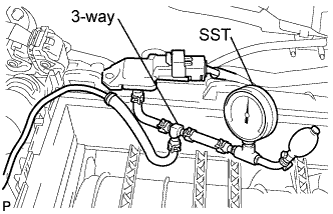
Using a 3-way connector, connect SST (turbocharger pressure gauge) to the hose between the turbo pressure sensor and vacuum hose.
- SST
- 09992-00242
-
Depress the clutch pedal, and then fully depress the accelerator pedal while the vehicle is stopped. Measure the turbo charging pressure at maximum engine speed (approximately 5,100 rpm).
Tech Tips
The intake air pressure should be approximately 1,700 mbar at 5,100 rpm.
If the pressure is too low, check the intake system and exhaust systems for leakage.
If there is no leakage, replace the turbocharger.
If the pressure is too high, check if the actuator hose is disconnected or cracked.
If it is not, check the turbocharger.
-
Install the turbo pressure sensor with the screw.
-
Install the air cleaner cap.
-
-
CHECK TURBINE SHAFT ROTATION
-
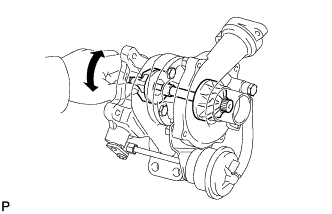
Hold the edge of the turbine shaft and turn it. Check that the turbine shaft turns smoothly. If the turbine shaft does not turn or is difficult to turn, replace the turbocharger.
-