DRIVE BELT INSPECTION

-
INSPECT FAN & GENERATOR V BELT
-
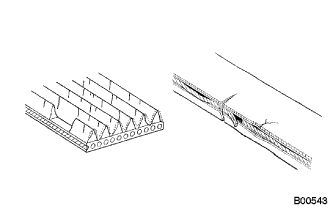
Visually check the belt for excessive wear, frayed cords etc.
If any defect is found, replace the belt.
Tech Tips
Cracks on the rib side of a belt are considered acceptable. If the belt has chunks missing from the ribs, it should be replaced.
-
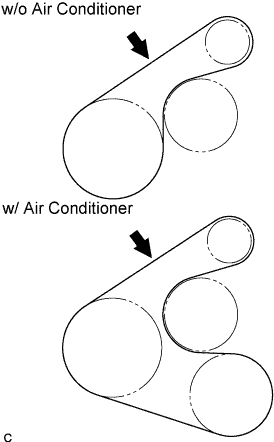
Check the belt deflection by pressing on the belt at the points indicated by the arrow marks in the illustration.
Deflection Item Specified Condition New belt 7 to 8 mm (0.28 to 0.31 in.) Used belt 9 to 11 mm (0.35 to 0.43 in.) If the belt deflection is not as specified, adjust it.
Tech Tips
-
The most appropriate force for adjustment above is 98 N (10 kgf, 22 lbf).
-
"New belt" refers to a belt which has been used on a running engine less than 5 minutes.
-
"Used belt" refers to a belt which has been used on a running engine for 5 minutes or more.
-
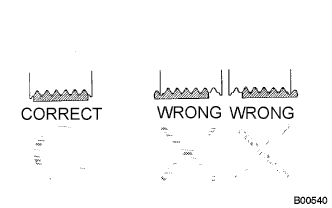
After installing a belt, check that it fits properly in the ribbed grooves.
-
Check with your hand to confirm that the belt has not slipped out of the groove on the bottom of the pulley.
-
After installing a new belt, run the engine for about 5 minutes and recheck the belt tension.
-
-
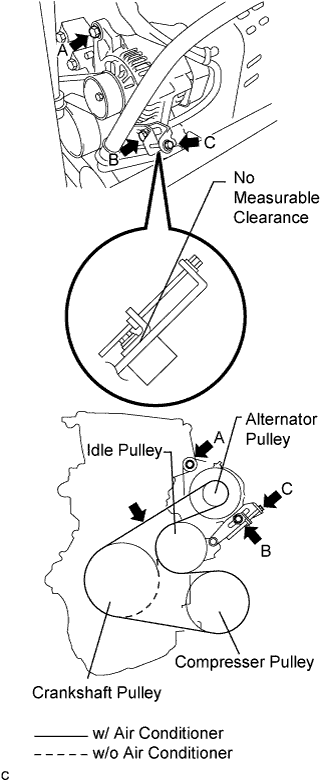
Adjust fan and generator V belt tension.
-
Loosen the A bolt.
-
Loosen the B bolt.
-
Loosely tighten the B bolt until there is no measurable clearance.
-
Turn the C bolt to adjust tension of the fan and generator V belt.
-
Tighten the B bolt.
- Torque:
- 34 N*m { 347 kgf*cm, 25 ft.*lbf }
-
Tighten the A bolt.
- Torque:
- 49 N*m { 500 kgf*cm, 36 ft.*lbf }
-
-
Visually check alternator wiring and listen for abnormal noises.
-
Check that the wiring is in good condition.
-
Check that there is no abnormal noise from the generator while the engine is running.
-
-
Inspect discharge warning light circuit.
-
Turn the ignition switch to the ON position. Check that the discharge warning light comes on.
-
Start the engine. Check that the light goes off.
-
-