ECD SYSTEM SYSTEM DIAGRAM

-
ENGINE CONTROL SYSTEM
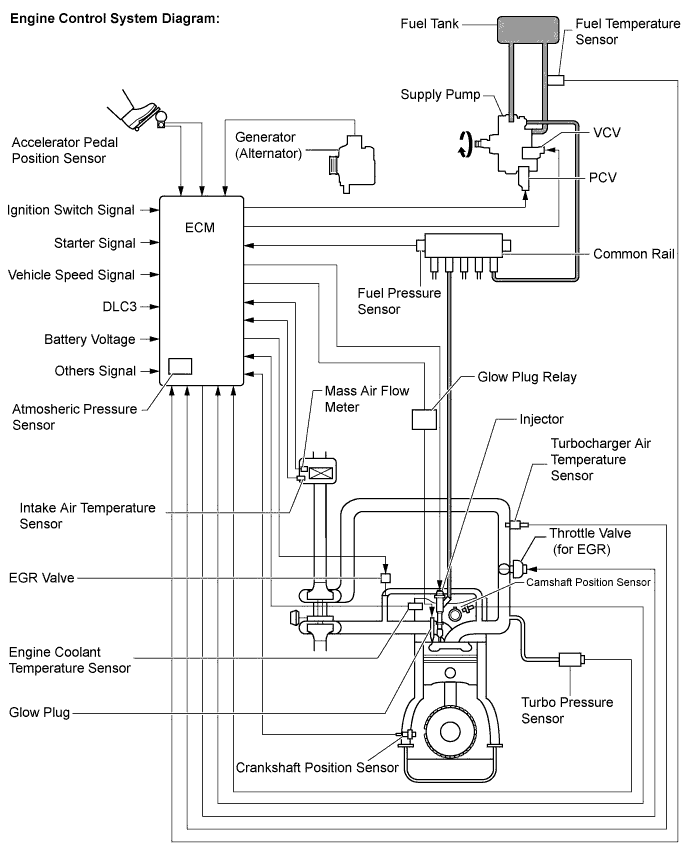
-
ECM WIRING DIAGRAM
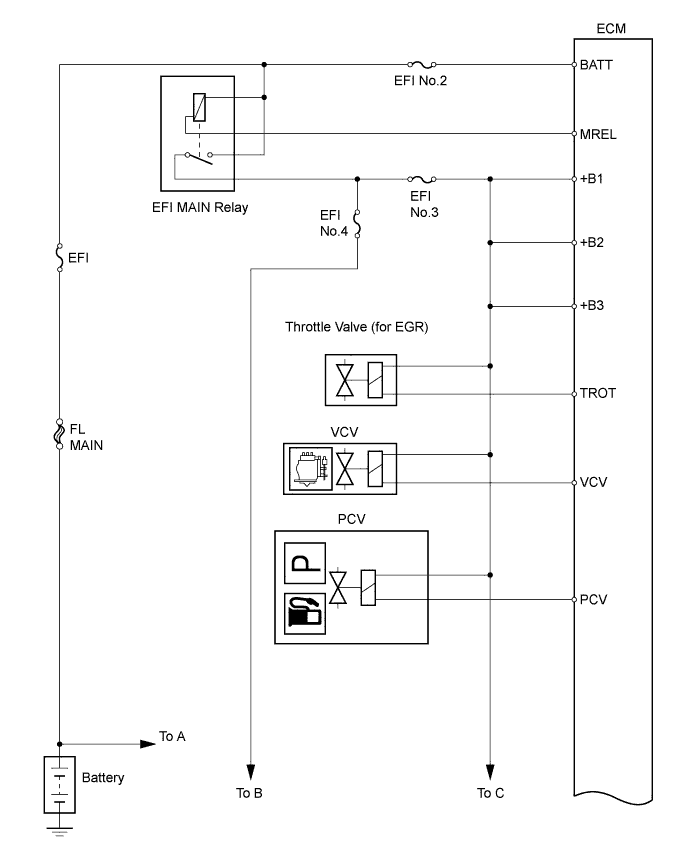
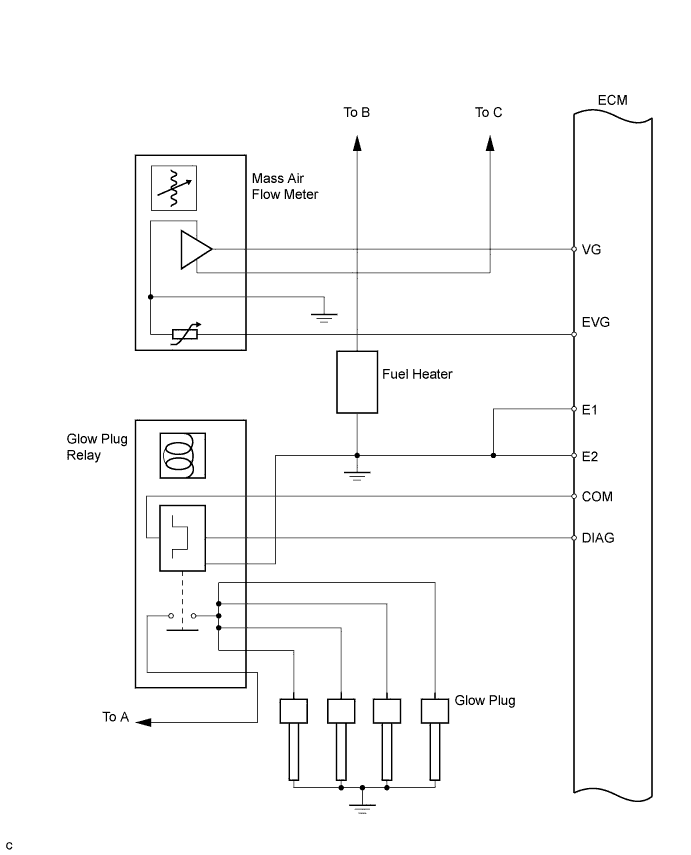
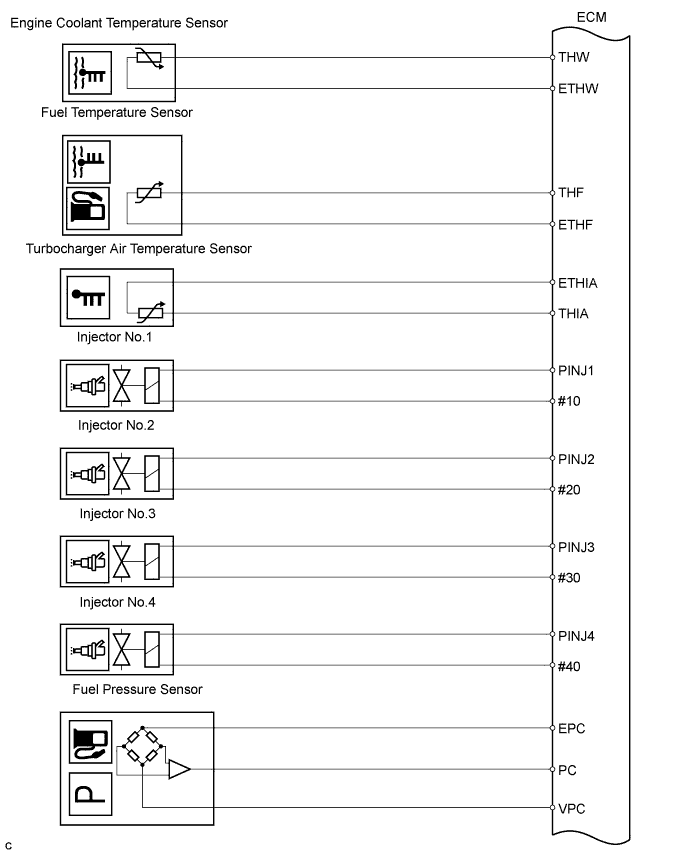
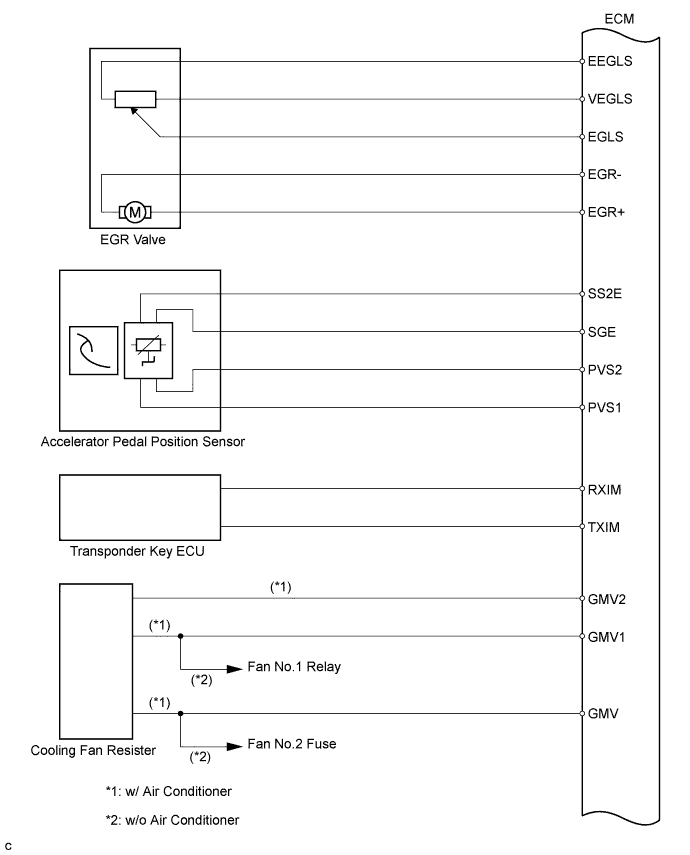
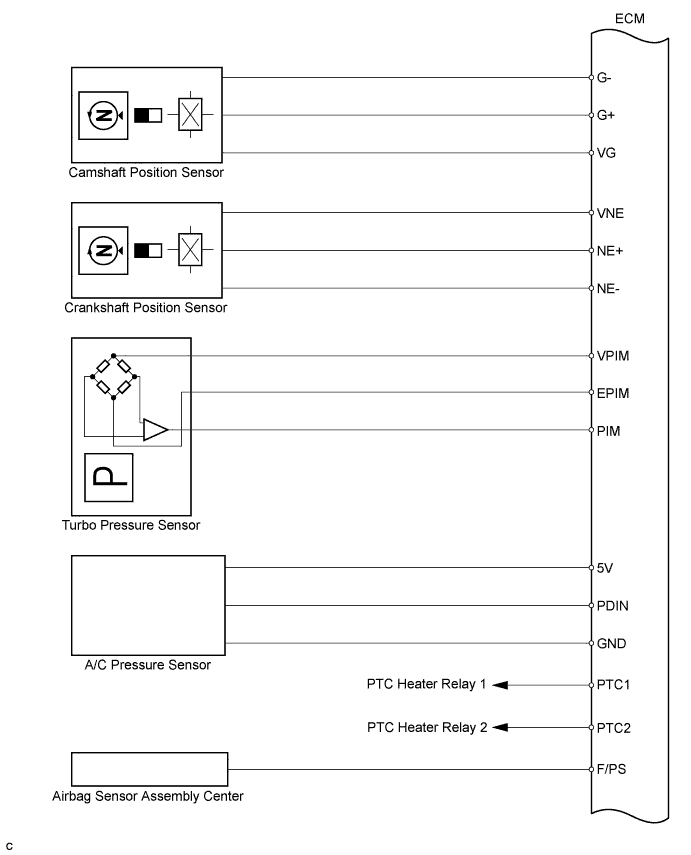
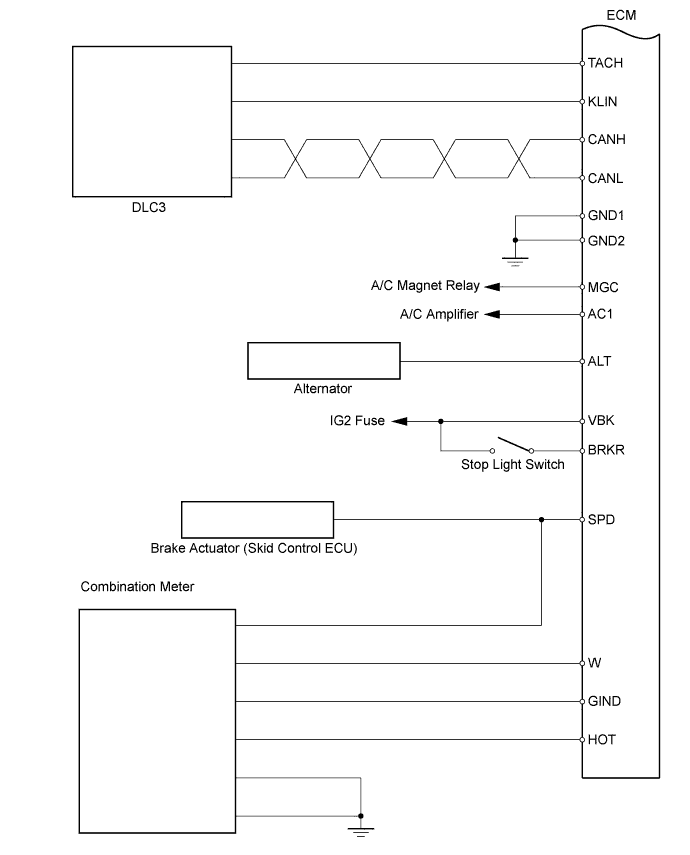
-
COMMON RAIL SYSTEM DESCRIPTION
-
COMMON RAIL SYSTEM:
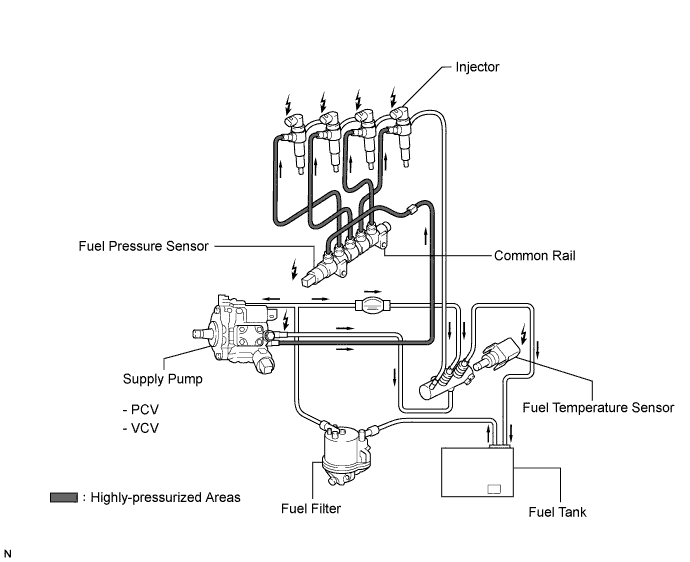
The common rail system uses highly-pressurized fuel for improved fuel economy and to provide robust engine power, while suppressing engine vibration and noise.
This system stores fuel, which has been pressurized and supplied by the supply pump, in the common rail.
By storing fuel at high-pressure, the common rail system can provide fuel at stable fuel injection pressures, regardless of the engine speed or engine load.
The ECM provides an electric current to the piezo-electric actuator in the injector, to regulate the fuel injection timing and volume, and also monitors the internal fuel pressure of the common rail using the fuel pressure sensor.
The ECM causes the supply pump to supply the fuel necessary to obtain the target fuel pressure, approximately 22 to 160 MPa (220 to 1,600 bars, 3,191 to 23,205 psi).
-
COMMON RAIL SYSTEM COMPONENTS:
Component Description Common rail Stores high-pressure fuel produced by supply pump. Supply pump Operated by crankshaft. Supplies high-pressure fuel to common rail. Injector Injects fuel to combustion chamber based on signals from ECM. Fuel pressure sensor Monitors internal fuel pressure of common rail and sends signals to ECM. Fuel temperature sensor Monitors fuel temperature and sends signals to ECM. Fuel filter Eliminates dirt or moisture from fuel system PCV (Pressure Control Valve) Adjusts valve opening angle using signals from ECM and controls pressure in common rail VCV (Fuel Flow Regulator Valve) Adjusts valve opening angle using signals from ECM and controls flow of fuel from feed pump to high pressure pump -
DIAGNOSTIC TROUBLE CODE DESCRIPTION FOR COMMON RAIL SYSTEM:
DTC No. Description P0001 Open in VCV circuit. P0002 Current of the VCV circuit is more than 2 A. P0003 Short in VCV circuit. P0004 Short in VCV circuit (Power supply side). P0089 Current of the PCV circuit is more than 2 A. P0091 Short in PCV circuit. P0092 Short in PCV circuit (Power supply side). P0181 Sudden change in fuel temperature sensor output. P0182 The output voltage from the fuel temperature sensor. P0183 The output voltage from the fuel temperature sensor. P0191 Extreme change in fuel temperature sensor output in a short period. P0192 The output voltage from the fuel pressure sensor less than 0.19 V (0 mbars (0 kgf/cm2, 0 psi)).
P0193 The output voltage from the fuel pressure sensor more than 4.81 V (1,800 mbars (1,835 kgf/cm2, 26,106 psi)).
P0201 Injector circuit fault (Cylinder 1). P0202 Injector circuit fault (Cylinder 2). P0203 Injector circuit fault (Cylinder 3). P0204 Injector circuit fault (Cylinder 4). P0263 Injection correction value for No.1 cylinder is below 60% or 140% or more. P0266 Injection correction value for No.2 cylinder is below 60% or 140% or more. P0269 Injection correction value for No.3 cylinder is below 60% or 140% or more. P0272 Injection correction value for No.4 cylinder is below 60% or 140% or more. P0606 ECM error P1113 Pressure is low. P1114 Engine cut-off function fault (Electric cut-off by injection). P1164 Either of the following condition (a) or (b) is met. (a) Rail pressure offset (b). The output pressure from fuel pressure sensor is more than threshold. P1165 Inconsistency between fuel pressure and PCV current. P1166 Pressure is high. P1167 Pressure controller oscillation or dynamic test. P1169 The output voltage from the ECM remains less than 40 V or more than 90 V. P1192 Engine cut-off function fault (Fuel cut-off by PCV and VCV). P1197 ECM error P1198 VCV adaptation insufficient fuel flow. P1210 Open in PCV circuit. P1366 Injector circuit fault (Cylinder 1). P1367 Injector circuit fault (Cylinder 2). P1368 Injector circuit fault (Cylinder 3). P1369 Injector circuit fault (Cylinder 4). P1641 ECM error P1668 Engine cut-off function fault (Fuel cut-off plausible).
-
-
INJECTION CONTROL SYSTEM DESCRIPTION
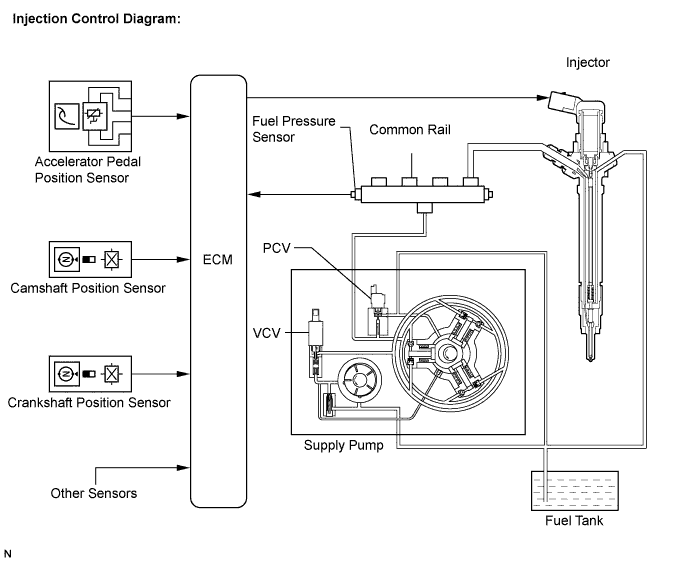
The ECM controls the fuel injection system by using the injectors and supply pump. The ECM regulates the fuel injection volume and fuel injection timing by controlling both the duration and timing of energization to the injector. The ECM regulates injection pressure by controlling the PCV (Pressure Control Valve) located in the supply pump.
The feed pump is used to pump fuel from the fuel tank to the supply pump.
-
SUPPLY PUMP OPERATION SYSTEM DESCRIPTION
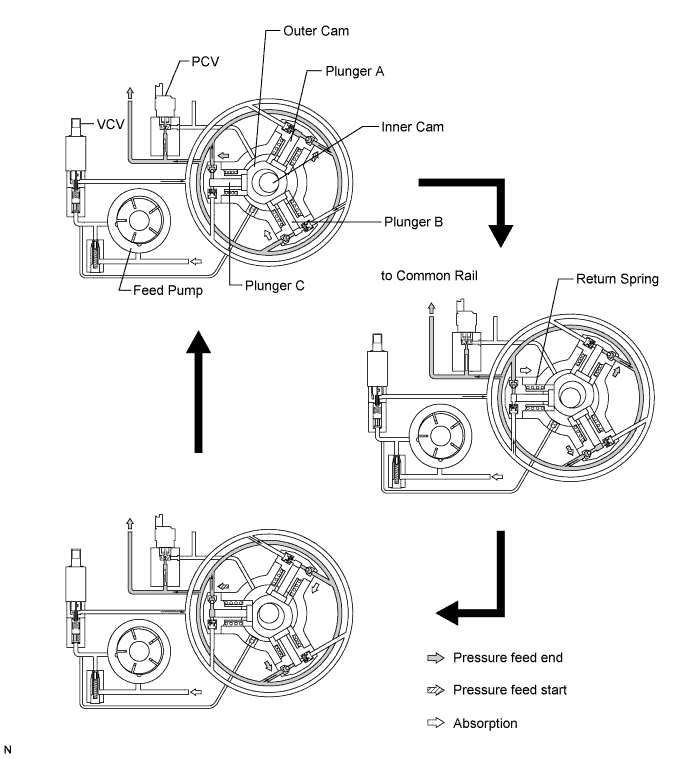
When the eccentric-shaft-shaped inner cam rotates, the outer cam pushes up plunger A, which pressure-feeds the fuel from the plunger to the common rail. When the pressure feed stroke of plunger A comes to an end, plunger B starts to pressure-feed the fuel. At the same time, plunger C is pushed back due to the reaction force of the spring and absorbs the fuel in the plunger. By using the three plungers to repeat these strokes in order, a stable pressure feed of fuel can be performed constantly.
The ECM calculates a target pressure in the common rail based on the engine condition. The ECM then sends a signal to the VCV (Fuel Flow Regulator Valve) to control the amount of fuel that will be absorbed in a plunger.
The control signal is DUTY.
-
PCV (PRESSURE CONTROL VALVE) OPERATION SYSTEM DESCRIPTION
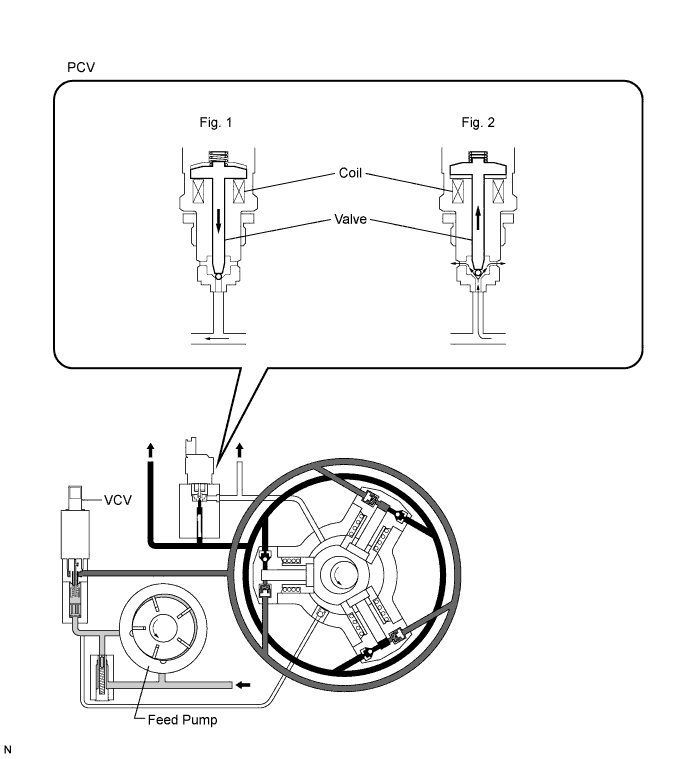
When the ignition switch is turned to the ON position, the coil attracts the valve based on the signals from the ECM to close the fuel path. (Fig.1)
When the ECM determines that the fuel pressure in the common rail exceeds the specified value based on a signal from the fuel pressure sensor in the common rail, the ECM controls the current applied to the PCV coil to open the valve. Then, the fuel pressure in the common rail will decrease to the specified value. (Fig. 2)
When the ignition switch is turned off, the current applied to the coil in the PCV will be shut off and fuel pressure opens the valve.
When the fuel pressure becomes lower than the spring force, the valve will close.
The PCV is normaly closed by return spring. This means that when no signal is applied to the coil, the pressure in the common rail will be not 0. In this way the valve provide a minimum pressure of 5 MPa (50 bars, 725 psi).
When a current is applied to the coil, an additional force is added to that of the spring. The control signal is DUTY, and the average current is 0.6 A with peak of 2 A. The injector needle returns spring tension is set to 7 MPa (70 bars, 1,015 psi). This pressure is higher than the pressure of PCV, which is set at 5 MPa (50 bars, 725 psi). In this way the injector will not open if PCV does not operate.
-
VCV (FUEL FLOW REGULATOR VALVE) OPERATION SYSTEM DESCRIPTION
Tech Tips
The ECM controls the VCV operation to regulate the fuel volume that is pumped by the supply pump to the common rail.
-
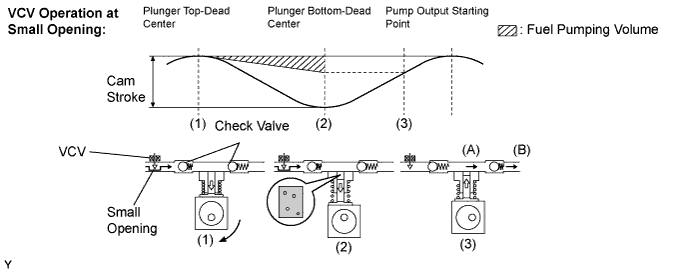
Small opening of the VCV:
-
When the opening of the VCV is small, the volume of fuel supplied to the high pressure pump is small. This is done by restricting the flow to the high pressure pump.
-
The suction volume becomes small due to the narrow path despite the plunger stroke being full. The difference between the geometrical volume and suction volume creates a vacuum.
-
Pump output will start when the fuel pressure at (A) becomes higher than the common rail pressure (B).
-
-
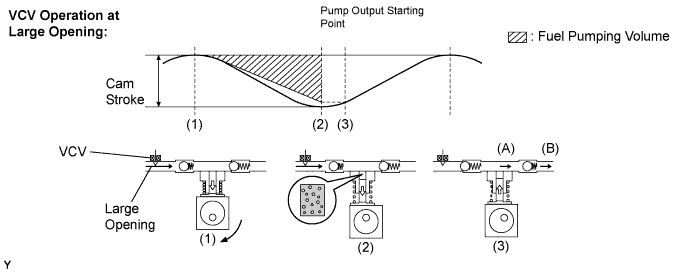
Large opening of the VCV:
-
When the opening of the VCV is large, the fuel suction path is kept wide. Therefore, the fuel volume supplied to the fuel pump is increased.
-
If the plunger stroke is full, the suction volume becomes large because of the wide path.
-
Pump output will start when the fuel pressure at (A) becomes higher than the common rail pressure (B).
-
-
-
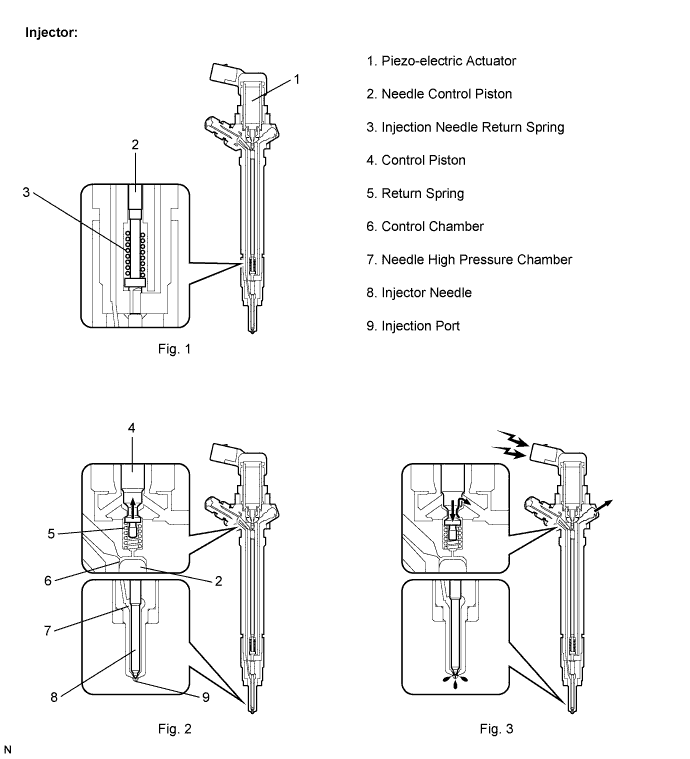
INJECTOR OPERATION SYSTEM DESCRIPTION
The injector injects the amount of the fuel calculated by the ECM into each cylinder.
A piezo-electric actuator, which is built into the injector, has characteristics that allow a fast response when voltage (70 V) is applied. Therefore, fuel injection can be performed quickly and accurately. (Refer to Fig. 1)
When no voltage is applied to the injector, the control piston is pressed to the top due to the force of the return spring. As a result, the fuel pressure values in the control chamber and the needle high pressure chamber become the same, and the needle control piston and injector needle are pressed downward due to the force of the return spring. Therefore, the injection needle is closed to stop fuel injection. (Refer to Fig. 2)
When voltage is applied to the injector, the piezo-electric actuator presses down the control piston. The pressure in the control chamber decreases because the high-pressure fuel in the control chamber is discharged. The fuel pressure in the needle high pressure chamber exceeds the force of the injection needle return spring, and the needle control piston and the injector needle are pressed upward to start fuel injection from the injection port. (Refer to Fig. 3)
When voltage being applied to the injector is stopped, the needle control piston and the injector needle are pressed down again to close the injection port and stop fuel injection.