SFI SYSTEM (w/o Electronic Throttle Control System) TERMINALS OF ECM

Tech Tips
Each ECM terminal's standard normal voltage is shown in the table below.
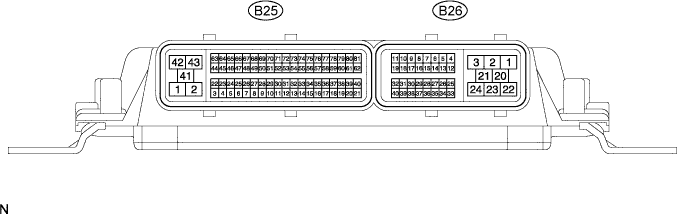
In the table, first follow the information under "Condition". Look under "Symbols (Terminals No.)" for the terminals to be inspected. The standard normal voltage between the terminals is shown under "STD Voltage". Use the illustration above as a reference for the ECM terminals.
| Symbols (Terminals No.) | Wiring Color | Terminal Description | Condition | STD Voltage |
|---|---|---|---|---|
| BATT (B25-42) - E1 (B26-24) | LG - W-B | Battery (for measuring battery voltage and for ECM memory) | Always | 9 to 14 V |
| IGSW (B25-47) - E1 (B26-24) | R - W-B | Ignition switch | Ignition switch ON | 9 to 14 V |
| +B (B26-3) - E1 (B26-24) | P - W-B | Power source of ECM | Ignition switch ON | 9 to 14 V |
| MREL (B25-66) - E1 (B26-24) | GR - W-B | EFI relay | Ignition switch ON | 9 to 14 V |
| VC (B25-29) - ETA (B25-40) | Y - BR | Power source of throttle position sensor (specific voltage) | Ignition switch ON | 4.5 to 5.5 V |
| VC2 (B25-9) - E21 (B25-20) | R - BR | Power source of manifold absolute pressure sensor (specific voltage) | Ignition switch ON | 4.5 to 5.5 V |
| VCG1 (B25-30) - E1 (B26-24) | O - W-B | Power source of camshaft position sensor (specific voltage) | Ignition switch ON | 4.5 to 5.5 V |
| PIM (B25-81) - E21 (B25-20) | Y - BR | Manifold absolute pressure sensor | Idling | 1.2 to 2.0 V |
| VTA (B25-80) - ETA (B25-40) | GR - BR | Throttle position sensor (for engine control) | Ignition switch ON, Accelerator pedal fully released | 0.4 to 0.9 V |
| VTA (B25-80) - ETA (B25-40) | GR - BR | Throttle position sensor (for engine control) | Ignition switch ON, Accelerator pedal fully depressed | 3.6 to 4.3 V |
| THA (B25-19) - E21 (B25-20) | w -BR | Intake air temperature sensor | Idling, Intake air temperature 20°C (68°F) | 1.5 to 3.0 V |
| THW (B26-9) - E2 (B26-32) | R - BR | Engine coolant temperature sensor | Idling, Engine coolant temperature 80°C (176°F) | 0.2 to 1.0 V |
| #1 (B26-25) - E01 (B25-1) #2 (B26-34) - E01 (B25-1) #3 (B26-26) - E01 (B25-1) |
W - W-B B - W-B R - W-B |
Injector | Ignition switch ON | 9 to 14 V |
| IGT1 (B25-68) - E1 (B26-24) IGT2 (B25-50) - E1 (B26-24) IGT3 (B25-49) - E1 (B26-24) |
G - W-B B - W-B O - W-B |
Ignition coil with igniter (ignition signal) | Idling | Pulse generation (See waveform 1) |
| G1 (B25-55) - G- (B25-56) | R - W-B | Camshaft position sensor | Idling | Pulse generation (See waveform 2) |
| NE+ (B25-27) - NE- (B25-8) | P - L | Crankshaft position sensor | Idling | Pulse generation (See waveform 2) |
| ISC (B25-3) - E1 (B26-24) ISC2 (B25-4) - E1 (B26-24) ISC3 (B25-23) - E1 (B26-24) ISC4 (B25-22) - E1 (B26-24) |
G - W-B L - W-B LG - W-B R - W-B |
Idle control valve | Idling | Pulse generation (See waveform 3) |
| STA (B25-73) - E1 (B26-24) | GR - W-B | Starter signal | Cranking | 5.5 V or more |
| FC (B26-28) - E1 (B26-24) | G - W-B | Fuel pump control | Ignition switch ON | 9 to 14 V |
| OX1A (B26-18) - E11 (B26-19) | W - B | Heated oxygen sensor (Sensor 1) | Maintain engine speed at 2,500 rpm for 2 minutes after warming up sensor | Pulse generation (See waveform 4) |
| OX1B (B26-17) - E12 (B26-11) | Y - BR | Heated oxygen sensor (Sensor 2) | Maintain engine speed at 2,500 rpm for 2 minutes after warming up sensor | Pulse generation (See waveform 5) |
| HT1A (B26-21) - E1 (B26-24) | L - W-B | Heated oxygen sensor heater | Ignition switch ON | 9 to 14 V |
| HT1B (B26-23) - E1 (B26-24) | R - W-B | Heated oxygen sensor heater | Ignition switch ON | 9 to 14 V |
| KNK1 (B25-71) - KNK2 (B25-52) | G - R | Knock sensor | Maintain engine speed at 4,000 rpm after warming up engine | Pulse generation (See waveform 6) |
| OCV- (B26-1) - E1 (B26-24) | G - W-B | Camshaft timing oil control valve | Idling | Pulse generation (See waveform 7) |
| EVP1 (B26-27) - E1 (B26-24) | V - W-B | EVAP VSV | Ignition switch ON | 9 to 14 V |
| W (B25-24) - E1 (B26-24) | O - W-B | MIL | Ignition switch ON (MIL goes on) | Below 3.0 V |
| SPD (B25-54) - E1 (B26-24) | Y - W-B | Speed signal from skid control ECU | Ignition switch ON, Rotate driving wheel slowly | Pulse generation |
-
WAVEFORM 1
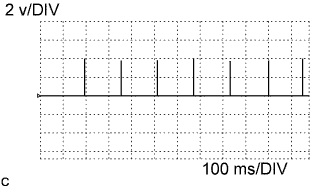
Igniter IGT signal (from ECM to igniter) ECM Terminal Name Between IGT1 (to IGT3) and E1 Tester Range 2 v/DIV, 100 ms/DIV Condition Idling Tech Tips
The wavelength becomes shorter as engine rpm increases.
-
WAVEFORM 2
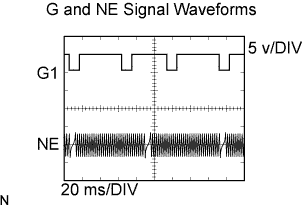
Camshaft position sensor, Crankshaft position sensor ECM Terminal Name (a) Between G1 and G-
(b) Between NE+ and NE-
Tester Range 5 v/DIV, 20 ms/DIV Condition Idle after engine warmed-up Tech Tips
-
The wavelength becomes shorter as engine rpm increases.
-
-
WAVEFORM 3
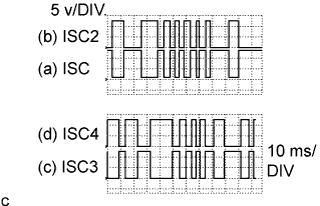
ISC valve signal ECM Terminal Name (a) Between ISC and E1
(b) Between ISC2 and E1
(c) Between ISC3 and E1
(d) Between ISC4 and E1
Tester Range 5 v/DIV, 10 ms/DIV Condition Idle with warm engine
-
The waveform varies depending on idle speed control valve.
-
When the idling speed is constant, the waveform may remain high or low. Under this condition, check the waveform by racing the engine.
-
-
WAVEFORM 4
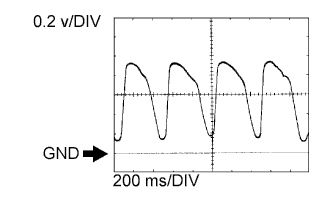
HO2S (sensor 1) ECM Terminal Name Between OX1A and E11 Tester Range 0.2 v/DIV, 200 ms/DIV Condition Maintain engine RPM at 2,500 rpm after engine warmed-up Tech Tips
In the DATA LIST, the items HO2S B1 S1 show the ECM input values of the HO2S (sensor 1).
-
WAVEFORM 5
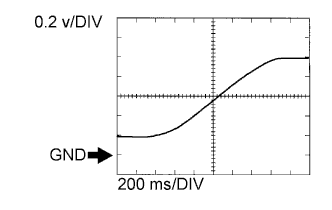
HO2S (sensor 2) ECM Terminal Name Between OX1B and E12 Tester Range 0.2 v/DIV, 200 ms/DIV Condition Maintain engine RPM at 2,500 rpm after engine warmed-up Tech Tips
In the DATA LIST, the items HO2S B1 S2 show the ECM input values of the HO2S (sensor 2).
-
WAVEFORM 6
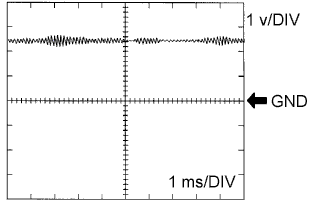
Knock sensor ECM Terminal Name Between KNK1 and KNK2 Tester Range 1 v/DIV, 1 ms/DIV Condition Maintain engine RPM at 4,000 rpm after engine warmed-up Tech Tips
-
The wavelength becomes shorter as engine rpm increases.
-
The waveforms and amplitudes displayed differ slightly depending on the vehicle.
-
-
WAVEFORM 7
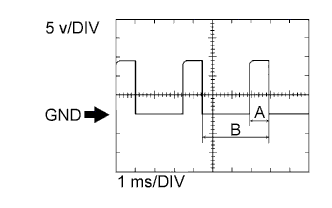
VVT OCV ECM Terminal Name Between OCV- and E1 Tester Range 5 v/DIV, 1 ms/DIV Condition Idling Tech Tips
In the DATA LIST, the items VVT OCV DUTY shows the duty ratio of voltage applied to the OCV (see the illustration above).
VVT OCV DUTY = A/B x 100 (%)