СИСТЕМА АВТОМАТИЧЕСКОЙ ТРАНСМИССИИ С ЭЛЕКТРОННЫМ УПРАВЛЕНИЕМ, Diagnostic DTC:P0710/38, P0712/38, P0713/38
| DTC Code | DTC Name |
|---|---|
| P0710/38 | Transmission Fluid Temperature Sensor "A" Circuit |
| P0712/38 | Transmission Fluid Temperature Sensor "A" Circuit Low Input |
| P0713/38 | Transmission Fluid Temperature Sensor "A" Circuit High Input |
DESCRIPTION
The ATF (Automatic Transmission Fluid) temperature sensor converts the fluid temperature into a resistance value which is input into the TCM.
The TCM applies a voltage to the temperature sensor through TCM terminal THOC.
The sensor resistance changes with the transmission fluid temperature. As the temperature becomes higher, the sensor resistance decreases.
One terminal of the sensor is grounded so that the sensor resistance decreases and the voltage goes down as the temperature becomes higher.
The TCM calculates the fluid temperature based on the voltage signal.
| DTC No. | DTC Detection Condition | Trouble Area |
|---|---|---|
| P0710/38 |
Tech Tips Within 0.5 sec., the malfunction switches from (a) to (b) or from (b) to (a) |
|
| P0712/38 | ATF temperature sensor resistance is less than 79 Ω for 0.5 sec. or more (1-trip detection logic) |
|
| P0713/38 | ATF temperature sensor resistance is more than 156 kΩ when 15 minutes or more have elapsed after the engine start DTC is detected for 0.5 sec. or more (1-trip detection logic) |
|
MONITOR DESCRIPTION
These DTCs indicate an open or short in the automatic transmission fluid (ATF) temperature sensor circuit. The automatic transmission fluid (ATF) temperature sensor converts ATF temperature to an electrical resistance value. Based on the resistance, the TCM determines the ATF temperature, and the TCM detects an open or short in the ATF temperature circuit. If the resistance value of the ATF temperature is less than 79 Ω*1or more than 156 kΩ*2, the TCM interprets this as a fault in the ATF sensor or wiring. The TCM will turn on the MIL and store the DTC.
*1: 150°C (302°F) or more is indicated regardless of the actual ATF temperature.
*2: -40°C (-40°F) is indicated regardless of the actual ATF temperature.
Tech Tips
The ATF temperature can be checked on the Intelligent Tester display.
WIRING DIAGRAM
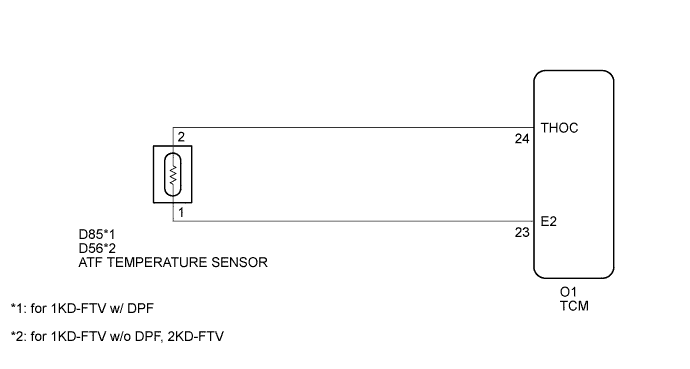
INSPECTION PROCEDURE
-
DATA LIST
Tech Tips
Using the intelligent tester to read the Data List allows the values or states of switches, sensors, actuators and other items to be read without removing any parts. This non-intrusive inspection can be very useful because intermittent conditions or signals may be discovered before parts or wiring is disturbed. Reading the Data List information early in troubleshooting is one way to save diagnostic time.
Note
In the table below, the values listed under "Normal Condition" are reference values. Do not depend solely on these reference values when deciding whether a part is faulty or not.
-
Warm up the engine.
-
Turn the ignition switch off.
-
Connect the intelligent tester to the DLC3.
-
Turn the ignition switch to ON.
-
Turn the intelligent tester on.
-
Enter the following menus: Powertrain / ECT / Data List.
-
According to the display on the tester, read the Data List.
ECT Tester Display Measurement Item/Range Normal Condition Diagnostic Note A/T Oil Temperature 3 ATF temperature sensor value/
Min.: -40°C (-40°F)
Max.: 215°C (419°F)
-
After stall test:
Approximately 80°C (176°F)
-
Equal to ambient temperature when engine is cold
If value is -40°C (-40°F) or 215°C (419°F), ATF temperature sensor circuit is opened or short circuited Tech Tips
When DTC P0712 is stored and the intelligent tester output is 150°C (302°F) or higher, there is a short circuit.
When DTC P0713 is stored and the intelligent tester output is -40°C (-40°F), there is an open circuit.
Check the temperature displayed on the tester in order to check if a malfunction exists.
Temperature Displayed Malfunction -40°C (-40°F) Open circuit 150°C (302°F) or higher Short circuit If a circuit related to the ATF temperature sensor becomes open, P0713 is immediately stored (in 0.5 seconds). When P0713 is stored, P0711 cannot be stored. It is not necessary to inspect the circuit when P0711 is stored.
-
-
PROCEDURE
-
INSPECT ATF TEMPERATURE SENSOR
-
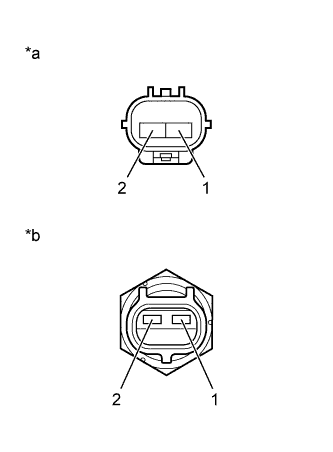
Text in Illustration *a Component without harness connected
(ATF Temperature Sensor (for 1KD-FTV w/ DPF))
*b Component without harness connected
(ATF Temperature Sensor (for 1KD-FTV w/o DPF, for 2KD-FTV))
Disconnect the ATF temperature sensor connector.
-
Measure the resistance according to the value(s) in the table below.
Standard Resistance Tester Connection Condition Specified Condition 1 - 2 Always 79 Ω to 156 kΩ 1 - Body ground Always 10 kΩ or higher 2 - Body ground Always 10 kΩ or higher Tech Tips
If the resistance is out of the specified range at either of the ATF temperatures shown in the table below, the driveability of the vehicle may decrease.
Standard Resistance ATF Temperature Specified Condition 20°C (68°F) 10.3 to 13.9 kΩ 110°C (230°F) 0.68 to 0.88 kΩ
NG 
REPLACE ATF TEMPERATURE SENSOR
OK 
-
-
CHECK HARNESS AND CONNECTOR (ATF TEMPERATURE SENSOR - TCM)
-
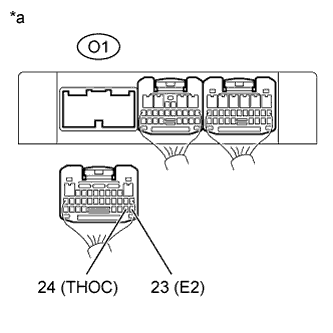
Text in Illustration *a Rear view of wire harness connector
(to TCM)
Disconnect the TCM connector.
-
Measure the resistance according to the value(s) in the table below.
Standard Resistance Tester Connection Condition Specified Condition O1-24 (THOC) - O1-23 (E2) Always 79 Ω to 156 kΩ O1-24 (THOC) - Body ground Always 10 kΩ or higher O1-23 (E2) - Body ground Always 10 kΩ or higher
NG
REPAIR OR REPLACE HARNESS OR CONNECTOR
OK 
REPLACE TCM
-