| DTC Code | DTC Name |
|---|---|
| P2769 | Torque Converter Clutch Solenoid Circuit Low (Shift Solenoid Valve SL) |
| P2770 | Torque Converter Clutch Solenoid Circuit High (Shift Solenoid Valve SL) |
DESCRIPTION
Shift solenoid valve SL is turned ON and OFF by signals from the ECM to control the hydraulic pressure acting on the lock-up relay valve, which then controls the operation of the lock-up clutch.
| DTC Code | DTC Detection Condition | Trouble Area |
|---|---|---|
| P2769 | The ECM detects a short in the shift solenoid valve SL circuit (once) when shift solenoid valve SL is operated (2-trip detection logic). |
|
| P2770 | The ECM detects an open in the shift solenoid valve SL circuit (once) when shift solenoid valve SL is not operated (2-trip detection logic). |
|
Fail-safe function:
If the ECM detects a malfunction, it turns shift solenoid valve SL OFF.
MONITOR DESCRIPTION
Torque converter lock-up is controlled by the ECM based on engine speed, engine load, engine temperature, vehicle speed, transmission temperature, and shift position selection. The ECM determines the lock-up status of the torque converter by comparing the engine speed (NE) to the input speed (NC0). The ECM calculates the actual transmission gear by comparing the input speed (NC0) to the output speed (SP2). When conditions are appropriate, the ECM requests "lock-up" by applying control voltage to shift solenoid valve SL. When shift solenoid valve SL is opened, shift solenoid valve SL applies pressure to the lock-up relay valve and locks the torque converter. If the ECM detects an open or short in shift solenoid valve SL circuit, the ECM interprets this as a fault in shift solenoid valve SL or its circuit. The ECM will illuminate the MIL and store a DTC.
INSPECTION PROCEDURE
PROCEDURE
- Click here
INSPECT TRANSMISSION WIRE (SHIFT SOLENOID VALVE SL)
-
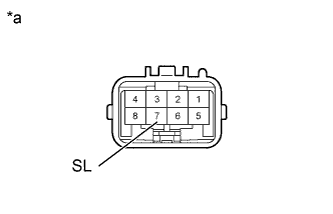
Disconnect the transmission wire connector.
-
Measure the resistance according to the value(s) in the table below.
Standard Resistance Tester Connection Condition Specified Condition 7 (SL) - Body ground 20°C (68°F) 11 to 15 Ω Table 1. Text in Illustration *a Component without harness connected
(Transmission Wire)
- OKClick here
- NGClick here
-
- Click here
CHECK HARNESS AND CONNECTOR (TRANSMISSION WIRE - ECM)
-
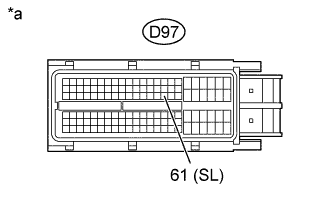
Disconnect the ECM connector.
-
Measure the resistance according to the value(s) in the table below.
Standard Resistance Tester Connection Condition Specified Condition D97-61 (SL) - Body ground 20°C (68°F) 11 to 15 Ω Table 2. Text in Illustration *a Front view of wire harness connector
(to ECM)
- OKClick here
- NGClick here
-
- Click here
REPAIR OR REPLACE HARNESS OR CONNECTOR
- Click here
REPLACE ECM
- Click here
INSPECT SHIFT SOLENOID VALVE SL
-
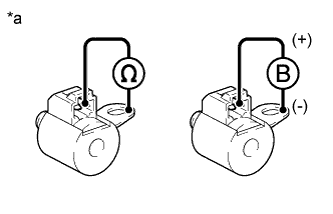
Remove shift solenoid valve SL.
-
Measure the resistance according to the value(s) in the table below.
Standard Resistance Tester Connection Condition Specified Condition Shift solenoid valve SL connector terminal - Shift solenoid valve SL body 20°C (68°F) 11 to 15 Ω -
Apply 12 V battery voltage to the shift solenoid valve and check that the valve moves and makes an operating noise.
OK Measurement Condition Specified Condition
-
Battery positive (+) → Shift solenoid valve SL connector
-
Battery negative (-) → Shift solenoid valve SL body
Valve moves and makes an operating noise Table 3. Text in Illustration *a Component without harness connected
(Shift Solenoid Valve SL)
-
- OKClick here
- NGClick here
-
- Click here
REPLACE SHIFT SOLENOID VALVE SL
- Click here
REPAIR OR REPLACE TRANSMISSION WIRE