СИСТЕМА SFI КОНТАКТЫ ECM
Tech Tips
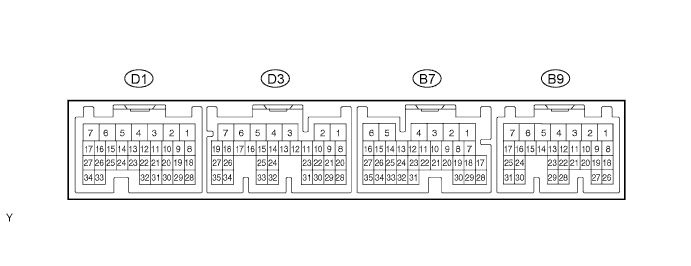
The standard normal voltage between each pair of ECM terminals is shown in the table below. The appropriate conditions for checking each pair of terminals are also indicated. The result of checks should be compared with the standard normal voltage for that pair of terminals, displayed in the STD Voltages column. The illustration above can be used as a reference to identify the ECM terminal locations.
| Terminal No. (Symbols) | Wiring Colors | Terminal Descriptions | Conditions | STD Voltages |
|---|---|---|---|---|
| B9-3 (BATT) - D1-3 (E1) | B-R - BR | Battery (for measuring the battery voltage and for the ECM memory) | Always | 11 to 14 V |
| B9-7 (+BM) - D1-3 (E1) | Y-B - BR | Power source of throttle motor | Always | 11 to 14 V |
| B9-9 (IGSW) - D1-3 (E1) | B-R - BR | Ignition switch | Ignition switch ON | 11 to 14 V |
| B9-1 (+B) - D1-3 (E1) | B-R - BR | Power source of ECM | Ignition switch ON | 11 to 14 V |
| B9-8 (MREL) - D1-3 (E1) | G-Y - BR | EFI relay | Ignition switch ON | 11 to 14 V |
| D1-18 (VC) - D1-28 (E2) | L-B - Y-R | Power source of sensor (specific voltage) |
Ignition switch ON | 4.5 to 5.0 V |
| D1-20 (VTA1) - D1-28 (E2) | R - Y-R | Throttle position sensor (for engine control) |
Ignition switch ON, Accelerator pedal fully released | 0.5 to 1.1 V |
| D1-20 (VTA1) - D1-28 (E2) | R - Y-R | Throttle position sensor (for engine control) |
Ignition switch ON, Accelerator pedal fully depressed | 3.3 to 4.9 V |
| D1-19 (VTA2) - D1-28 (E2) | G - Y-R | Throttle position sensor (for sensor malfunction detection) |
Ignition switch ON, Accelerator pedal fully released | 2.1 to 3.1 V |
| D1-19 (VTA2) - D1-28 (E2) | G - Y-R | Throttle position sensor (for sensor malfunction detection) |
Ignition switch ON, Accelerator pedal fully depressed | 4.5 to 5.0 V |
| B9-18 (VPA) - B9-20 (EPA) | L - W-L | Accelerator pedal position sensor (for engine control) |
Ignition switch ON, Accelerator pedal fully released | 0.5 to 1.1 V |
| B9-18 (VPA) - B9-20 (EPA) | L - W-L | Accelerator pedal position sensor (for engine control) |
Ignition switch ON, Accelerator pedal fully depressed | 2.6 to 4.5 V |
| B9-19 (VPA2) - B9-21 (EPA2) | B - W-R | Accelerator pedal position sensor (for sensor malfunction detection) |
Ignition switch ON, Accelerator pedal fully released | 1.2 to 2.0 V |
| B9-19 (VPA2) - B9-21 (EPA2) | B - W-R | Accelerator pedal position sensor (for sensor malfunction detection) |
Ignition switch ON, Accelerator pedal fully depressed | 3.4 to 5.0 V |
| B9-26 (VCPA) - B9-20 (EPA) | W - W-L | Power source of accelerator pedal position sensor (for VPA) |
Ignition switch ON | 4.5 to 5.5 V |
| B9-27 (VCP2) - B9-21 (EPA2) | R-L - W-R | Power source of accelerator pedal position sensor (for VPA2) |
Ignition switch ON | 4.5 to 5.5 V |
| D3-28 (VG) - D3-30 (E2G) | Y-G - L-R | Mass air flow meter | Idling, Shift position P or N, A/C switch OFF | 0.5 to 3.0 V |
| D3-29 (THA) - D1-28 (E2) | R - Y-R | Intake air temperature sensor | Idling, Intake air temperature 20°C (68°F) | 0.5 to 3.4 V |
| D1-32 (THW) - D1-28 (E2) | R-W - Y-R | Engine coolant temperature sensor | Idling, Engine coolant temperature 80°C (176°F) | 0.2 to 1.0 V |
| B9-28 (THB) - D1-28 (E2) | R - Y-R | Battery temperature sensor | Ignition switch ON | 0.5 to 4.5 V |
| D3-6 (#1) - D1-7 (E01) D3-5 (#2) - D1-7 (E01) D3-2 (#3) - D1-7 (E01) D3-1 (#4) - D1-7 (E01) |
B - W-B B-W - W-B Y - W-B R - W-B |
Fuel injector | Ignition switch ON | 11 to 14 V |
| D3-6 (#1) - D1-7 (E01) D3-5 (#2) - D1-7 (E01) D3-2 (#3) - D1-7 (E01) D3-1 (#4) - D1-7 (E01) |
B - W-B B-W - W-B Y - W-B R - W-B |
Fuel injector | Idling | Pulse generation (see waveform 1) |
| D1-17 (IGT1) - D1-3 (E1) D1-16 (IGT2) - D1-3 (E1) D1-15 (IGT3) - D1-3 (E1) D1-14 (IGT4) - D1-3 (E1) |
R-L - BR L-W - BR B-Y - BR Y-R - BR |
Ignition coil with igniter (ignition coil signal) |
Idling | Pulse generation (see waveform 2) |
| D1-23 (IGF1) - D1-3 (E1) | W-R - BR | Ignition coil with igniter (ignition confirmation signal) |
Ignition switch ON | 4.5 to 5.0 V |
| D1-23 (IGF1) - D1-3 (E1) | W-R - BR | Ignition coil with igniter (ignition confirmation signal) |
Idling | Pulse generation (see waveform 2) |
| D1-26 (G2) - D1-34 (NE-) | Y - B | Camshaft position sensor | Idling | Pulse generation (see waveform 3) |
| D1-27 (NE+) - D1-34 (NE-) | Y - B | Crankshaft position sensor | Idling | Pulse generation (see waveform 3) |
| B9-25 (FC) - D1-3 (E1) | L-Y - BR | Fuel pump control | Ignition switch ON | 11 to 14 V |
| B9-25 (FC) - D1-3 (E1) | L-Y - BR | Fuel pump control | Idling | Below 1.5 V |
| D1-5 (M+) - D3-3 (ME01) | Y - BR | Throttle actuator | Idling with warm engine | Pulse generation (see waveform 4) |
| D1-4 (M-) - D3-3 (ME01) | L - BR | Throttle actuator | Idling with warm engine | Pulse generation (see waveform 5) |
| D1-21 (A1A+) - D1-3 (E1) | Y - BR | A/F sensor | Always (Ignition switch ON) | 3.3 V*1 |
| D1-31 (A1A-) - D1-3 (E1) | L - BR | A/F sensor | Always (Ignition switch ON) | 3.0 V*1 |
| D1-25 (OX1B) - D1-28 (E2) | B - Y-R | Heated oxygen sensor | Engine speed maintained 2,500 rpm for 2 minutes after warming up sensor | Pulse generation (see waveform 6) |
| D1-1 (HA1A) - D3-7 (E04) | Y - BR | A/F sensor heater | Idling | Below 3.0 V |
| D1-1 (HA1A) - D3-7 (E04) | Y - BR | A/F sensor heater | Ignition switch ON | 11 to 14 V |
| D1-2 (HT1B) - D3-4 (E03) | Y - BR | Heated oxygen sensor heater | Idling | Below 3.0 V |
| D1-2 (HT1B) - D3-4 (E03) | Y - BR | Heated oxygen sensor heater | Ignition switch ON | 11 to 14 V |
| D1-29 (KNK1) - D1-30 (EKNK) | G - R | Knock sensor | Maintain engine speed 4,000 rpm after warming up | Pulse generation (see waveform 7) |
| D1-13 (OC1+) - D1-12 (OC1-) | G-B - B-Y | Camshaft timing oil control valve (OCV) | Idling | Pulse generation (see waveform 8) |
| D3-23 (PRG) - D1-7 (E01) | B - W-B | EVAP VSV | Ignition switch ON | 11 to 14 V |
| D3-23 (PRG) - D1-7 (E01) | B - W-B | EVAP VSV | Idling | Pulse generation (see waveform 9) |
| B9-12 (STA) - D1-3 (E1) | R - BR | Starter signal | Shift position N, ignition switch START | 5.5 V or more |
| B7-4 (STP) - D1-3 (E1) | R-W - BR | Stop light switch | Brake pedal depressed | 7.5 to 14 V |
| B7-4 (STP) - D1-3 (E1) | R-W - BR | Stop light switch | Brake pedal released | Below 1.5 V |
| B9-16 (ST1-) - D1-3 (E1) | R-L - BR | Stop light switch | Ignition switch ON, Brake pedal depressed | Below 1.5 V |
| B9-16 (ST1-) - D1-3 (E1) | R-L - BR | Stop light switch | Ignition switch ON, Brake pedal released | 7.5 to 14 V |
| B7-30 (W) - D1-7 (E01) | G-R - W-B | MIL | Idling | 11 to 14 V |
| B7-30 (W) - D1-7 (E01) | G-R - W-B | MIL | Ignition switch ON | Below 3.5 V |
| B9-15 (ELS) - D1-3 (E1) | G - BR | Electric load | Taillight switch ON | 7.5 to 14 V |
| B9-15 (ELS) - D1-3 (E1) | G - BR | Electric load | Taillight switch OFF | 0 to 1.5 V |
| B7-1 (TACH) - D1-3 (E1) | B-Y - BR | Engine speed | Idling | Pulse generation (see waveform 10) |
| B7-8 (SPD) - D1-3 (E1) | P-L - BR | Speed signal from combination meter | Driving at 20 km/h (12 mph) | Pulse generation (see waveform 11) |
| B7-17 (TC) - D1-3 (E1) | P - BR | Terminal TC of DLC3 | Ignition switch ON | 11 to 14 V |
| D3-32 (PSW) - D1-3 (E1) | G-W - BR | Power steering oil pressure switch | While turning steering wheel | Below 1.5 V |
| B7-32 (F/PS) - D1-3 (E1) | L - BR | Airbag sensor assembly | Idling with warm engine | Pulse generation (see waveform 12) |
| B9-30 (NSW) - D1-3 (E1) | B-W - BR | Park/Neutral switch signal | IG switch ON and shift lever in P or N position | Below 1 V |
| B9-30 (NSW) - D1-3 (E1) | B-W - BR | Park/Neutral switch signal | IG switch ON and shift lever in any position except P and N | 11 to 14 V |
| B7-33 (CANH) - D1-3 (E1) | B - BR | Communication signal with other components | Ignition switch ON | Pulse generation (see waveform 13) |
| B7-34 (CANL) - D1-3 (E1) | W - BR | Communication signal with other components | Ignition switch ON | Pulse generation (see waveform 14) |
| D1-24 (AIRV) - D1-3 (E1) | Y - BR | Air switch valve for secondary air injection system | Ignition switch ON | 11 to 14 V |
| D1-11 (AIRP) - D1-3 (E1) | W-R - BR | Air pump control | Ignition switch ON | 11 to 14 V |
| D3-20 (AIDI) - D1-3 (E1) | LG - BR | Diagnostic information signal for secondary air injection system | Secondary air injection system operates | Pulse generation (see waveform 15) |
| D3-22 (AIP) - D1-28 (E2) | R - Y-R | Secondary air injection system pressure signal | Ignition switch ON | 4.5 to 5.0 V |
*1: The ECM terminal voltage is constant regardless of the output voltage from the sensor.
-
WAVEFORM 1
-
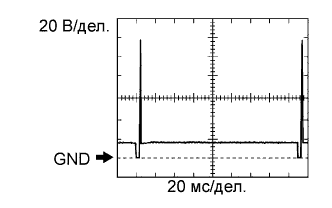
Fuel injector
ECM Terminal Names Between #1 (to #4) and E01 Tester Ranges 20 V/DIV, 20 msec./DIV Conditions Idling Tech Tips
The wavelength becomes shorter as the engine rpm increases.
-
-
WAVEFORM 2
-
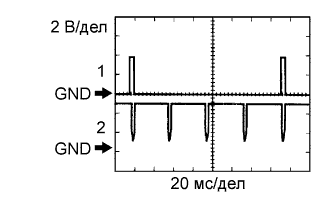
Igniter IGT signal (from ECM to igniter)
-
Igniter IGF signal (from igniter to ECM)
ECM Terminal Names
-
Between IGT (1 to 4) and E1
-
Between IGF1 and E1
Tester Ranges 2 V/DIV, 20 msec./DIV Conditions Idling Tech Tips
The wavelength becomes shorter as the engine rpm increases.
-
-
-
WAVEFORM 3
-
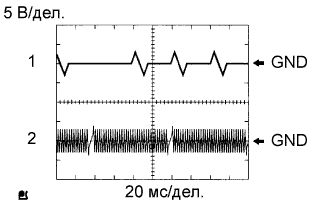
Camshaft position sensor
-
Crankshaft position sensor
ECM Terminal Names
-
Between G2 and NE-
-
Between NE+ and NE-
Tester Ranges 5 V/DIV, 20 msec./DIV Conditions Idling Tech Tips
The wavelength becomes shorter as the engine rpm increases.
-
-
-
WAVEFORM 4
-
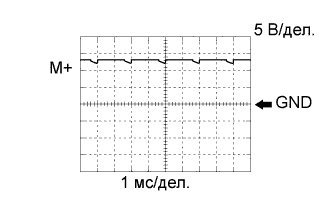
Throttle actuator positive terminal
ECM Terminal Names Between M+ and ME01 Tester Ranges 5 V/DIV, 1 msec./DIV Conditions Idling with warm engine Tech Tips
The duty ratio varies depending on the throttle actuator operation.
-
-
WAVEFORM 5
-
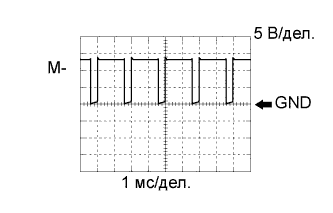
Throttle actuator negative terminal
ECM Terminal Names Between M- and ME01 Tester Ranges 5 V/DIV, 1 msec./DIV Conditions Idling with warm engine Tech Tips
The duty ratio varies depending on the throttle actuator operation.
-
-
WAVEFORM 6
-
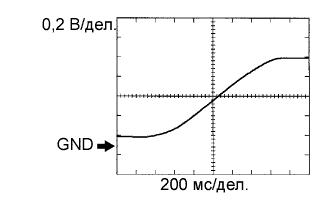
Heated oxygen sensor
ECM Terminal Names Between OX1B and E2 Tester Ranges 0.2 V/DIV, 200 msec./DIV Conditions Engine speed maintained 2,500 rpm for 2 minutes after warming up engine Tech Tips
In the DATA LIST, item O2S B1S2 shows the input values from the heated oxygen sensor to the ECM.
-
-
WAVEFORM 7
-
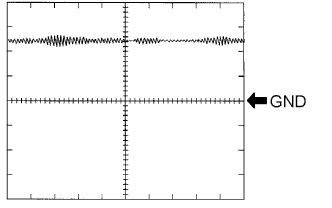
Knock sensor
ECM Terminal Names Between KNK1 and EKNK Tester Ranges 0.01 to 10 V/DIV, 0.01 to 10 msec./DIV Conditions Engine speed maintained 4,000 rpm after warming up engine Tech Tips
-
The wavelength becomes shorter as the engine rpm increases.
-
The waveforms and amplitudes displayed differ slightly depending on the vehicle.
-
-
-
WAVEFORM 8
-
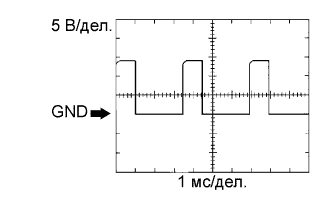
Camshaft timing oil control valve (OCV)
ECM Terminal Names Between OC1+ and OC1- Tester Ranges 5 V/DIV, 1 msec./DIV Conditions idling
-
-
WAVEFORM 9
-
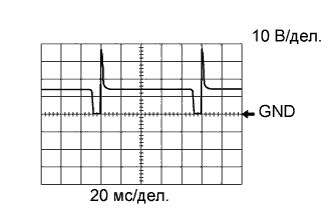
EVAP VSV
ECM Terminal Names Between PRG and E01 Tester Ranges 10 V/DIV, 20 msec./DIV Conditions idling Tech Tips
If the waveform is not similar to the illustration, check the waveform again after idling for 10 minutes or more.
-
-
WAVEFORM 10
-
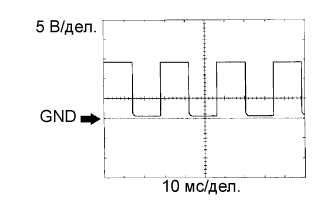
Engine speed signal
ECM Terminal Names Between TACH and E1 Tester Ranges 5 V/DIV, 10 msec./DIV Conditions idling Tech Tips
The wavelength becomes shorter as the engine rpm increases.
-
-
WAVEFORM 11
-
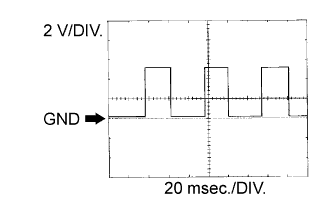
Vehicle speed signal
ECM Terminal Names Between SPD and E1 Tester Ranges 2 V/DIV, 20 msec./DIV Conditions Driving at 20 km/h (12 mph) Tech Tips
The wavelength becomes shorter as the vehicle speed increases.
-
-
WAVEFORM 12
-
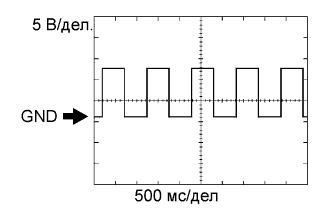
Airbag sensor assembly
ECM Terminal Names Between F/PS and E1 Tester Ranges 5 V/DIV, 500 msec./DIV Conditions Idling with warm engine
-
-
WAVEFORM 13
-
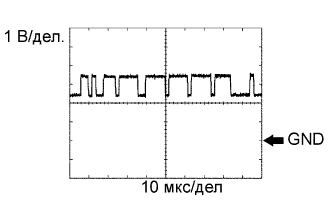
CAN communication signal
ECM Terminal Names Between CANH and E1 Tester Ranges 1 V/DIV, 10 μs/DIV Conditions Ignition switch ON
-
-
WAVEFORM 14
-
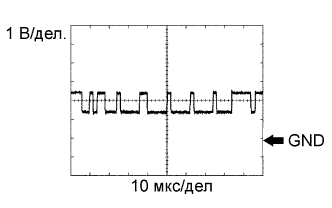
CAN communication signal
ECM Terminal Names Between CANL and E1 Tester Ranges 1 V/DIV, 10 μs/DIV Conditions Ignition switch ON
-
-
WAVEFORM 15
-
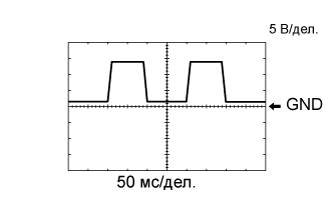
Terminal DI of air injection control driver
ECM Terminal Names Between AIDI and E1 Tester Ranges 5 V/DIV, 50 ms/DIV Conditions Performing ACTIVE TEST using intelligent tester (secondary air injection system) Tech Tips
The wavelength changes when the air injection control driver detects malfunctions in the air injection system Click here.
-