CHARGING SYSTEM ON-VEHICLE INSPECTION
-
CHECK BATTERY CONDITION
Note
If the battery is weak or if the engine is difficult to start, perform the following procedures.
-
Check the battery for damage and deformation. If severe damage, deformation or leakage is found, replace the battery.
-
Check the electrolyte quantity of each cell.
-
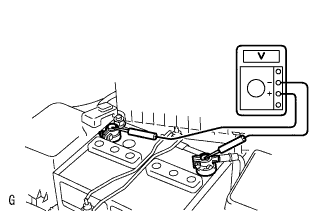
For maintenance-free batteries:
-
If the electrolyte quantity is below the lower line, replace the battery.
-
If the electrolyte quantity is above the lower line, check the battery voltage when cranking the engine. If the voltage is less than 9.6 V, recharge or replace the battery.
Tech Tips
Before checking the battery voltage, turn off all the electrical systems (headlights, blower motor, rear defogger, etc.).
-
-
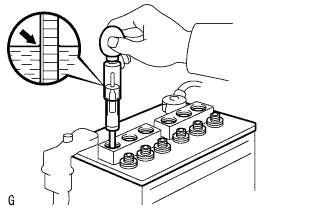
For non-maintenance-free batteries:
-
If the electrolyte quantity is below the lower line, add distilled water to each cell. Then, recharge the battery and check the electrolyte's specific gravity.
Standard specific gravity 1.25 to 1.29 at 20°C (68°F) If the electrolyte quantity is above the lower line, check the battery voltage when cranking the engine. If the voltage is less than 9.6 V, recharge or replace the battery.
Tech Tips
Before checking the battery voltage, turn off all the electrical systems (headlights, blower motor, rear defogger, etc.).
-
-
-
-
CHECK BATTERY TERMINAL
-
Check that the battery terminals are not loose or corroded.
If the terminals are corroded, clean them.
-
-
CHECK FUSES
-
Measure the resistance of the ALT fuse, ALT-S fuse, GAUGE NO. 1 fuse and GAUGE NO. 2 fuse.
Standard resistance Below 1 Ω
-
If the results are not as specified, replace the fuses as necessary.
-
-
-
CHECK V-RIBBED BELT
-
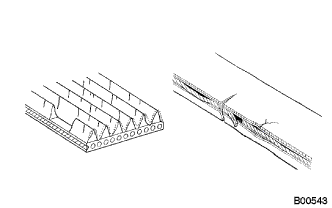
Check the belt for wear, cracks or other signs of damage.
If any of the following defects is found, replace the V-ribbed belt.
-
The belt is worn out, cracked, or the cords are exposed.
-
The cracks reach the cords in more than one place.
-
The belt has chunks missing from the ribs.
-
-
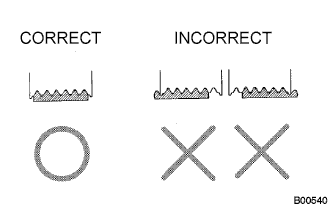
Check that the belt fits properly in the ribbed grooves.
Tech Tips
Check with your hands to confirm that the belt has not slipped out of the groove on the bottom of the pulley.
If it has slipped out, replace the V-ribbed belt. Install a new V-ribbed belt correctly.
-
-
INSPECT GENERATOR WIRING
-
Visually check the generator wiring.
-
Check that the wiring is in good condition.
-
-
-
CHECK FOR ABNORMAL NOISES
-
Listen for abnormal noises from the generator.
-
Check that no abnormal noises are heard from the generator while the engine is running.
-
-
-
INSPECT CHARGE WARNING LIGHT CIRCUIT
-
Turn the ignition switch on (IG). Check that the charge warning light comes on.
-
Start the engine and check that the light goes off.
If the light does not operate as specified, troubleshoot the charge warning light circuit.
-
-
INSPECT CHARGING CIRCUIT WITHOUT LOAD
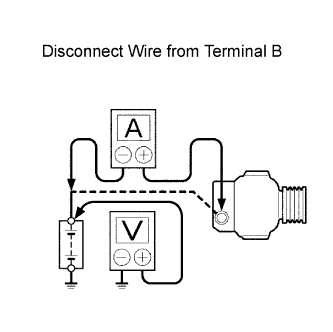
-
Connect a voltmeter and ammeter to the charging circuit as follows.
-
Disconnect the wire from terminal B of the generator, then connect it to the negative (-) lead of an ammeter.
-
Connect the positive (+) lead of the ammeter to terminal B of the generator.
-
Connect the positive (+) lead of a voltmeter to the positive (+) terminal of the battery.
-
Ground the negative (-) lead of the voltmeter.
-
-
Check the charging circuit.
-
Keep the engine speed at 2000 rpm and check the reading on the ammeter and voltmeter.
Standard amperage 10 A or less Standard voltage 13.2 to 14.8 V If the result is not as specified, replace the generator.
Tech Tips
If the battery is not fully charged, the ammeter reading will sometimes be more than the standard amperage.
-
-
-
INSPECT CHARGING CIRCUIT WITH LOAD
-
With the engine running at 2000 rpm, turn the high beam headlights on and turn the heater blower switch to the "HI" position.
-
Check the reading on the ammeter.
Standard amperage 30 A or more If the ammeter reading is less than the standard amperage, repair the generator.
Tech Tips
If the battery is fully charged, the indication will sometimes be less than the standard amperage. If this is the case, add more electrical load (operate the wipers, rear window defogger, etc.) and check the reading on the ammeter again.
-