EXHAUST MANIFOLD INSTALLATION
-
INSTALL AIR FUEL RATIO SENSOR (for Bank 1 Sensor 1)
-
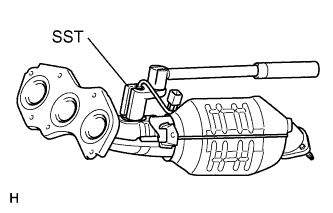
Using SST, install the air fuel ratio sensor to the exhaust manifold sub-assembly RH.
- SST
- 09224-00010
- Torque:
- 40 N*m { 408 kgf*cm, 30 ft.*lbf, for use with SST }
- 44 N*m { 449 kgf*cm, 32 ft.*lbf, for use without SST }
Tech Tips
-
Use a torque wrench with a fulcrum length of 30 cm (11.81 in.).
-
Make sure that SST and the wrench are connected in a straight line.
-
-
INSTALL EXHAUST MANIFOLD SUB-ASSEMBLY RH
-
Install a new gasket.
-
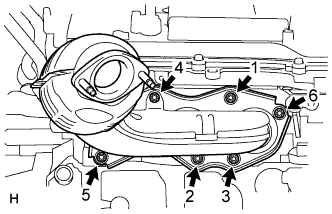
Install the exhaust manifold sub-assembly RH by tightening the 6 nuts in the order shown in the illustration.
- Torque:
- 21 N*m { 214 kgf*cm, 15 ft.*lbf }
-
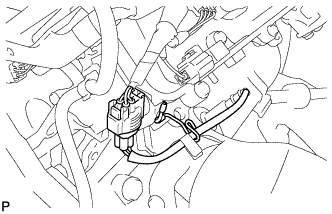
Connect the air fuel ratio sensor (for bank 1 sensor 1) connector and install the clamp.
-
-
INSTALL MANIFOLD STAY
-
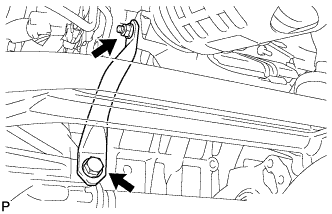
Install the manifold stay with the bolt and nut.
- Torque:
- Bolt
- 34 N*m { 347 kgf*cm, 25 ft.*lbf }
- Nut
- 35 N*m { 357 kgf*cm, 26 ft.*lbf }
-
-
INSTALL EXHAUST MANIFOLD SUB-ASSEMBLY LH
-
Install a new gasket.
-
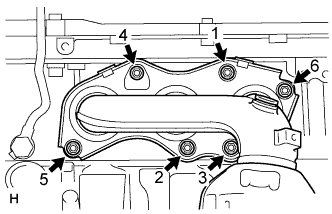
Install the exhaust manifold sub-assembly LH by tightening the 6 nuts in the order shown in the illustration.
- Torque:
- 21 N*m { 214 kgf*cm, 15 ft.*lbf }
-
-
INSTALL NO. 2 MANIFOLD STAY
-
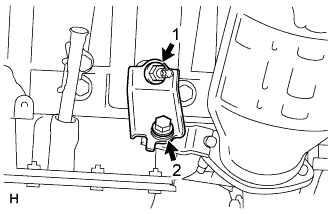
Install the No. 2 manifold stay by tightening the bolt and nut in the order shown in the illustration.
- Torque:
- 34 N*m { 347 kgf*cm, 25 ft.*lbf }
-
-
INSTALL FRONT EXHAUST PIPE ASSEMBLY
-
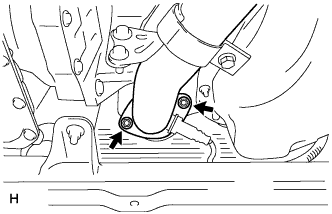
Install a new gasket to the front exhaust pipe assembly.
-
Install the front exhaust pipe assembly with 2 new nuts.
- Torque:
- 56 N*m { 571 kgf*cm, 41 ft.*lbf }
-
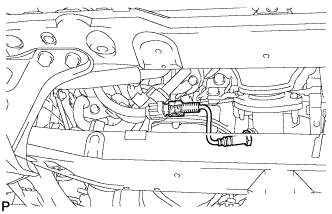
Connect the heated oxygen sensor (for bank 2 sensor 2) connector.
-
-
INSTALL FRONT NO. 3 EXHAUST PIPE SUB-ASSEMBLY
-
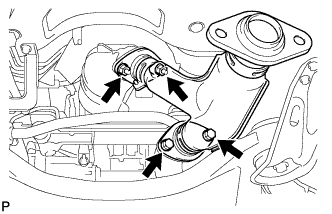
Install 2 new gaskets to the front No. 3 exhaust pipe sub-assembly.
-
Install the front No. 3 exhaust pipe sub-assembly with 2 new nuts and the 2 bolts.
- Torque:
- 56 N*m { 571 kgf*cm, 41 ft.*lbf }
-
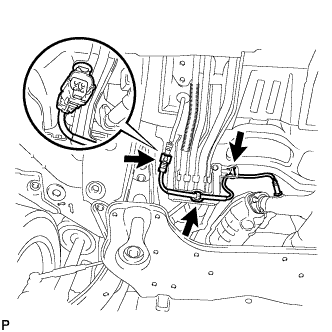
Install the 3 clamps and connect the heated oxygen sensor (for bank 1 sensor 2) connector.
-
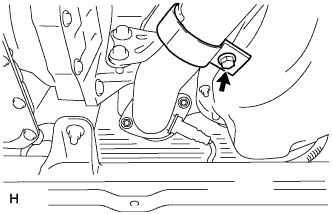
Tighten the front exhaust pipe assembly bolt.
- Torque:
- 21 N*m { 214 kgf*cm, 15 ft.*lbf }
-
-
INSTALL CENTER EXHAUST PIPE ASSEMBLY
-
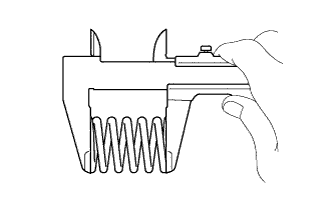
Using vernier calipers, measure the free length of the compression spring.
Minimum 41.5 mm (1.63 in.) Tech Tips
If the length is less than the minimum, replace the compression spring.
-
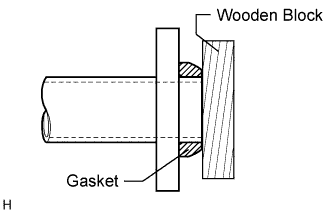
Using a plastic-faced hammer and wooden block, tap in a new gasket until its surface is flush with the front No. 3 exhaust pipe sub-assembly.
Note
-
Tap in the gasket in the correct direction.
-
Do not reuse the removed gasket.
-
Do not push in the gasket while installing the center exhaust pipe assembly.
-
-
Connect the 3 exhaust pipe supports, and install the center exhaust pipe assembly.
-
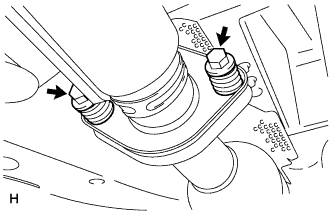
Install the 2 compression springs and 2 bolts.
- Torque:
- 48 N*m { 489 kgf*cm, 35 ft.*lbf }
-
-
INSTALL TAIL EXHAUST PIPE ASSEMBLY
-
Using vernier calipers, measure the free length of the compression spring.
Minimum 40.5 mm (1.59 in.) Tech Tips
If the length is less than the minimum, replace the compression spring.
-
Using a plastic-faced hammer and wooden block, tap in a new gasket until its surface is flush with the center exhaust pipe assembly.
Note
-
Tap in the gasket in the correct direction.
-
Do not reuse the removed gasket.
-
Do not push in the gasket while installing the tail exhaust pipe assembly.
-
-
Connect the exhaust pipe support, and install the tail exhaust pipe assembly.
-
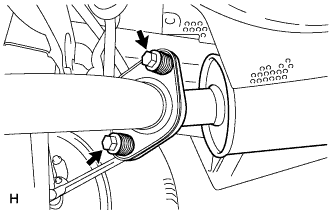
Install the 2 compression springs and 2 bolts.
- Torque:
- 48 N*m { 489 kgf*cm, 35 ft.*lbf }
-
-
TEMPORARILY TIGHTEN PROPELLER WITH CENTER BEARING SHAFT ASSEMBLY (for 4WD)
-
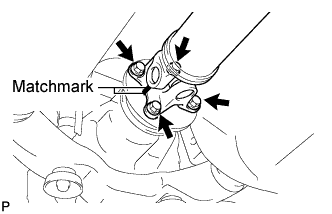
Align the matchmarks on the propeller shaft flange and differential companion flange, and connect the shaft with the 4 bolts, 4 washers and 4 nuts.
-
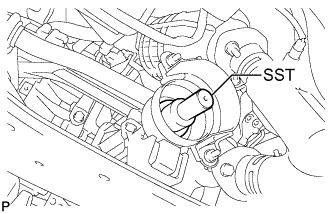
Remove SST from the transaxle.
-
Insert the yoke into the transaxle.
-
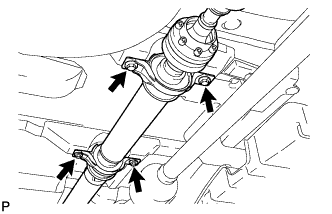
Install the 4 adjusting shims and propeller shaft with center bearing, and temporarily tighten the 4 bolts.
-
Tighten the 4 bolts.
- Torque:
- 74 N*m { 750 kgf*cm, 54 ft.*lbf }
-
-
FULLY TIGHTEN PROPELLER WITH CENTER BEARING SHAFT ASSEMBLY (for 4WD)
-
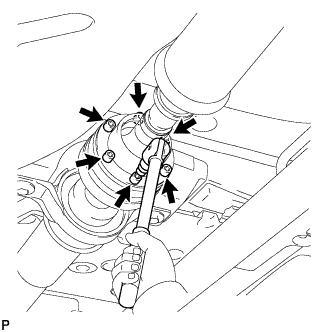
Remove the piece of cloth from the joint.
-
Using a hexagon wrench (6 mm), tighten the 6 bolts.
- Torque:
- 26 N*m { 265 kgf*cm, 19 ft.*lbf }
-
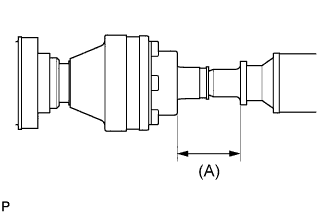
With the vehicle unloaded, adjust the dimension between the rear side of the cover and shaft as shown in the illustration.
(A) 58.0 +/- 0.5 mm (2.283 +/- 0.02 in.) -
Under the same condition as above, adjust the front and rear dimensions between the edge surface of the center support bearing and the edge surface of the cushion respectively as shown, and then tighten the bolts.
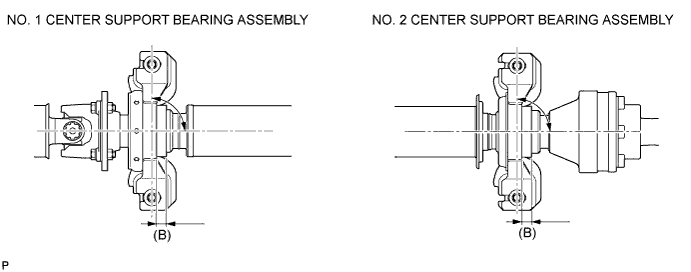
- Torque:
- 37 N*m { 375 kgf*cm, 27 ft.*lbf }
(B) 12.5 +/- 1.0 mm (0.492 +/- 0.039 in.) -
Check that the center line of the bracket is at the right angle in the shaft axial direction.
-
If any vibration or noise occurs, perform joint angle check as follows and replace the adjusting shim with a proper one.
-
Turn the propeller shaft several times by hand to stabilize the center support bearings.
-
Using a jack, raise and lower the differential to stabilize the differential mounting cushion.
-
Remove the transfer dynamic damper.
-
Using SST, measure the transfer installation angle (A) and front propeller shaft installation angle (B).
- SST
- 09370-50010
No. 1 joint angle (A) - (B) = -1.3° to -3.3° -
Using SST, measure the rear propeller shaft installation angle (C) and rear differential shaft installation angle (D).
- SST
- 09370-50010
No. 2 joint angle (C) - (D) = 1.8° to 3.5° 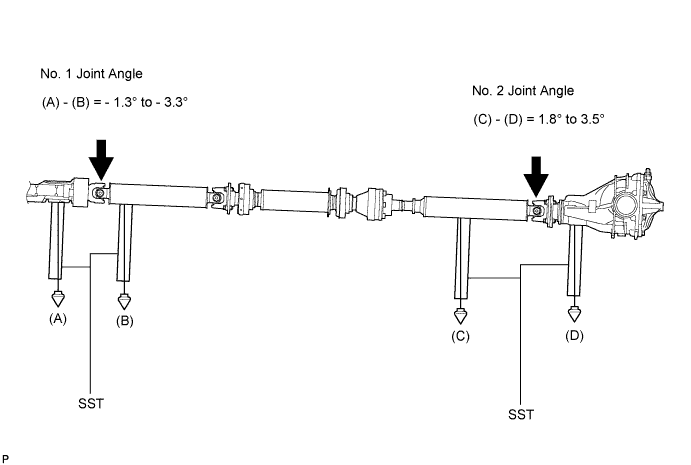
Tech Tips
If the measured angle is not within the specification, adjust it with the center support bearing adjusting shim.
Center support bearing adjusting shim thickness Thickness mm (in.) Thickness mm (in.) 3.2 (0.126) 11.0 (0.433) 4.5 (0.177) 13.5 (0.531) 6.5 (0.256) 15.5 (0.610) 9.0 (0.354) 17.5 (0.689) -
Install the transfer dynamic damper.
- Torque:
- 26 N*m { 265 kgf*cm, 19 ft.*lbf }
-
-
-
INSTALL NO. 2 EXHAUST MANIFOLD HEAT INSULATOR
-
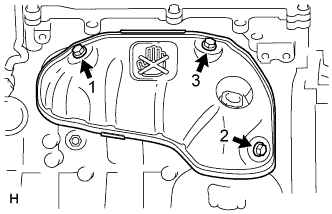
Install the No. 2 exhaust manifold heat insulator by tightening the 3 bolts in the order shown in the illustration.
- Torque:
- 8.5 N*m { 87 kgf*cm, 75 in.*lbf }
-
-
INSTALL AIR FUEL RATIO SENSOR NO.2 (for Bank 2 Sensor 1)
-
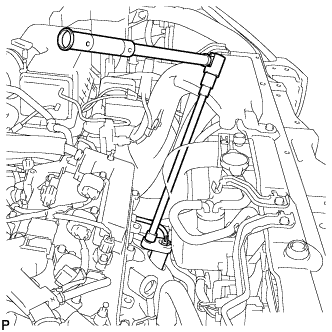
Using SST, install the air fuel ratio sensor to the exhaust manifold sub-assembly LH.
- SST
- 09224-00010
- Torque:
- 40 N*m { 408 kgf*cm, 30 ft.*lbf, for use with SST }
- 44 N*m { 449 kgf*cm, 32 ft.*lbf, for use without SST }
Tech Tips
-
Use a torque wrench with a fulcrum length of 30 cm (11.81 in.).
-
Make sure that SST and the wrench are connected in a straight line.
-
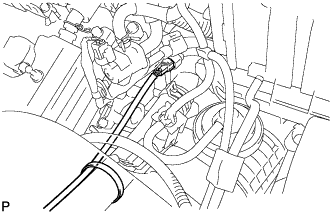
Connect the air fuel ratio sensor connector and install the clamp.
-
-
INSTALL NO. 2 OIL LEVEL DIPSTICK GUIDE
-
Install a new O-ring to the No. 2 engine oil level dipstick guide.
-
Apply a light coat of engine oil to the O-ring.
-
Push in the No. 2 engine oil level dipstick guide end into the No. 1 engine oil level dipstick guide.
-
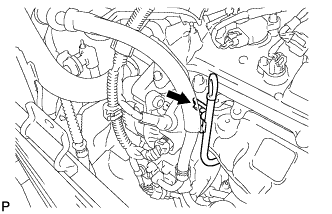
Install the No. 2 oil level dipstick guide with the bolt.
- Torque:
- 21 N*m { 214 kgf*cm, 15 ft.*lbf }
-
-
INSTALL RADIATOR RESERVE TANK ASSEMBLY
-
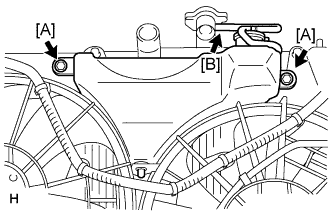
Install the radiator reserve tank assembly with the 2 bolts [A].
- Torque:
- 5.4 N*m { 55 kgf*cm, 48 in.*lbf }
-
Connect the hose [B].
-
-
CONNECT NO. 1 RADIATOR HOSE
-
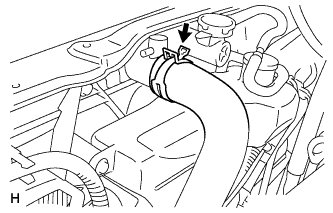
Connect the No. 1 radiator hose to the radiator.
-
-
ADD ENGINE COOLANT
-
Tighten the radiator drain cock plug by hand.
-
Tighten the 2 cylinder block drain cock plugs.
- Torque:
- 13 N*m { 130 kgf*cm, 9 ft.*lbf, for cylinder block drain cock plugs }
-
Loosen the air drain cock plug from the water inlet housing.
-
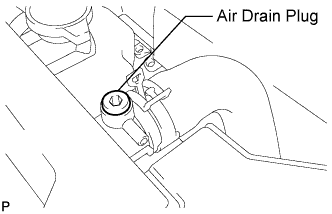
Loosen the air drain plug at the top of the radiator 3 or 4 turns.
-
Add TOYOTA Super Long Life Coolant (SLLC) to the radiator inlet opening until coolant overflows from the engine air drain cock hole. Then tighten the air drain cock plug to the water inlet housing.
- Torque:
- 13 N*m { 130 kgf*cm, 9 ft.*lbf, for air drain cock plug }
-
Continue to add TOYOTA Super Long Life Coolant (SLLC) to the radiator inlet opening until coolant overflows from the radiator air drain hole. Then close the air drain plug at the top of the radiator.
- Torque:
- 1.5 N*m { 15 kgf*cm, 13 in.*lbf, for air drain plug }
Tech Tips
If the coolant level at the radiator inlet opening drops after squeezing the No. 1 and No. 2 radiator hoses, add coolant.
-
Slowly fill the radiator with TOYOTA Super Long Life Coolant (SLLC).
Standard capacity Condition Specified Condition w/ Rear Heater 11.7 liters (12.4 US qts, 10.3 Imp. qts) w/o Rear Heater 9.5 liters (10.1 US qts, 8.4 Imp. qts) Tech Tips
-
TOYOTA vehicles are filled with TOYOTA SLLC at the factory. In order to avoid damage to the engine cooling system and other technical problems, only use TOYOTA SLLC or similar high quality ethylene glycol based non-silicate, non-amine, non-nitrite, non-borate coolant with long-life hybrid organic acid technology (coolant with long-life hybrid organic acid technology is a combination of low phosphates and organic acids).
-
Contact your TOYOTA dealer for further details.
Note
Never use water as a substitute for engine coolant.
-
-
Slowly pour coolant into the radiator reservoir tank until it reaches the FULL line.
-
Squeeze the No. 1 and No. 2 radiator hoses several times by hand, and then check the level of the coolant.
If the coolant level is low, add coolant.
-
Bleed air from the cooling system.
-
Warm up the engine until the thermostat opens. While the thermostat is open, circulate the coolant for several minutes.
Tech Tips
The thermostat open timing can be confirmed by squeezing the inlet radiator hose by hand, and checking when the engine coolant starts to flow inside the hose.
-
Maintain the engine speed at 2500 to 3000 rpm.
-
Squeeze the inlet and outlet radiator hoses several times by hand to bleed air.
CAUTION:
When squeezing the radiator hoses:
-
Wear protective gloves.
-
Be careful as the radiator hoses are hot.
-
Keep your hands away from the radiator fan.
Note
-
Make sure that the radiator reservoir still has some coolant in it.
-
If the coolant temperature gauge indicates an excessive temperature, turn off the engine and let it cool.
-
If there is not enough coolant, the engine may overheat or be seriously damaged.
-
If the radiator reservoir does not have enough coolant, perform the following: 1) stop the engine, 2) wait until the coolant has cooled down, and 3) add coolant until the reservoir is filled to the FULL line.
-
-
-
Stop the engine and wait until the engine coolant cools down.
-
Add engine coolant to the FULL line on the radiator reservoir.
-
-
INSPECT FOR COOLANT LEAK
CAUTION:
Do not remove the radiator cap while the engine and radiator are still hot. Pressurized, hot engine coolant and steam may be released and cause serious burns.
Note
Before performing each inspection, turn the A/C switch off.
-
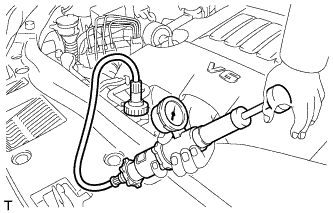
Fill the radiator with coolant and attach a radiator cap tester.
-
Warm up the engine.
-
Using the radiator cap tester, increase the pressure inside the radiator to 118 kPa (1.2 kgf/cm2, 17 psi), and check that the pressure does not drop.
If the pressure drops, check the hoses, radiator and water pump for leaks. If no external leaks are found, check the heater core, cylinder block and cylinder head.
-
-
INSPECT FOR EXHAUST GAS LEAK
If exhaust gas is leaking, repair the leak. Replace damaged or worn parts as necessary.
-
INSPECT AND ADJUST TRANSFER OIL (for 4WD)
-
INSTALL NO. 2 ENGINE UNDER COVER
-
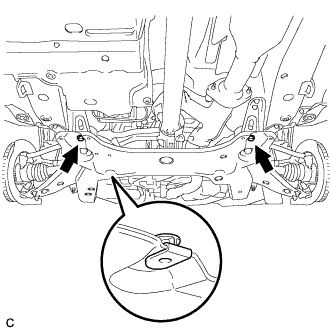
Install the No. 2 engine under cover with the 2 bolts.
-
-
INSTALL NO. 1 ENGINE UNDER COVER
-
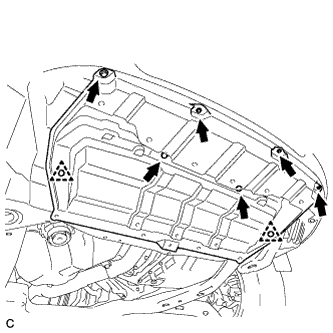
Install the No. 1 engine under cover with the 6 bolts and 2 clips.
-
-
INSTALL ENGINE UNDER COVER ASSEMBLY
-
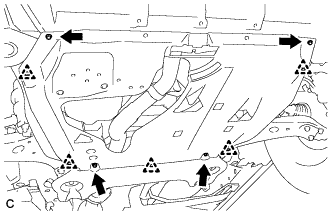
Install the engine under cover assembly with the 2 bolts, 2 screws and 5 clips.
-
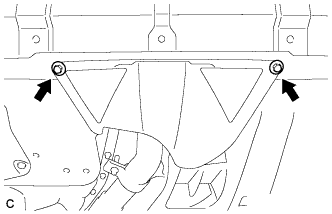
Install the engine under cover assembly RR with the 2 bolts.
-
-
INSTALL V-BANK COVER SUB-ASSEMBLY
-
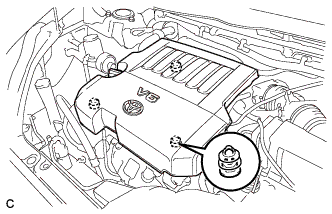
Fit the 3 retainers and install the V-bank cover.
-
-
INSTALL FRONT WHEEL RH