SFI SYSTEM MIL Circuit
DESCRIPTION
The MIL (Malfunction Indicator Lamp) is used to indicate vehicle malfunctions detected by the ECM. When the ignition switch is turned to ON, power is supplied to the MIL circuit, and the ECM provides the circuit ground which illuminates the MIL.
The MIL operation can be checked visually: When the ignition switch is first turned to ON, the MIL should illuminate and should then turn off. If the MIL remains illuminated or does not illuminate, conduct the following troubleshooting procedure using the intelligent tester.
WIRING DIAGRAM
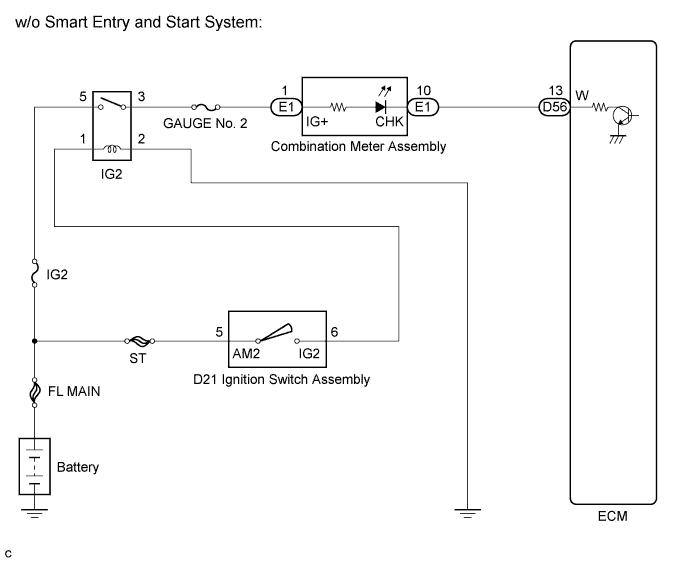
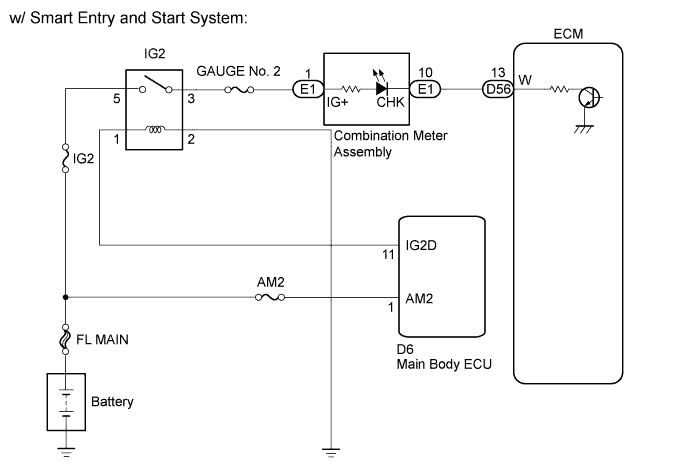
INSPECTION PROCEDURE
Note
Inspect the fuses for circuits related to this system before performing the following inspection procedure.
PROCEDURE
-
CHECK THAT MIL IS ILLUMINATED
-
Turn the ignition switch on (IG).
-
Check the illumination of the MIL.
Result Result Proceed to MIL remains illuminated (Even after ignition switch on (IG) and several seconds have passed, MIL still remains illuminated) A MIL remains off (Does not illuminate at all) B MIL illuminates for several seconds, but turns off after engine is started C
B 
CHECK THAT ENGINE STARTS Click here
C 
PROCEED TO NEXT SUSPECTED AREA SHOWN IN PROBLEM SYMPTOMS TABLE Click here
A 
-
-
CHECK WHETHER MIL TURNS OFF
-
Connect the intelligent tester to the DLC3.
-
Turn the ignition switch on (IG).
-
Turn the tester on.
-
Enter the following menus: Powertrain / Engine and ECT / DTC.
-
Check if any DTCs have been stored. Note down any DTCs.
-
Clear the DTCs Click here.
-
Check if the MIL goes off.
OK MIL goes off.
NG
CHECK HARNESS AND CONNECTOR (CHECK FOR SHORT IN WIRE HARNESS) Click here
OK 
REPAIR CIRCUITS INDICATED BY OUTPUT DTCS Click here
-
-
CHECK HARNESS AND CONNECTOR (CHECK FOR SHORT IN WIRE HARNESS)
-
Disconnect the D56 ECM connector.
-
Turn the ignition switch on (IG).
-
Check that the MIL is not illuminated.
OK MIL is not illuminated. -
Reconnect the ECM connector.
NG
CHECK HARNESS AND CONNECTOR (COMBINATION METER ASSEMBLY - ECM) Click here
OK
REPLACE ECM Click here
-
-
CHECK HARNESS AND CONNECTOR (COMBINATION METER ASSEMBLY - ECM)
-
Disconnect the combination meter assembly connector.
-
Disconnect the ECM connector.
-
Measure the resistance according to the value(s) in the table below.
Standard Resistance (Check for Short) Tester Connection Condition Specified Condition E1-10 (CHK) or D56-13 (W) - Body ground Always 10 kΩ or higher -
Reconnect the combination meter assembly connector.
-
Reconnect the ECM connector.
NG
REPAIR OR REPLACE HARNESS OR CONNECTOR (COMBINATION METER ASSEMBLY - ECM)
OK
REPLACE COMBINATION METER ASSEMBLY Click here
-
-
CHECK THAT ENGINE STARTS
-
Turn the ignition switch on (IG).
-
Start the engine.
Result Result Proceed to Engine starts A Engine does not start* B Tech Tips
*: The intelligent tester cannot communicate with the ECM.
B
GO TO VC OUTPUT CIRCUIT Click here
A
-
-
CHECK ECM (W TERMINAL VOLTAGE)
-
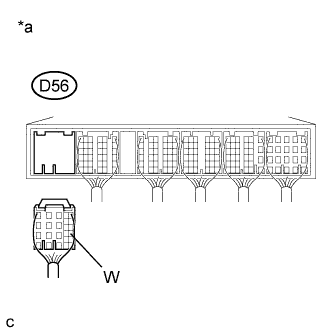
Text in Illustration *a Rear view of wire harness connector
(to ECM)
Disconnect the ECM connector.
-
Turn the ignition switch on (IG).
-
Measure the voltage according to the value(s) in the table below.
Standard Voltage Tester Connection Switch Condition Specified Condition D56-13 (W) - Body ground Ignition switch on (IG) 11 to 14 V -
Reconnect the ECM connector.
NG
CHECK HARNESS AND CONNECTOR (COMBINATION METER ASSEMBLY - ECM) Click here
OK
REPLACE ECM Click here
-
-
CHECK HARNESS AND CONNECTOR (COMBINATION METER ASSEMBLY - ECM)
-
Disconnect the combination meter assembly connector.
-
Disconnect the ECM connector.
-
Measure the resistance according to the value(s) in the table below.
Standard Resistance (Check for Open) Tester Connection Condition Specified Condition E1-10 (CHK) - D56-13 (W) Always Below 1 Ω -
Reconnect the ECM connector.
-
Reconnect the combination meter assembly connector.
NG
REPAIR OR REPLACE HARNESS OR CONNECTOR (COMBINATION METER ASSEMBLY - ECM)
OK
REPLACE COMBINATION METER ASSEMBLY Click here
-