| DTC Code | DTC Name |
|---|---|
| P2195 | Oxygen (A/F) Sensor Signal Stuck Lean (Bank 1 Sensor 1) |
| P2196 | Oxygen (A/F) Sensor Signal Stuck Rich (Bank 1 Sensor 1) |
| P2197 | Oxygen (A/F) Sensor Signal Stuck Lean (Bank 2 Sensor 1) |
| P2198 | Oxygen (A/F) Sensor Signal Stuck Rich (Bank 2 Sensor 1) |
DESCRIPTION
-
Although the DTC titles say oxygen sensor, these DTCs relate to the air fuel ratio sensor.
-
Sensor 1 refers to the sensor mounted in front of the three-way catalytic converter and located near the engine assembly.
The air fuel ratio sensor generates a voltage* that corresponds to the actual air fuel ratio. This sensor voltage is used to provide the ECM with feedback so that it can control the air fuel ratio. The ECM determines the deviation from the stoichiometric air fuel ratio level, and regulates the fuel injection time. If the air fuel ratio sensor malfunctions, the ECM is unable to control the air fuel ratio accurately.
The air fuel ratio sensor is the planar type and is integrated with the heater, which heats the solid electrolyte (zirconia element). This heater is controlled by the ECM. When the intake air volume is low (the exhaust gas temperature is low), a current flows into the heater to heat the sensor, in order to facilitate accurate oxygen concentration detection. In addition, the sensor and heater portions are narrower than the conventional type. The heat generated by the heater is conducted to the solid electrolyte through the alumina, therefore the sensor activation is accelerated.
A three-way catalytic converter is used in order to convert the carbon monoxide (CO), hydrocarbon (HC), and nitrogen oxide (HOx) into less harmful substances. To allow the three-way catalytic converter to function effectively, it is necessary to keep the air fuel ratio of the engine near the stoichiometric air fuel ratio.
*: Value changes inside the ECM. Since the air fuel ratio sensor is the current output element, a current is converted to a voltage inside the ECM. Any measurements taken at the air fuel ratio sensor or ECM connectors will show a constant voltage.
| DTC No. | DTC Detection Condition | Trouble Area |
|---|---|---|
| P2195 P2197 |
Conditions (a) and (b) continue for 2 seconds or more (2 trip detection logic): (a) Air fuel ratio sensor voltage is more than 3.8 V (b) Heated oxygen sensor voltage is 0.15 V or more |
|
| P2195 P2197 |
While fuel-cut operation is performed (during vehicle deceleration), air fuel ratio sensor current is 3.6 mA or more for 3 seconds (2 trip detection logic) |
|
| P2196 P2198 |
Conditions (a) and (b) continue for 2 seconds or more (2 trip detection logic): (a) Air fuel ratio sensor voltage is less than 2.8 V (b) Heated oxygen sensor voltage is less than 0.6 V |
|
| P2196 P2198 |
While fuel-cut operation is performed (during vehicle deceleration), air fuel ratio sensor current is less than 1.4 mA for 3 seconds (2 trip detection logic) |
|
-
DTCs P2195 and P2196 indicate malfunctions related to the bank 1 air fuel ratio sensor circuit.
-
DTCs P2197 and P2198 indicate malfunctions related to the bank 2 air fuel ratio sensor circuit.
-
Bank 1 refers to the bank that includes cylinder No. 1.
-
Bank 2 refers to the bank that includes cylinder No. 2.
-
When any of these DTCs are set, check the air fuel ratio sensor voltage output by selecting the following menu items on the intelligent tester: Powertrain Engine and ECT / Data List / A/F Control System / AFS B1S1 or AFS B2S1.
-
Short-term fuel trim values can also be read using the intelligent tester.
-
The ECM regulates the voltages at the A1A+, A2A+, A1A- and A2A- terminals of the ECM to a constant level. Therefore, the air fuel ratio sensor voltage output cannot be confirmed without using the intelligent tester.
-
If an air fuel ratio sensor malfunction is detected, the ECM sets a DTC.
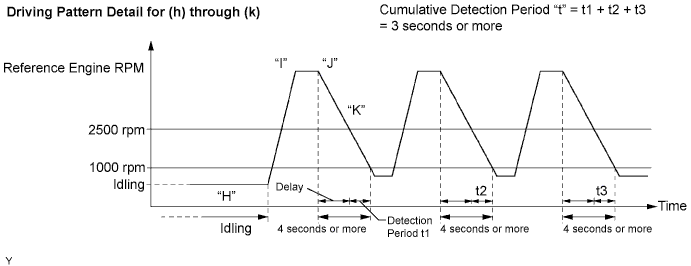
CONFIRMATION DRIVING PATTERN
This confirmation driving pattern is used in steps 3, 6 and 13 of the following diagnostic troubleshooting procedure when using the intelligent tester.
-
Connect the intelligent tester to the DLC3 (Procedure "A").
-
Turn the ignition switch on (IG) (Procedure "B").
-
Turn the tester on (Procedure "C").
-
Clear the DTCs (Click here) (Procedure "D").
-
Start the engine, and warm it up until the ECT reaches 70°C (158°F) or higher (Procedure "E").
-
Select the following menu items on the tester to check the fuel-cut status: Powertrain / Engine and ECT / Data List / Idle Fuel Cut (Procedure "F").
-
Drive the vehicle at between 60 km/h (38 mph) and 120 km/h (75 mph) for at least 10 minutes (Procedure "G").
-
Change the transmission to the 2nd gear (Procedure "H").
-
Drive the vehicle at a proper vehicle speed to perform fuel-cut operation (refer to the following HINT) (Procedure "I").
Tip:Fuel-cut is performed when the following conditions are met:
-
Accelerator pedal is fully released.
-
Engine speed is 2500 rpm or more (fuel injection resumes at 1000 rpm).
-
-
Accelerate the vehicle to 64 km/h (40 mph) or more by depressing the accelerator pedal for at least 10 seconds (Procedure "J").
-
Soon after performing procedure "J" , release the accelerator pedal for at least 4 seconds without depressing the brake pedal, in order to execute fuel-cut control (Procedure "K").
-
Allow the vehicle to decelerate until the vehicle speed declines to less than 10 km/h (6 mph) (Procedure "L").
-
Repeat procedures from "H" through "K" in this section at least 3 times per driving cycle (Procedure "M").
Tip:Completion of all air fuel ratio sensor monitors is required to change the value in TEST RESULT.
CAUTION:Strictly observe posted speed limits, traffic laws, and road conditions when performing these driving patterns.
INSPECTION PROCEDURE
Malfunctioning areas can be identified by performing the Control the Injection Volume for A/F sensor function provided in the Active Test. The Control the Injection Volume for A/F Sensor function can help to determine whether the air fuel ratio sensor, heated oxygen sensor and other potential trouble areas are malfunctioning.
-
The following instructions describe how to conduct the Control the Injection Volume for A/F Sensor operation using an intelligent tester.
-
-
Connect the intelligent tester to the DLC3.
-
Start the engine and turn the tester on.
-
Warm up the engine at an engine speed of 2500 rpm for approximately 90 seconds.
-
Select the following menu items on the tester: Powertrain / Engine and ECT / Active Test / Control the Injection Volume for A/F Sensor.
-
Perform the Control the Injection Volume for A/F Sensor operation with the engine in an idling condition (press the Right or Left button to change the fuel injection volume).
-
Monitor the voltage outputs of the air fuel ratio and heated oxygen sensors (AFS B1S1 and O2S B1S2 or AFS B2S1 and O2S B2S2) displayed on the tester.
Tip:
-
The Control the Injection Volume for A/F Sensor operation lowers the fuel injection volume by 12.5% or increases the injection volume by 25%.
-
Each sensor reacts in accordance with increases and decreases in the fuel injection volume.
Standard voltage Tester Display (Sensor) Injection Volume Status Voltage AFS B1S1 or AFS B2S1 (Air fuel ratio) +25% Rich Less than 3.0 AFS B1S1 or AFS B2S1 (Air fuel ratio) -12.5% Lean More than 3.35 O2S B1S2 or O2S B2S2 (Heated oxygen) +25% Rich More than 0.55 O2S B1S2 or O2S B2S2 (Heated oxygen) -12.5% Lean Less than 0.4 Note:The air fuel ratio sensor has an output delay of a few seconds and the heated oxygen sensor has a maximum output delay of approximately 20 seconds.
Case Air Fuel Ratio Sensor (Sensor 1)
Output Voltage
Heated Oxygen Sensor (Sensor 2)
Output Voltage
Main Suspected Trouble Area 1 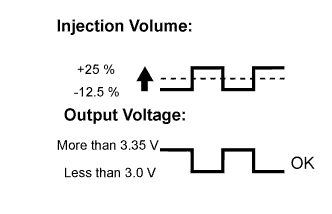
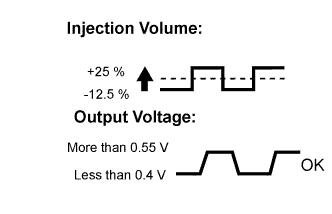
- 2 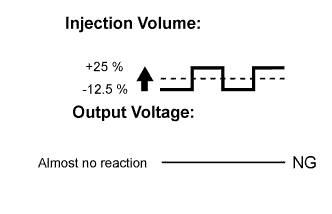
-
Air fuel ratio sensor
-
Air fuel ratio sensor heater
-
Air fuel ratio sensor circuit
3
-
Heated oxygen sensor
-
Heated oxygen sensor heater
-
Heated oxygen sensor circuit
4
-
Fuel pressure
-
Gas leakage from exhaust system
(Air fuel ratio extremely lean or rich)
-
-
-
-
Following the Control the Injection Volume for A/F Sensor procedure enables technicians to check and graph the voltage outputs of both the air fuel ratio and heated oxygen sensors.
-
The following air fuel ratio control procedure enables the technician to check and graph the voltage output of both the heated oxygen sensors. To display the graph, select the following menu items on the tester: View / Line Graph.
Tip:
-
Read freeze frame data using the intelligent tester. The ECM records vehicle and driving condition information as freeze frame data the moment a DTC is stored. When troubleshooting, freeze frame data can be helpful in determining whether the vehicle was running or stopped, whether the engine was warmed up or not, whether the air fuel ratio was lean or rich, as well as other data recorded at the time of a malfunction.
-
A low air fuel ratio sensor voltage could be caused by a rich air fuel mixture. Check for conditions that would cause the engine to run rich.
-
A high air fuel ratio sensor voltage could be caused by a lean air fuel mixture. Check for conditions that would cause the engine to run lean.
-
-
PROCEDURE
- Click here
CHECK ANY OTHER DTCS OUTPUT (IN ADDITION TO P2195, P2196, P2197 OR P2198)
-
Connect the intelligent tester to the DLC3.
-
Turn the ignition switch on (IG).
-
Turn the tester on.
-
Select the following menu items: Powertrain / Engine and ECT / DTC.
-
Read the DTCs.
Result Display (DTC Output) Proceed to P2195, P2196, P2197 or P2198 A P2195, P2196, P2197 or P2198 and other DTCs B Tip:If any DTCs other than P2195, P2196, P2197 or P2198 are output, troubleshoot those DTCs first.
-
- Click here
READ VALUE USING INTELLIGENT TESTER (OUTPUT VOLTAGE OF AIR FUEL RATIO SENSOR)
-
Connect the intelligent tester to the DLC3.
-
Start the engine.
-
Turn the tester on.
-
Warm up the air fuel ratio sensor at an engine speed of 2500 rpm for 90 seconds.
-
Select the following menu items on the tester: Powertrain / Engine and ECT / Data List / A/F Control System / AFS B1S1 or AFS B2S1 and Engine Speed.
-
Check the air fuel ratio sensor voltage 3 times, when the engine is in each of the following conditions:
-
While idling (check for at least 30 seconds) (Step (1))
-
At an engine speed of approximately 2500 rpm (without any sudden changes in engine speed) (Step (2))
-
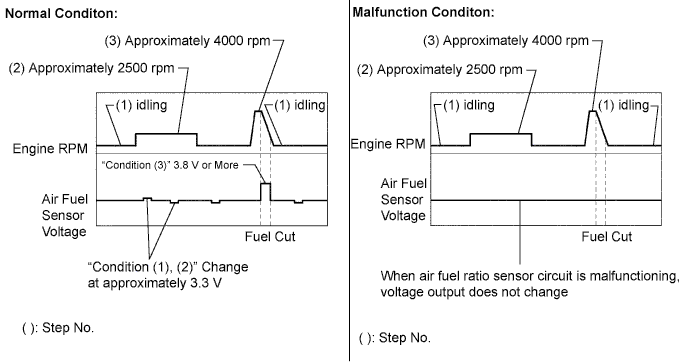
Raise the engine speed to 4000 rpm and then quickly release the accelerator pedal so that the throttle valve is fully closed (Step (3)).
Standard voltage Condition Air Fuel Ratio Sensor Voltage Variation Reference Steps (1) and (2) Changes at approximately 3.3 V Between 3.1 V and 3.5 V Step (3) Increases to 3.8 V or more This occurs during engine deceleration (when fuel-cut performed) Tip:For more information, see the diagrams below.
Tip:
-
If the output voltage of the air fuel ratio sensor remains at approximately 3.3 V (see Malfunction Condition diagram) under any conditions, including those described on the previous page, the air fuel ratio sensor may have an open circuit. (This will also happen if the air fuel ratio sensor heater has an open circuit.)
-
If the output voltage of the air fuel ratio sensor remains at either approximately 3.8 V or more, or 2.8 V or less (see Malfunction Condition diagram) under any conditions, including those described on the previous page, the air fuel ratio sensor may have a short circuit.
-
The ECM stops fuel injection (fuel cut) during engine deceleration. This causes a lean condition and results in a momentary increase in the air fuel ratio sensor output voltage.
-
The ECM must establish a closed throttle valve position learning value to perform fuel cut. If the battery terminal has been reconnected, the vehicle must be driven over 16 km/h (10 mph) to allow the ECM to learn the closed throttle valve position.
-
When the vehicle is driven:
The output voltage of the air fuel ratio sensor may be below 2.8 V during fuel enrichment. For the vehicle, this translates to a sudden increase in speed with the accelerator pedal fully depressed when trying to overtake another vehicle. The air fuel ratio sensor is functioning normally.
-
The air fuel ratio sensor is a current output element; therefore, the current is converted into a voltage inside the ECM. Measuring the voltage at the connectors of the air fuel ratio sensor or ECM will show a constant voltage result.
-
-
- OKClick here
- NGClick here
-
- Click here
PERFORM CONFIRMATION DRIVING PATTERN
- NEXTClick here
- Click here
CHECK WHETHER DTC OUTPUT RECURS (DTC P2195, P2196, P2197 OR P2198)
-
Connect the intelligent tester to the DLC3.
-
Turn the ignition switch on (IG) and turn the tester on.
-
Read the DTCs using the intelligent tester.
-
Select the following menu items: Powertrain / Engine and ECT / DTC.
Result Display (DTC Output) Proceed to No output A P2195, P2196, P2197 or P2198 (air fuel ratio sensor pending DTCs) B
-
- Click here
REPLACE AIR FUEL RATIO SENSOR
-
Replace the air fuel ratio sensor (Click here).
- NEXTClick here
-
- Click here
PERFORM CONFIRMATION DRIVING PATTERN
- NEXTClick here
- Click here
CHECK WHETHER DTC OUTPUT RECURS
-
Read the DTCs using the intelligent tester.
-
Select the following menu items: Powertrain / Engine and ECT / DTC.
Result Display (DTC Output) Proceed to No output A P2195, P2196, P2197 or P2198 B
-
- Click here
INSPECT AIR FUEL RATIO SENSOR (HEATER RESISTANCE)
-
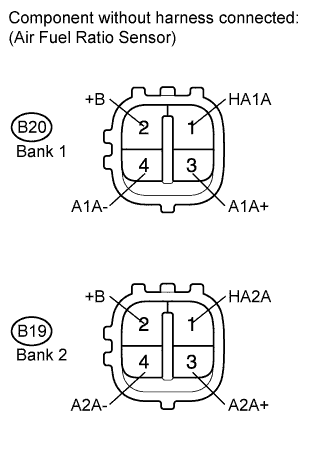
Disconnect the air fuel ratio sensor connector.
-
Measure the resistance according to the value(s) in the table below.
Standard resistance Bank 1 Tester Connection Condition Specified Condition 1 (HA1A) - 2 (+B) 20°C (68°F) 1.8 to 3.4 Ω 1 (HA1A) - 4 (A1A-) Always 10 kΩ or higher Bank 2 Tester Connection Condition Specified Condition 1 (HA2A) - 2 (+B) 20°C (68°F) 1.8 to 3.4 Ω 1 (HA2A) - 4 (A2A-) Always 10 kΩ or higher -
Reconnect the air fuel ratio sensor connector.
- OKClick here
- NGClick here
-
- Click here
CHECK HARNESS AND CONNECTOR (AIR FUEL RATIO SENSOR - ECM)
-
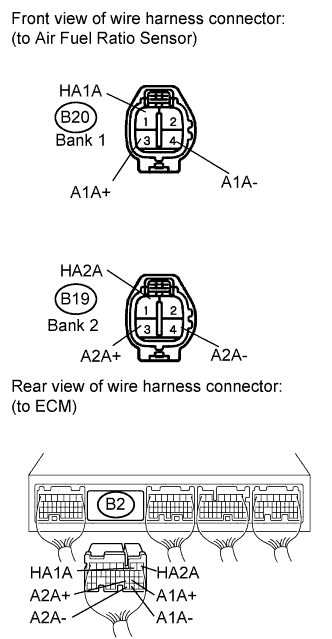
Disconnect the air fuel ratio sensor connector.
-
Disconnect the ECM connector.
-
Measure the resistance according to the value(s) in the table below.
Standard resistance (Check for open) Bank 1 Tester Connection Condition Specified Condition B20-1 (HA1A) - B2-2 (HA1A) Always Below 1 Ω B20-3 (A1A+) - B2-22 (A1A+) Always Below 1 Ω B20-4 (A1A-) - B2-30 (A1A-) Always Below 1 Ω Bank 2 Tester Connection Condition Specified Condition B19-1 (HA2A) - B2-1 (HA2A) Always Below 1 Ω B19-3 (A2A+) - B2-23 (A2A+) Always Below 1 Ω B19-4 (A2A-) - B2-31 (A2A-) Always Below 1 Ω Standard resistance (Check for short) Bank 1 Tester Connection Condition Specified Condition B20-1 (HA1A) or B2-2 (HA1A) - Body ground Always 10 kΩ or higher B20-3 (A1A+) or B2-22 (A1A+) - Body ground Always 10 kΩ or higher B20-4 (A1A-) or B2-30 (A1A-) - Body ground Always 10 kΩ or higher Bank 2 Tester Connection Condition Specified Condition B19-1 (HA2A) or B2-1 (HA2A) - Body ground Always 10 kΩ or higher B19-3 (A2A+) or B2-23 (A2A+) - Body ground Always 10 kΩ or higher B19-4 (A2A-) or B2-31 (A2A-) - Body ground Always 10 kΩ or higher -
Reconnect the ECM connector.
-
Reconnect the air fuel ratio sensor connector.
- OKClick here
- NGClick here
-
- Click here
CHECK AIR INDUCTION SYSTEM
-
Check the air induction system for vacuum leakage.
OK No leakage from air induction system.
- OKClick here
- NGClick here
-
- Click here
CHECK FUEL PRESSURE
-
Check the fuel pressure (Click here).
- OKClick here
- NGClick here
-
- Click here
REPLACE AIR FUEL RATIO SENSOR
-
Replace the air fuel ratio sensor (Click here).
- NEXTClick here
-
- Click here
PERFORM CONFIRMATION DRIVING PATTERN
- NEXTClick here
- Click here
CHECK WHETHER DTC OUTPUT RECURS (DTC P2195, P2196, P2197 OR P2198)
-
Read the DTCs using the intelligent tester.
-
Select the following menu items: Powertrain / Engine and ECT / DTC.
Result Display (DTC Output) Proceed to No output A P2195, P2196, P2197 or P2198 B
-
- Click here
CONFIRM WHETHER VEHICLE HAS RUN OUT OF FUEL IN PAST
-
Has the vehicle run out of fuel in the past?
- YESClick here
- NOClick here
-
- Click here
GO TO DTC CHARTClick here
- Click here
END
- Click here
REPLACE ECMClick here
- Click here
REPLACE AIR FUEL RATIO SENSORClick here
- Click here
REPAIR OR REPLACE HARNESS OR CONNECTOR
- Click here
REPAIR OR REPLACE AIR INDUCTION SYSTEM
- Click here
REPAIR OR REPLACE FUEL SYSTEM
- Click here
CHECK INTERMITTENT PROBLEMS
- Click here
DTC CAUSED BY RUNNING OUT OF FUEL