SFI SYSTEM, Diagnostic DTC:P2118
| DTC Code | DTC Name |
|---|---|
| P2118 | Throttle Actuator Control Motor Current Range / Performance |
DESCRIPTION
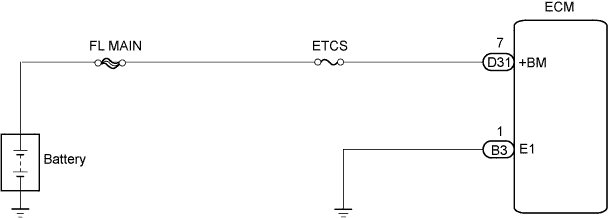
The electronic throttle control system has a dedicated power supply circuit. The voltage (+BM) is monitored and when it is low (less than 4 V), the ECM determines that there is a malfunction in the electronic throttle control system and cuts off the current to the throttle actuator.
When the voltage becomes unstable, the electronic throttle control system itself becomes unstable. For this reason, when the voltage is low, the current to the throttle actuator is cut. If repairs are made and the system returns to normal, turn the ignition switch off. The ECM then allows the current to flow to the throttle actuator so that it can be restarted.
Tech Tips
The electronic throttle control system does not use a throttle cable.
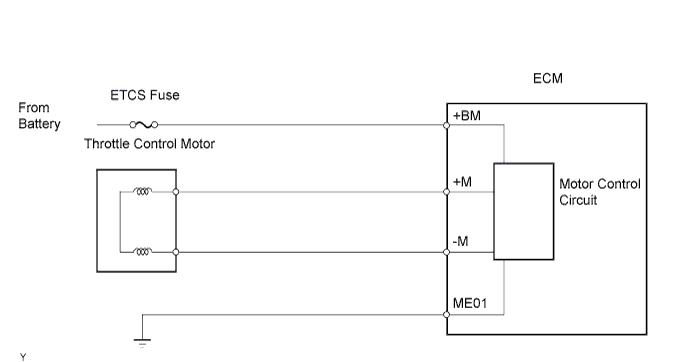
| DTC No. | DTC Detection Condition | Trouble Area |
|---|---|---|
| P2118 | Open in electronic throttle control system power source (+BM) circuit (1 trip detection logic) |
|
FAIL-SAFE
When this DTC, as well as other DTCs relating to electronic throttle control system malfunctions, is set, the ECM enters fail-safe mode. During fail-safe mode, the ECM cuts the current to the throttle actuator off, and the throttle valve is returned to a 6° throttle angle by the return spring. The ECM then adjusts the engine output by controlling the fuel injection (intermittent fuel-cut) and ignition timing, in accordance with the accelerator pedal opening angle, to allow the vehicle to continue at a minimal speed. If the accelerator pedal is depressed gently, the vehicle can be driven slowly.
Fail-safe mode continues until a pass condition is detected, and the ignition switch is then turned off.
WIRING DIAGRAM
INSPECTION PROCEDURE
Tech Tips
Read freeze frame data using the intelligent tester. The ECM records vehicle and driving condition information as freeze frame data the moment a DTC is stored. When troubleshooting, freeze frame data can be helpful in determining whether the vehicle was running or stopped, whether the engine was warmed up or not, whether the air fuel ratio was lean or rich, as well as other data recorded at the time of a malfunction.
PROCEDURE
-
CHECK FUSE (ETCS FUSE)
-
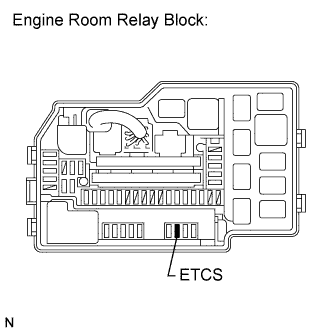
Remove the ETCS fuse from the engine room relay block.
-
Measure the resistance according to the value(s) in the table below.
Standard resistance Tester Connection Condition Specified Condition ETCS fuse Always Below 1 Ω -
Reinstall the ETCS fuse.
NG 
CHECK FOR SHORTS IN ALL HARNESSES AND CONNECTORS CONNECTED TO FUSE AND REPLACE FUSE (ETCS FUSE)
OK 
-
-
INSPECT ECM TERMINAL VOLTAGE (+BM TERMINAL)
-
Turn the ignition switch on (IG).
-
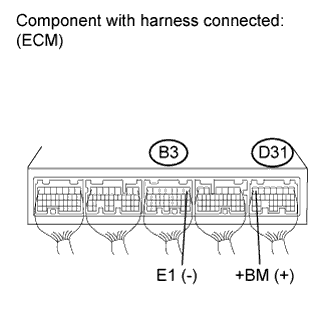
Measure the voltage according to the value(s) in the table below.
Standard voltage Tester Connection Switch Condition Specified Condition D31-7 (+BM) - B3-1 (E1) Ignition switch on (IG) 9 to 14 V
NG 
CHECK HARNESS AND CONNECTOR (ECM - ETCS FUSE, ETCS FUSE - BATTERY) Click here
OK 
REPLACE ECM Click here
-
-
CHECK HARNESS AND CONNECTOR (ECM - ETCS FUSE, ETCS FUSE - BATTERY)
-
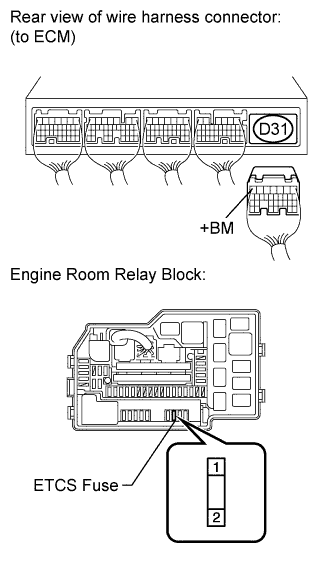
Remove the ETCS fuse from the engine room relay block.
-
Disconnect the ECM connector.
-
Measure the resistance according to the value(s) in the table below.
Standard resistance (Check for open) Tester Connection Condition Specified Condition ETCS fuse (2) - D31-7 (+BM) Always Below 1 Ω Standard resistance (Check for short) Tester Connection Condition Specified Condition ETCS fuse (2) or D31-7 (+BM) - Body ground Always 10 kΩ or higher -
Reconnect the ECM connector.
-
Reinstall the ETCS fuse.
NG
REPAIR OR REPLACE HARNESS OR CONNECTOR (ECM - ETCS FUSE)
OK
REPAIR OR REPLACE HARNESS OR CONNECTOR (ETCS FUSE - FL MAIN FUSE)
-