SFI SYSTEM TERMINALS OF ECM
-
SFI SYSTEM
Tech Tips
The standard normal voltage between each pair of the ECM terminals is shown in the table below. The appropriate conditions for checking each pair of the terminals are also indicated.
The check results should be compared with the standard normal voltage for that pair of terminals, listed in the "Specified Condition" column.
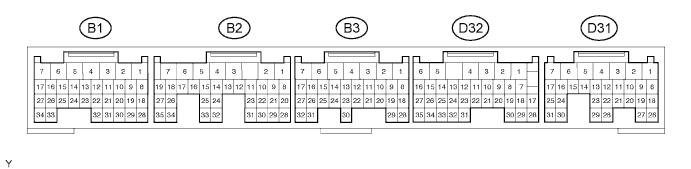
The illustration above can be used as a reference to identify the ECM terminal locations.
Terminal No. (Symbol) Wiring Color Terminal Description Condition Specified Condition D31-1 (+B) - B3-1 (E1) SB - W-B Power source of ECM Ignition switch on (IG) 9 to 14 V D31-2 (+B2) - B3-1 (E1) GR - W-B Power source of ECM Ignition switch on (IG) 9 to 14 V D31-3 (BATT) - B3-1 (E1) R - W-B Battery (for measuring the battery voltage and for the ECM memory) Always 9 to 14 V D31-7 (+BM) - B3-1 (E1) L - W-B Power source of ETCS throttle motor Always 9 to 14 V D31-8 (MREL) - B3-1 (E1) L - W-B EFI relay operation signal Ignition switch on (IG) 9 to 14 V D31-9 (IGSW) - B3-1 (E1) W - W-B Ignition switch signal Ignition switch on (IG) 9 to 14 V D31-10 (FC) - B3-1 (E1) P - W-B C/OPEN relay operation signal (fuel pump control) Ignition switch on (IG) 9 to 14 V D31-15 (STP) - B3-1 (E1) R - W-B Stop light switch signal Brake pedal depressed 7.5 to 14 V D31-15 (STP) - B3-1 (E1) R - W-B Stop light switch signal Brake pedal released Below 1.5 V D31-16 (ST1-) - B3-1 (E1) LG - W-B Stop light switch signal (opposite to STP terminal) Ignition switch on (IG), Brake pedal depressed Below 1.5 V D31-16 (ST1-) - B3-1 (E1) LG - W-B Stop light switch signal (opposite to STP terminal) Ignition switch on (IG), Brake pedal released 7.5 to 14 V D31-17 (ACCR)*2-B3-1 (E1)
O - W-B ACC relay control signal Cranking Below 1.5 V D31-18 (VPA) - D31-20 (EPA) R - SB Accelerator pedal position sensor signal (for engine control) Ignition switch on (IG), Accelerator pedal fully released 0.5 to 1.1 V D31-18 (VPA) - D31-20 (EPA) R - SB Accelerator pedal position sensor signal (for engine control) Ignition switch on (IG), Accelerator pedal fully depressed 2.6 to 4.5 V D31-19 (VPA2) - D31-21 (EPA2) GR - V Accelerator pedal position sensor signal (for sensor malfunction detection) Ignition switch on (IG), Accelerator pedal fully released 1.2 to 2.0 V D31-19 (VPA2) - D31-21 (EPA2) GR - V Accelerator pedal position sensor signal (for sensor malfunction detection) Ignition switch on (IG), Accelerator pedal fully depressed 3.4 to 5.0 V D31-23 (TC) - B3-1 (E1) L - W-B Terminal TC of DLC3 Ignition switch on (IG) 9 to 14 V D31-26 (VCPA) - D31-20 (EPA) SB - SB Power source of accelerator pedal position sensor (for VPA) Ignition switch on (IG) 4.5 to 5.0 V D31-27 (VCP2) - D31-21 (EPA2) LG - V Power source of accelerator pedal position sensor (for VPA2) Ignition switch on (IG) 4.5 to 5.0 V D32-1 (TACH) - B3-1 (E1) B - W-B Engine speed signal (for combination meter) Idling Pulse generation
(see waveform 11)
D32-8 (SPD) - B3-1 (E1) LG - W-B Vehicle speed signal from combination meter Ignition switch on (IG), driving wheel rotated slowly Pulse generation
(see waveform 8)
D32-30 (W) - B3-1 (E1) Y - W-B Malfunction Indicator Lamp (MIL) operation signal Ignition switch on (IG) Below 3.0 V D32-30 (W) - B3-1 (E1) Y - W-B Malfunction Indicator Lamp (MIL) operation signal Idling 9 to 14 V D32-33 (CANH) - B3-1 (E1) R - W-B CAN communication line Ignition switch on (IG) Pulse generation
(see waveform 12)
D32-34 (CANL) - B3-1 (E1) W - W-B CAN communication line Ignition switch on (IG) Pulse generation
(see waveform 13)
B3-1 (E1) - Body ground W-B Earth (ground) circuit of ECM Always Below 1 V B3-2 (#10) - B1-7 (E01)
B3-3 (#20) - B1-7 (E01)
B3-4 (#30) - B1-7 (E01)
B3-5 (#40) - B1-7 (E01)
B3-6 (#50) - B1-7 (E01)
B3-7 (#60) - B1-7 (E01)
L - W-B
Y - W-B
B - W-B
W - W-B
R - W-B
G - W-B
Fuel injector operation signal Ignition switch on (IG) 9 to 14 V B3-2 (#10) - B1-7 (E01)
B3-3 (#20) - B1-7 (E01)
B3-4 (#30) - B1-7 (E01)
B3-5 (#40) - B1-7 (E01)
B3-6 (#50) - B1-7 (E01)
B3-7 (#60) - B1-7 (E01)
L - W-B
Y - W-B
B - W-B
W - W-B
R - W-B
G - W-B
Fuel injector operation signal Idling Pulse generation
(see waveform 3)
B3-11 (STA) - B3-1 (E1) B - W-B Starter relay operation signal Cranking 9 to 14 V B3-12 (STSW)*2- B3-1 (E1)
P - W-B Starter relay operation signal Cranking 9 to 14 V B3-15 (OC2+) - B3-14 (OC2-) LG - P Camshaft timing oil control valve operation signal (Intake side) Ignition switch on (IG) Pulse generation
(see waveform 1)
B3-17 (OC1+) - B3-16 (OC1-) Y - L Camshaft timing oil control valve operation signal (Intake side) Ignition switch on (IG) Pulse generation
(see waveform 1)
B3-18 (VV2+) - B3-28 (VV2-) P - L Variable valve timing sensor signal (Intake side) Idling Pulse generation
(see waveform 5)
B3-19 (VV1+) - B3-29 (VV1-) G - R Variable valve timing sensor signal (Intake side) Idling Pulse generation
(see waveform 5)
B3-21 (NE+) - B3-20 (NE-) W - B Crankshaft position sensor signal Idling Pulse generation
(see waveform 5)
B3-23 (EV2+) - B3-22 (EV2-) L - R Variable valve timing sensor signal (Exhaust side) Idling Pulse generation
(see waveform 5)
B3-25 (EV1+) - B3-24 (EV1-) B - W Variable valve timing sensor signal (Exhaust side) Idling Pulse generation
(see waveform 5)
B3-26 (OE1+) - B3-31 (OE1-) G - R Camshaft timing oil control valve operation signal (Exhaust side) Ignition switch on (IG) Pulse generation
(see waveform 1)
B3-27 (OE2+) - B3-32 (OE2) P - W Camshaft timing oil control valve operation signal (Exhaust side) Ignition switch on (IG) Pulse generation
(see waveform 1)
B3-30 (FPR) - B3-1 (E1) G - W-B Fuel pump control Cranking 9 to 14 V B3-30 (FPR) - B3-1 (E1) G - W-B Fuel pump control Idling Below 3 V B1-1 (HT1B) - B3-1 (E1) R - W-B Heated oxygen sensor heater operation signal Idling Below 3.0 V B1-1 (HT1B) - B3-1 (E1) R - W-B Heated oxygen sensor heater operation signal Ignition switch on (IG) 9 to 14 V B1-3 (ACM) - B3-1 (E1) G - W-B VSV for active control mount system operation signal Ignition switch on (IG) 9 to 14 V B1-4 (M-) - B2-3 (ME01) L - W-B Throttle drive motor operation signal (negative terminal) Idling with warm engine Pulse generation
(see waveform 10)
B1-5 (M+) - B2-3 (ME01) R - W-B Throttle drive motor operation signal (positive terminal) Idling with warm engine Pluse generation
(see waveform 9)
B1-6 (E02) - Body ground W-B Earth (ground) circuit of ECM Always Below 1 V B1-7 (E01) - Body ground W-B Earth (ground) circuit of ECM Always Below 1 V B1-8 (IGT1) - B3-1 (E1)
B1-9 (IGT2) - B3-1 (E1)
B1-10 (IGT3) - B3-1 (E1)
B1-11 (IGT4) - B3-1 (E1)
B1-12 (IGT5) - B3-1 (E1)
B1-13 (IGT6) - B3-1 (E1)
Y - BR
P - BR
G - BR
L - BR
B - BR
BR - BR
Ignition coil with igniter (ignition signal) Idling Pulse generation
(see waveform 6)
B1-17 (GE01) - B3-1 (E1) DR-N - W-B Shielded earth (ground) circuit of throttle drive motor Always Below 1 V B1-18 (OX1B) - B1-28 (E2) B - BR Heated oxygen sensor signal With engine speed at 2500 rpm for 2 minutes after warming up Pulse generation
(see waveform 2)
B1-19 (VTA2) - B1-28 (E2) LG - BR Throttle position sensor signal (for sensor malfunction detection) Ignition switch on (IG), Accelerator pedal fully released 2.1 to 3.1 V B1-19 (VTA2) - B1-28 (E2) LG - BR Throttle position sensor signal (for sensor malfunction detection) Ignition switch on (IG), Accelerator pedal fully depressed 4.5 to 5.0 V B1-20 (VTA1) - B1-28 (E2) B - BR Throttle position sensor signal (for engine control) Ignition switch on (IG), Throttle valve fully closed 0.5 to 1.2 V B1-20 (VTA1) - B1-28 (E2) B - BR Throttle position sensor signal (for engine control) Ignition switch on (IG), Throttle valve fully open 3.2 to 4.8 V B1-21 (THW) - B1-28 (E2) W - BR Engine coolant temperature sensor signal Idling, Engine coolant temperature 80°C (176°F) 0.2 to 1.0 V B1-22 (THA) - B1-28 (E2) P - BR Intake air temperature sensor signal Idling, Intake air temperature 20°C (68°F) 0.5 to 3.4 V B1-23 (VC) - B1-28 (E2) R - BR Power source of sensors (specific voltage) Ignition switch on (IG) 4.5 to 5.0 V B1-24 (IGF1) - B3-1 (E1) W - W-B Ignition coil with igniter (ignition confirmation signal) Ignition switch on (IG) 4.5 to 5.0 V B1-24 (IGF1) - B3-1 (E1) W - W-B Ignition coil with igniter (ignition confirmation signal) Idling Pulse generation
(see waveform 6)
B1-27 (AICV) - B3-1 (E1) W - W-B VSV for Air intake control system operation signal Ignition switch on (IG) 9 to 14 V B1-28 (E2) - Body ground BR Earth (ground) circuit of sensors for ETCS Always Below 1 V B1-29 (E2G) - Body ground Y Earth (ground) circuit of sensor for mass air flow meter Always Below 1 V B1-30 (VG) - B1-29 (E2G) R - Y Mass air flow meter signal Idling, Shift lever position P or N, A/C switch OFF 0.5 to 3.0 V B1-33 (ACIS) - B3-1 (E1) L - W-B VSV for ACIS (Acoustic Control Induction System) operation signal Ignition switch on (IG) 9 to 14 V B1-34 (PRG) - B3-1 (E1) G - W-B Purge VSV for EVAP system operation signal Ignition switch on (IG) 9 to 14 V B1-34 (PRG) - B3-1 (E1) G - W-B Purge VSV for EVAP system operation signal Idling Pulse generation
(see waveform 7)
B2-1 (HA2A) - B2-6 (E05) B - W-B Air fuel ratio sensor heater operation signal Idling Below 3.0 V B2-1 (HA2A) - B2-6 (E05) B - W-B Air fuel ratio sensor heater operation signal Ignition switch on (IG) 9 to 14 V B2-2 (HA1A) - B2-7 (E04) L - W-B Air fuel ratio sensor heater operation signal Idling Below 3.0 V B2-2 (HA1A) - B2-7 (E04) L - W-B Air fuel ratio sensor heater operation signal Ignition switch on (IG) 9 to 14 V B2-3 (ME01) - Body ground W-B Earth (ground) circuit of ECM Always Below 1 V B2-4 (E03) - Body ground W-B Earth (ground) circuit of ECM Always Below 1 V B2-5 (HT2B) - B3-1 (E1) R - W-B Heated oxygen sensor heater operation signal Idling Below 3.0 V B2-5 (HT2B) - B3-1 (E1) R - W-B Heated oxygen sensor heater operation signal Ignition switch on (IG) 9 to 14 V B2-6 (E05) - Body ground W-B Earth (ground) circuit of ECM Always Below 1 V B2-7 (E04) - Body ground W-B Earth (ground) circuit of ECM Always Below 1 V B2-8 (STAR) - B3-1 (E1) GR - W-B Park/Neutral position switch signal Ignition switch on (IG), Shift lever position P or N Below 3.0 V B2-8 (STAR) - B3-1 (E1) GR - W-B Park/Neutral position switch signal Ignition switch on (IG), Shift lever position other than P or N 9 to 14 V B2-21 (KNK2) - B2-20 (EKN2) R - G Knock sensor signal With engine speed at 4000 rpm after warming up Pulse generation
(see waveform 4)
B2-22 (A1A+) - B3-1 (E1) BR - W-B Air fuel ratio sensor signal Ignition switch on (IG) 3.3 V*1
B2-23 (A2A+) - B3-1 (E1) P - W-B Air fuel ratio sensor signal Ignition switch on (IG) 3.3 V*1
B2-28 (EKNK) - B2-29 (KNK1) W - B Earth (ground) circuit of knock sensor With engine speed at 4000 rpm after warming up Pulse generation
(see waveform 4)
B2-29 (KNK1) - B2-28 (EKNK) B - W Knock sensor signal With engine speed at 4000 rpm after warming up Pulse generation
(see waveform 4)
B2-30 (A1A-) - B3-1 (E1) Y - W-B Air fuel ratio sensor Ignition switch on (IG) 3.0 V*1
B2-31 (A2A-) - B3-1 (E1) L - W-B Air fuel ratio sensor Ignition switch on (IG) 3.0 V*1
B2-33 (OX2B) - B1-28 (E2) B - BR Heated oxygen sensor signal With engine speed at 2500 rpm for 2 minutes after warming up Pulse generation
(see waveform 2)
*1: The ECM terminal voltage is constant regardless of the output voltage from the sensor.
*2: w/ Smart Entry and Start System
-
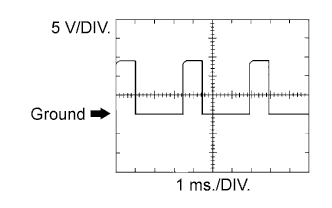
WAVEFORM 1
-
Camshaft timing oil control valve operation signal
ECM Terminal Name Between OC1+ and OC1- , OC2+ and OC2- , OE1+ and OE1- , or OE2+ and OE2- Tester Range 5 V/DIV., 1 ms./DIV. Condition Idling Tech Tips
The wavelength becomes shorter as the engine rpm increases.
-
-
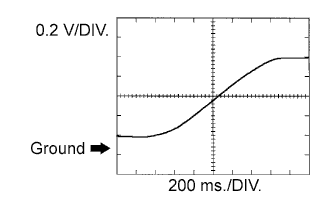
WAVEFORM 2
-
Heated oxygen sensor signal
ECM Terminal Name Between OX1B and E2, or OX2B and E2 Tester Range 0.2 V/DIV., 200 ms./DIV. Condition Engine speed is maintained at 2500 rpm for 2 minutes after sensor is warmed up Tech Tips
In the DATA LIST, item O2S B1S2 shows the ECM input values from the heated oxygen sensor.
-
-
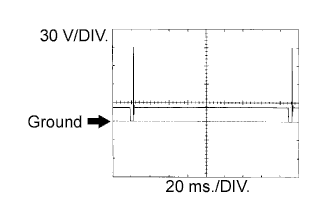
WAVEFORM 3
-
Fuel injector operation signal
ECM Terminal Name Between #10 (to 60) and E01 Tester Range 30 V/DIV., 20 ms./DIV. Condition Idling Tech Tips
The wavelength becomes shorter as the engine rpm increases.
-
-
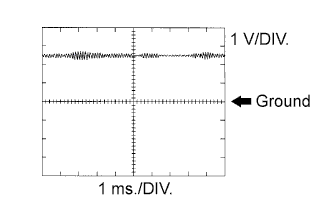
WAVEFORM 4
-
Knock sensor signal
ECM Terminal Name Between KNK1 and EKNK, or KNK2 and EKN2 Tester Range 0.01 to 10 V/DIV., 0.01 to 10 ms./DIV. Condition Engine speed is maintained at 4000 rpm after engine is warmed up Tech Tips
-
The wavelength becomes shorter as the engine rpm increases.
-
The waveforms and amplitudes displayed differ slightly depending on the vehicle.
-
-
-
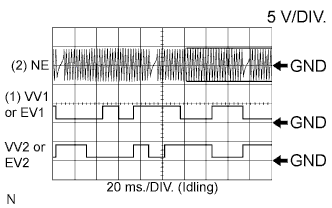
WAVEFORM 5
-
Variable valve timing sensor signal (1)
-
Crankshaft position sensor signal (2)
ECM Terminal Name (1) Between VV1+ and VV1- , VV2+ and VV2-, EV1+ and EV1-, or EV2+ and EV2-
(2) Between NE+ and NE-
Tester Range 5 V/DIV., 20 ms./DIV. Condition Idling Tech Tips
The wavelength becomes shorter as the engine rpm increases.
-
-
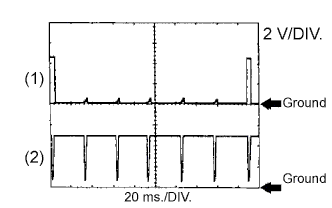
WAVEFORM 6
-
Igniter IGT signal (from ECM to igniter) (1)
-
Igniter IGF signal (from igniter to ECM) (2)
ECM Terminal Name (1) Between IGT (1 to 6) and E1
(2) Between IGF1 and E1
Tester Range 2 V/DIV., 20 ms./DIV. Condition Idling Tech Tips
The wavelength becomes shorter as the engine rpm increases.
-
-
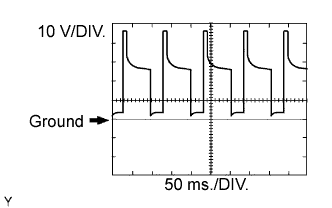
WAVEFORM 7
-
Purge VSV for EVAP system operation signal
ECM Terminal Name Between PRG and E1 Tester Range 10 V/DIV., 50 ms./DIV. Condition Idling Tech Tips
If the waveform is not similar to that shown in the illustration, check the waveform again after idling for 10 minutes or more.
-
-
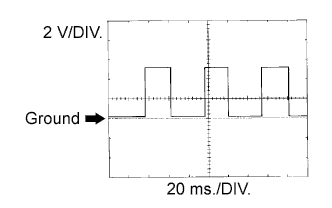
WAVEFORM 8
-
Vehicle speed signal
ECM Terminal Name Between SPD and E1 Tester Range 2 V/DIV., 20 ms./DIV. Condition Driving at 12 mph (20 km/h) Tech Tips
-
The wavelength becomes shorter as the vehicle speed increases.
-
Depending on the vehicle, the output waveform voltage may rise to 12 V if influenced by optionally installed systems.
-
-
-
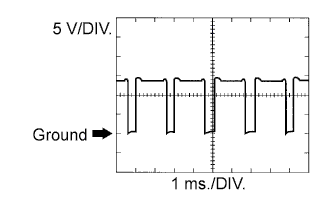
WAVEFORM 9
-
Throttle drive motor operation signal (positive terminal)
ECM Terminal Name Between M+ and ME01 Tester Range 5 V/DIV., 1 ms./DIV. Condition Idling with warm engine Tech Tips
The duty ratio varies depending on the throttle actuator operation.
-
-
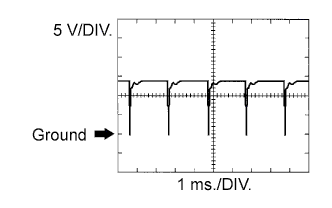
WAVEFORM 10
-
Throttle drive motor operation signal (negative terminal)
ECM Terminal Name Between M- and ME01 Tester Range 5 V/DIV., 1 ms./DIV. Condition Idling with warm engine Tech Tips
The duty ratio varies depending on the throttle actuator operation.
-
-
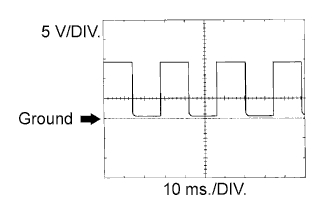
WAVEFORM 11
-
Engine speed signal
ECM Terminal Name Between TACH and E1 Tester Range 5 V/DIV., 10 ms./DIV. Condition Idling Tech Tips
The wavelength becomes shorter as the engine rpm increases.
-
-
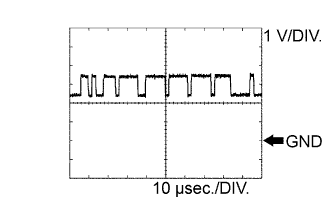
WAVEFORM 12
-
CAN communication signal
ECM Terminal Name Between CANH and E1 Tester Range 1 V/DIV., 10 μsec./DIV. Condition Engine stops and ignition switch on (IG) Tech Tips
The waveform varies depending on the CAN communication signal.
-
-
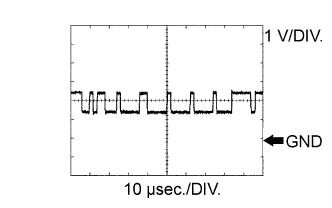
WAVEFORM 13
-
CAN communication signal
ECM Terminal Name Between CANL and E1 Tester Range 1 V/DIV., 10 μsec./DIV. Condition Engine stops and ignition switch on (IG) Tech Tips
The waveform varies depending on the CAN communication signal.
-
-