REAR BRAKE INSPECTION
-
INSPECT BRAKE CYLINDER AND PISTON
-
Inspect the cylinder bore and the piston for rust or scoring. If necessary, replace the rear disc brake cylinder assembly and piston.
-
-
INSPECT PAD LINING THICKNESS
-
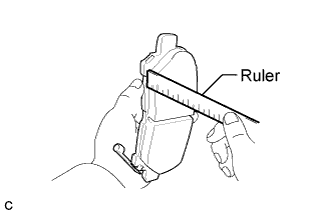
Using a ruler, measure the pad lining thickness.
Standard thickness 10.0 mm (0.394 in.) Minimum thickness 1.0 mm (0.039 in.) If the pad lining thickness is less than the minimum, replace the brake pads.
Tech Tips
Be sure to check wear of the rear disc after replacing the brake pads with new ones.
-
-
INSPECT NO. 1 REAR DISC BRAKE PAD SUPPORT PLATE
-
Inspect the No. 1 rear disc brake pad support plate. If necessary, replace the No. 1 rear disc brake pad support plate.
Tech Tips
Make sure that it has sufficient rebound, and has no deformation, cracks or wear, and all rust and dirt are cleaned off.
-
-
INSPECT NO. 2 REAR DISC BRAKE PAD SUPPORT PLATE
Tech Tips
Inspect the No. 2 rear disc brake pad support plate using the same procedure with the No. 1 rear disc brake pad support plate. If necessary, replace the No. 2 rear disc brake pad support plate.
-
INSPECT DISC THICKNESS
-
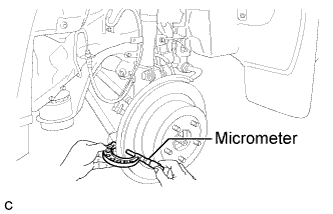
Using a micrometer, measure the disc thickness.
Standard thickness 10.0 mm (0.390 in.) Minimum thickness 8.5 mm (0.334 in.) If the disc thickness is less than the minimum, replace the rear disc.
-
-
INSPECT DISC RUNOUT
-
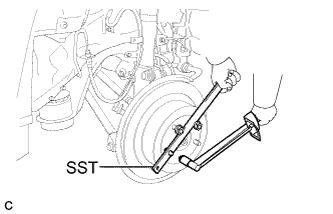
Using SST to hold the rear disc, tighten the rear disc with the 3 nuts.
- SST
- 09330-00021
- Torque:
- 103 N*m { 1050 kgf*cm, 76 ft.*lbf }
-
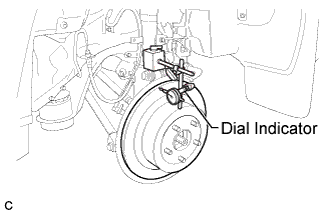
Using a dial indicator, measure the disc runout 10 mm (0.39 in.) away from the outer edge of the rear disc.
Maximum disc runout 0.15 mm (0.0059 in.) Note
-
Keep the magnet of the dial indicator away from the axle hub and speed sensor.
-
Install the dial indicator to the shock absorber.
Tech Tips
If the runout exceeds the maximum value, change the installation position of the disc on the rear axle hub to minimize runout. If the runout exceeds the maximum even after the installation position is changed, check the bearing play in the axial direction and the axle hub runout (for 2WD: Click here, for 4WD: Click here. If the bearing play and the axle hub runout are normal and if the disc thickness is not within the specified range, grind the disc. If the disc thickness is less than the minimum, replace the disc.
-
-
Remove the 3 hub nuts and the rear disc.
-