HEADLIGHT ASSEMBLY (for Halogen Headlight) INSTALLATION

-
INSTALL HEADLIGHT ASSEMBLY (Body Type Wide)
-
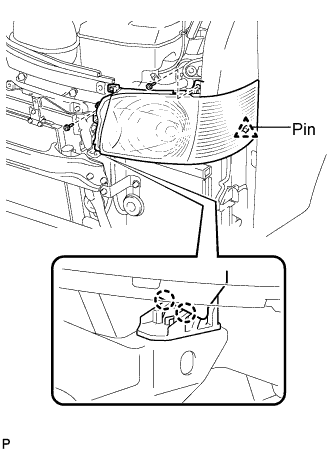
Connect each connector.
-
Engage the 2 claws.
-
Install the headlight assembly with the 2 screws and the pin.
-
-
INSTALL HEADLIGHT ASSEMBLY (Body Type Narrow)
-
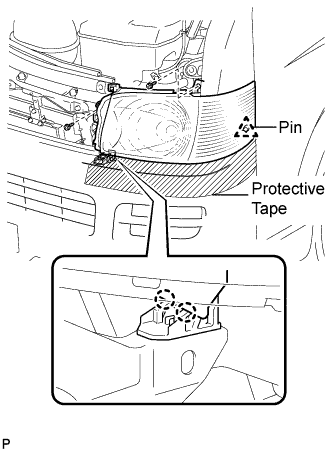
Attach protective tape to the position shown in the illustration.
-
Connect each connector.
-
Engage the 2 claws.
-
Install the headlight assembly with the 2 screws and the pin.
-
-
INSTALL FRONT BUMPER SIDE SUPPORT (Body Type Wide)
-
INSTALL FRONT BUMPER ASSEMBLY (Body Type Wide)
-
INSTALL STEP PLATE COVER LH (Body Type Wide)
-
INSTALL STEP PLATE COVER RH (Body Type Wide)
-
INSTALL RADIATOR GRILLE
-
VEHICLE PREPARATION FOR HEADLIGHT AIM ADJUSTMENT
-
Prepare the vehicle:
-
Ensure that there is no damage or deformation to the body around the headlights.
-
Fill the fuel tank.
-
Make sure that the oil is filled to the specified level.
-
Make sure that the coolant is filled to the specified level.
-
Inflate the tires to the appropriate pressure.
-
Place the spare tire, tools, and jack in their original positions.
-
Unload the trunk.
-
Sit a person of average weight (75 kg, 165 lb) in the driver's seat.
-
-
-
PREPARATION FOR HEADLIGHT AIMING (Using a screen)
-
Prepare the vehicle according to the following conditions:
-
Place the vehicle in a location that is dark enough to clearly observe the cutoff line. The cutoff line is a distinct line, below which light from the headlights can be observed and above which it cannot.
-
Place the vehicle at a 90° angle to the wall.
-
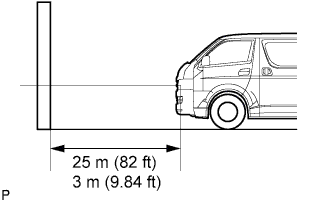
Create a 25 m (82 ft) distance between the vehicle (headlight bulb center) and the wall.
-
Place the vehicle on a level surface.
-
Bounce the vehicle up and down to settle the suspension.
Note
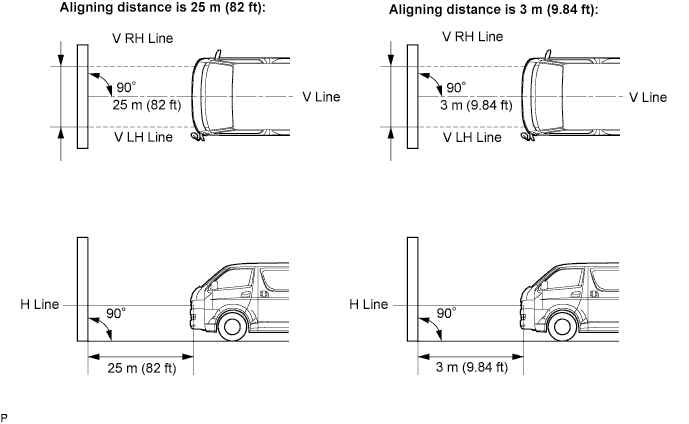
A distance of 25 m (82 ft) between the vehicle (headlight bulb center) and the wall is necessary for proper aim adjustment. If unavailable, secure a distance of exactly 3 m (9.84 ft) for check and adjustment. (The target zone will change with the distance so follow the instructions in the illustration.)
-
-
Prepare a piece of thick white paper (approximately 2 m (6.6 ft) (height) x 4 m (13.1 ft) (width)) to use as a screen.
-
Draw a vertical line down the center of the screen (V line).
-
Set the screen as shown in the illustration.
Tech Tips
-
Stand the screen perpendicular to the ground.
-
Align the V line on the screen with the center of the vehicle.
-
-
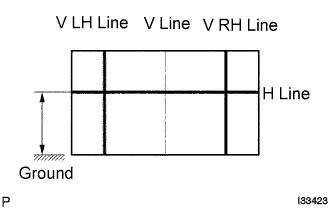
Draw base lines (H line, V LH, V RH lines) on the screen as shown in the illustration.
Tech Tips
-
The base lines differ for "low-beam inspection" and "high-beam inspection".
-
Make the headlight bulb center marks on the screen. If the center mark cannot be observed on the headlight, use the center of the headlight bulb or the manufacturer's name marked on the headlight as the center mark.
-
H Line (Headlight height):
-
Draw a horizontal line across the screen so that it passes through the center marks. The H line should be at the same height as the headlight bulb center marks of the low-beam headlights.
-
-
V LH Line, V RH Line (Center mark position of left-hand (LH) and right-hand (RH) headlights):
-
Draw two vertical lines so that they intersect the H line at each center mark (aligned with the center of the low-beam headlight bulbs).
-
-
-
-
HEADLIGHT AIMING INSPECTION
-
Cover or disconnect the connector of the headlight on the opposite side to prevent light from the headlight not being inspected from affecting headlight aiming inspection.
Note
Do not keep the headlight covered for more than 3 minutes. The headlight lens is made of synthetic resin, and may easily melt or be damaged due to heat.
Tech Tips
When checking the aim of the high-beam, cover the low-beam or disconnect the connector.
-
Start the engine.
Note
Engine rpm must be 1,500 or more.
-
With headlight leveling switch:
-
Set the headlight leveling switch to 0 (zero).
-
-
Turn on the headlight and make sure that the cutoff line falls within the specified area, as shown in the illustration.
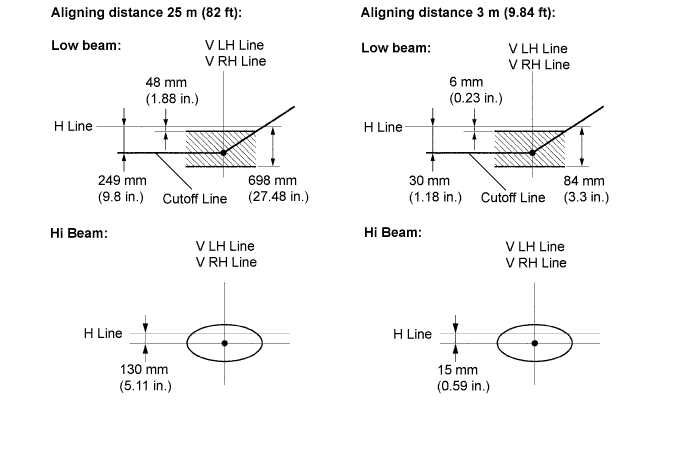
Tech Tips
-
Alignment distance is 25 m (82 ft):
-
The cutoff line is 48 mm (1.88 in.) to 698 mm (27.48 in.) below the H line on low-beams (ECE Reg.48).
-
Alignment distance is 3 m (9.84 ft):
-
The cutoff line is 6 mm (0.23 in.) to 84 mm (3.3 in.) below the H line on low-beams (ECE Reg.48).
-
Alignment distance is 25 m (82 ft):
-
The cutoff line is 249 mm (9.8 in.) below the H line on low-beams.
-
Alignment distance is 3 m (9.84 ft):
-
The cutoff line is 30 mm (1.18 in.) below the H line on low-beams.
-
Since the low-beam light and the high-beam light are a unit, if the aim on one is correct, the other should also be correct. However, check both beams just to make sure.
-
-
-
HEADLIGHT AIMING ADJUSTMENT
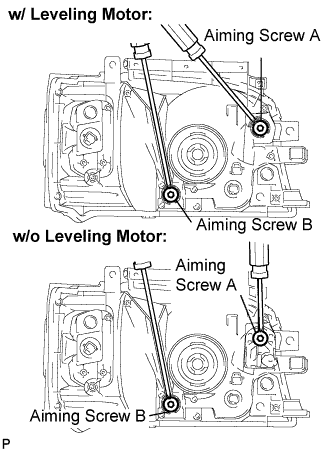
-
Adjust the aim vertically:
-
Adjust the headlight aim into the specified range by turning aiming screw A with a screwdriver.
Note
The final turn of the aiming screw should be made in the clockwise direction. If the screw is tightened excessively, loosen it and then retighten it, so that the final turn of the screw is in the clockwise direction.
Tech Tips
-
Perform low-beam aim adjustment.
-
The headlight aim moves up when turning the aiming screw clockwise, and moves down when turning the aiming screw counterclockwise.
-
-
Adjust the aim horizontally:
-
Adjust the headlight aim into the specified range by turning aiming screw B with a screwdriver.
Note
The final turn of the aiming screw should be made in the clockwise direction. If the screw is tightened excessively, loosen it and then retighten it, so that the final turn of the screw is in the clockwise direction.
Tech Tips
Perform low-beam aim adjustment.
-
-
-
VEHICLE PREPARATION FOR FOG LIGHT AIM ADJUSTMENT
-
Prepare the vehicle:
-
Ensure that there is no damage or deformation to the body around the fog light.
-
Fill the fuel tank.
-
Make sure that the oil is filled to the specified level.
-
Make sure that the coolant is filled to the specified level.
-
Inflate the tires to the appropriate pressure.
-
Place the spare tire, tools, and jack in their original positions.
-
Unload the trunk.
-
Sit a person of average weight (75 kg, 165 lb) in the drivers seat.
-
-
-
PREPARATION FOR FOG LIGHT AIMING
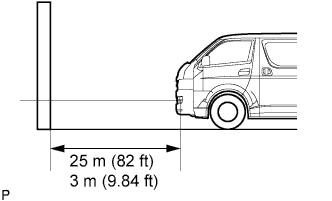
-
Prepare the vehicle according to the following conditions:
-
Place the vehicle in a location that is dark enough to clearly observe the cutoff line. The cutoff line is a distinct line, below which light from the fog light can be observed and above which it cannot.
-
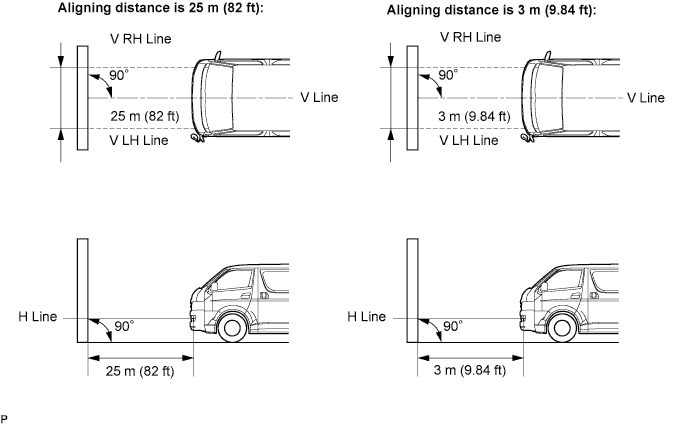
Place the vehicle at a 90° angle to the wall.
-
Create a 25 m (82 ft) distance between the vehicle (fog light bulb center) and the wall.
-
Place the vehicle on a level surface.
-
Bounce the vehicle up and down to settle the suspension.
Note
A distance of 25 m (82 ft) between the vehicle (fog light bulb center) and the wall is necessary for proper aim adjustment. If unavailable to secure a distance of exactly 3 m (9.84 ft) to check and adjustment. (The target zone will change with the distance, follow the instructions in the illustration.)
-
-
Prepare a piece of thick white paper (approximately 2 m (6.6 ft) (height) x 4 m (13.1 ft) (width)) to use as a screen.
-
Draw a vertical line down the center of the screen (V line).
-
Set the screen as shown in the illustration.
Tech Tips
-
Stand the screen perpendicular to the ground.
-
Align the V line on the screen with the center of the vehicle.
-
-
Draw base lines (H line, V LH, V RH lines) on the screen as shown in the illustration.
Tech Tips
Make the fog light bulb center marks on the screen. If the center mark cannot be observed on the fog light, use the center of the fog light bulb or the manufacturer's name marked on the fog light as the center mark.
-
H Line (Fog light height):
-
Draw a horizontal line across the screen so that it passes through the center marks. The H line should be at the same height as the fog light bulb center marks of the low-beam fog lights.
-
-
V LH Line, V RH Line (Center mark position of left-hand (LH) and right-hand (RH) fog lights):
-
Draw two vertical lines so that they intersect the H line at each center mark.
-
-
-
-
FOG LIGHT AIMING INSPECTION
-
Cover or disconnect the connector of the fog light on the opposite side to prevent light from the fog light not being inspected from affecting fog light aiming inspection.
-
Start the engine.
Note
Engine rpm must be 1,500 or more.
-
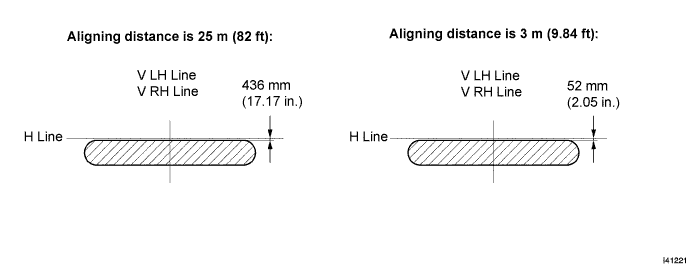
Turn on the fog light and make sure that the cutoff line falls within the specified area, as shown in the illustration.
-
-
FOG LIGHT AIMING ADJUSTMENT
-
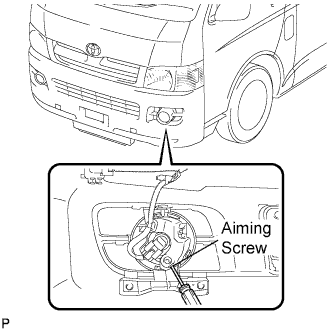
Adjust the fog light aim into the specified range by turning the aiming screw with a screwdriver.
Note
The final turn of the aiming screw should be made in the clockwise direction. If the screw is tightened excessively, loosen it and then retighten it, so that the final turn of the screw is in the clockwise direction.
-