REAR HEATER ASSEMBLY INSTALLATION

-
INSTALL REAR HEATER ASSEMBLY
-
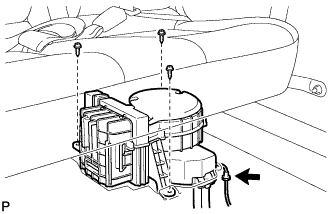
Install the rear heater assembly with the 3 screws.
Note
Tighten the screws in the order shown in the illustration to install the rear heater assembly.
-
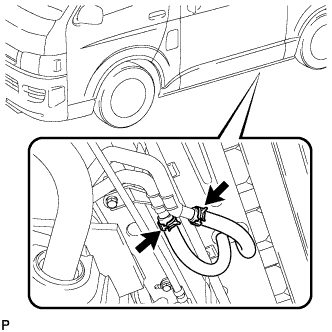
Install the 2 water hoses with the 2 clips.
-
-
ADD ENGINE COOLANT (2TR-FE)
-
Firmly tighten the drain plugs and fill the reservoir tank with coolant to the top of the inlet.
-
Remove the 2-way that is located near the throttle body.
-
When air is bled and the coolant drains out, firmly install the 2-way.
-
Add coolant up to the B line mark in the reservoir tank and install the radiator cap.
Coolant Capacity Condition Capacity w/ front and rear heaters 13.6 liters (14.4 US qts, 12.0 lmp. qts) w/ front heater 11.6 liters (12.3 US qts, 10.2 lmp. qts) w/o heater 10.6 liters (11.2 US qts, 9.3 lmp. qts) -
Warm up the engine.
-
After the engine cools down, check that the coolant level is between the LOW and FULL level marks.
-
-
ADD ENGINE COOLANT (2KD-FTV)
-
Firmly tighten the drain plugs and fill the radiator reserve tank assembly with coolant to the top of the inlet.
-
Loosen the bleeder plug of outlet housing.
-
When air is bled and the coolant drains out, firmly install the bleeder plug.
-
Add coolant up to the B line mark in the radiator reserve tank assembly and install the radiator cap.
Coolant capacity Condition Capacity w/ rear heater 17.0 liters (18.0 US qts, 15.0 imp. qts) w/o rear heater 15.0 liters (15.9 US qts, 13.2 imp. qts) -
Warm up the engine.
-
After the engine cools down check that the coolant level is between the LOW and FULL level marks.
-
-
ADD ENGINE COOLANT (5L-E)
-
Close the engine drain plug.
- Torque:
- 57 N*m { 581 kgf*cm, 42 ft.*lbf }
-
Close the radiator drain cock plug.
-
Slowly fill the cooling system with coolant.
Tech Tips
The coolant level inside the radiator should be abserved after pressing the radiator hose inlet and radiator hose outlet by hand..
-
Slowly pour coolant into the radiator reserve tank until it reaches the FULL line.
-
Install the radiator cap to the radiator reserve tank.
-
Press the inlet and outlet radiator hoses several times by hand while warming up the engine.
-
Stop the engine, and wait until the engine coolant cools down.
-
Add coolant to the FULL line of the radiator reservoir.
-
-
CHECK FOR ENGINE COOLANT LEAKS (2TR-FE)
CAUTION:
Do not remove the radiator cap while the engine and radiator are still hot. Pressurized, hot engine coolant and steam may be released and cause serious burns.
-
Fill the radiator with coolant and attach a radiator cap tester to the radiator.
-
Warm up the engine.
-
Using a radiator cap tester, increase the pressure inside the radiator to 137 kPa (1.4 kgf/cm2, 19.9 psi), and check that the pressure does not drop.
Tech Tips
If the pressure drops, check the hoses, radiator or water pump for leaks. If no external leaks are found, check the heater core, cylinder block and cylinder head.
-
-
CHECK FOR ENGINE COOLANT LEAKS (2KD-FTV)
CAUTION:
Do not remove the radiator cap while the engine and radiator are still hot. Pressurized, hot engine coolant and steam may be released and cause serious burns.
-
Fill the radiator with coolant and attach a radiator cap tester to the radiator.
-
Warm up the engine.
-
Using a radiator cap tester, increase the pressure inside the radiator to 137 kPa (1.4 kgf/cm2, 19.9 psi), and check that the pressure does not drop.
Tech Tips
If the pressure drops, check the hoses, radiator or water pump for leaks. If no external leaks are found, check the heater core, cylinder block and cylinder head.
-
-
CHECK FOR ENGINE COOLANT LEAKS (5L-E)
CAUTION:
Do not remove the radiator cap while the engine and radiator are still hot. Pressurized, hot engine coolant and steam may be released and cause serious burns.
-
Fill the radiator with coolant and attach a radiator cap tester to the radiator.
-
Warm up the engine.
-
Using a radiator cap tester, increase the pressure inside the radiator to 118 kPa (1.2 kgf/cm2, 17.1 psi), and check that the pressure does not drop.
Tech Tips
If the pressure drops, check the hoses, radiator or water pump for leaks. If no external leaks are found, check the heater core, cylinder block, and cylinder head.
-