EMISSION CONTROL SYSTEM ON-VEHICLE INSPECTION

-
VISUALLY CHECK HOSES, CONNECTIONS AND GASKETS
-
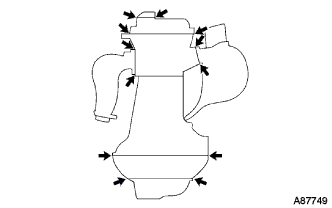
Check that there are no cracks, leaks or damage.
Note
-
Detachment or other problems with the engine oil dipstick, filler cap, PCV hose and other components may cause the engine to run improperly.
-
Air suction caused by disconnections, looseness or cracks in the parts of the air induction system between the throttle body and cylinder head will cause engine failure or engine malfunctions.
If any defects are found, replace the parts as necessary.
-
-
-
INSPECT DUTY VACUUM SWITCHING VALVE (EVAP VSV)
-
Check if the vacuum hose is connected correctly.
-
Disconnect the vacuum hose from the charcoal canister, and connect a vacuum gauge.
-
Using the flowchart below, perform an EVAP VSV operation inspection when the engine coolant temperature is 55°C (131°F) or less (while the engine is cold (VSV is closed)).
Tech Tips
The ECM turns the VSV off so that the route between the charcoal canister and intake manifold is closed, and fuel vapor in the canister is not purged to the intake manifold.
-
EVAP VSV operation flowchart.
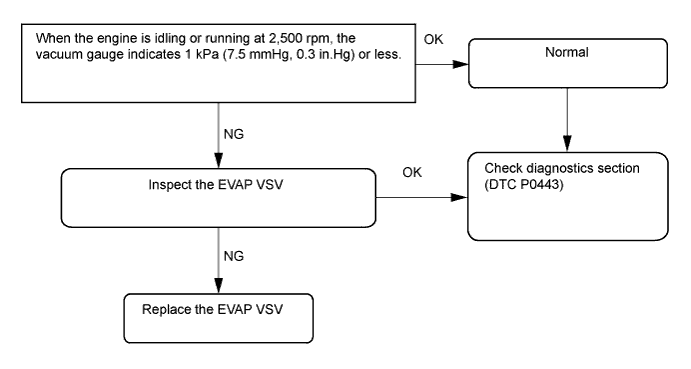
-
-
Using the flowchart below, perform an EVAP VSV operation inspection when the engine coolant temperature is 80°C (176°F) or more (while the engine is hot (VSV is opened)).
Tech Tips
The ECM turns the VSV on so that a vacuum is created in the intake manifold and the charcoal canister's fuel vapor is purged to the intake manifold.
-
EVAP VSV operation flowchart.
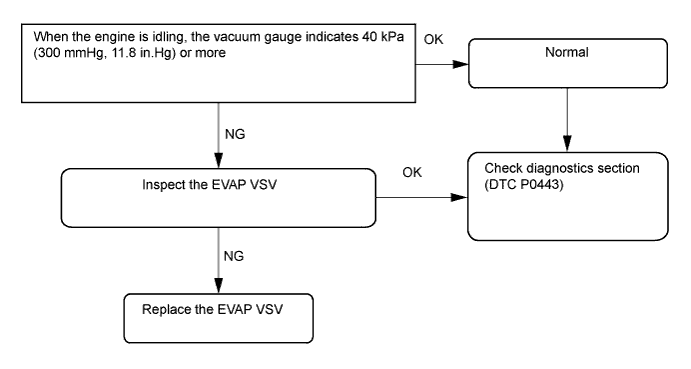
-
-