INTAKE SYSTEM ON-VEHICLE INSPECTION

-
CHECK INTAKE MANIFOLD (w/o DPF)
-
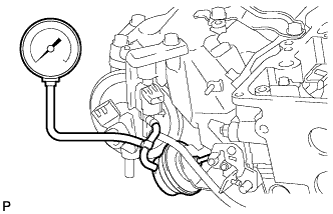
Using a 3-way connector, connect a vacuum gauge between the control valve and VSV.
-
Warm up the engine.
-
Measure the vacuum.
Standard Vacuum Engine Condition VSV Condition Specified Condition Idling ON Approx. 35 kPa (263 mmHg, 10.3 in.Hg) 3000 rpm or higher OFF 0 kPa (0 mmHg, 0 in.Hg)
-
-
CHECK INTAKE AIR CONTROL SYSTEM
-
Check for leakage or clogging between the air cleaner housing and turbocharger inlet, and between the turbocharger outlet and cylinder head.
Condition Operation Clogged air cleaner Clean or replace Collapsed or deformed hoses Repair or replace Leakage from connections Check each connection and repair Cracks in components Check and replace
-
-
CHECK EXHAUST SYSTEM
-
Check for leakage or clogging between the cylinder head and turbocharger inlet, and between the turbocharger outlet and exhaust pipe.
Condition Operation Deformed components Repair or replace Foreign matter in passages Remove Leakage from components Repair or replace Cracks in components Check and replace
-
-
CHECK BOOST PRESSURE
-
Connect the intelligent tester to the DLC3.
-
Start the engine and turn the tester on.
-
Warm up the engine.
Tech Tips
Be sure to perform the inspection when the engine coolant temperature is between 75 to 90°C (167 to 194°F).
-
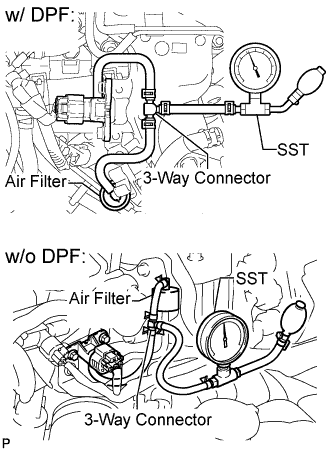
Using a 3-way connector, connect SST (turbocharger pressure gauge) between the diesel turbo pressure sensor (manifold absolute pressure sensor) and the gas filter.
- SST
- 09992-00242
-
Fully apply the parking brake and chock the 4 wheels.
-
w/ DPF:
-
for Manual Transmission:
While depressing the clutch pedal, fully depress the accelerator pedal. Measure the boost pressure at maximum engine speed (approximately 4600 rpm).
Standard Pressure (Gauge Pressure) 5 to 35 kPa (0.05 to 0.35 kgf/cm2, 0.72 to 5.0 psi) -
for Automatic Transmission:
Move the shift lever to P or N, and then fully depress the accelerator pedal. Measure the boost pressure at maximum engine speed (approximately 4600 rpm).
Standard Pressure (Gauge Pressure) 5 to 35 kPa (0.05 to 0.35 kgf/cm2, 0.72 to 5.0 psi) If the pressure is lower than the standard, the following problems may be present.
-
The intake system or exhaust system has leakage or blockage.
-
The turbocharger sub-assembly is malfunctioning.
-
The EGR valve does not close.
-
The diesel throttle body does not open.
-
The vacuum hose connected to the diesel turbo pressure sensor (manifold absolute pressure sensor) is cracked or disconnected.
-
The mass air flow meter is malfunctioning.
-
A fuel injector is malfunctioning.
If the pressure is higher than the standard, check the turbocharger and/or boost control components (pressure sensor, vacuum hose, wire harness, etc.).
-
-
-
w/o DPF:
-
for Manual Transmission:
While depressing the clutch pedal, fully depress the accelerator pedal. Measure the boost pressure at maximum engine speed (approximately 4450 rpm).
Standard Pressure (Gauge Pressure) 10 to 40 kPa (0.10 to 0.41 kgf/cm2, 1.4 to 5.8 psi) -
for Automatic Transmission:
Move the shift lever to P or N, and then fully depress the accelerator pedal. Measure the boost pressure at maximum engine speed (approximately 4450 rpm).
Standard Pressure (Gauge Pressure) 10 to 40 kPa (0.10 to 0.41 kgf/cm2, 1.4 to 5.8 psi) If the pressure is lower than the standard, the following problems may be present.
-
The intake system or exhaust system has leakage or blockage.
-
The turbocharger sub-assembly or turbo motor driver is malfunctioning.
-
The EGR valve does not close.
-
The diesel throttle body does not open.
-
The vacuum hose connected to the diesel turbo pressure sensor (manifold absolute pressure sensor) is cracked or disconnected.
-
The mass air flow meter is malfunctioning.
-
A fuel injector is malfunctioning.
If the pressure is higher than the standard, check the turbocharger and/or boost control components (turbo motor driver, pressure sensor, vacuum hose, wire harness, etc.).
-
-
-
Chart showing the suspected trouble areas when the pressure is lower than the standard.
Tech Tips
-
○: If a problem listed in the leftmost column of the chart exists, or if a part in the leftmost column of the chart has a malfunction, the value of the Data List item in the uppermost row of the chart will meet the conditions shown in the row labeled "Value which represents a malfunction".
-
The values in the chart are applicable when the engine coolant temperature is between 75 to 90°C (167 to 194°F).
-
The values in the chart are for vehicles equipped with a manual transmission. For vehicles with an automatic transmission, use these values as a reference only as they may differ from the actual values.
-
The values in the chart are valid in areas with an absolute atmospheric pressure higher than 95 kPa. Standard atmospheric pressure is 101 kPa. Atmospheric pressure decreases by 1 kPa for every 100 m increase in altitude, and is also affected by the current weather conditions.
-
When the altitude increases, atmospheric pressure and MAP decrease.
Item MAP
(Absolute pressure inside intake manifold)
MAF
(Intake air flow rate)
Accel Position Actual Throttle Position Actual EGR Valve Position EGR Close Lrn. Status
(EGR valve fully closed position learning status)
Fuel Pressure Injection Feedback Val #1 (to #4) Values taken from an actual normal vehicle
*1
- 115 to 150 g/sec. 99% or more 0% 0% OK - -3 to +3 mm3/st
Values which represent a malfunction
*1
None MAF is less than 115 g/sec. Accel Position is not fully depressed position
*2
Actual Throttle Position is not fully open position Actual EGR Valve Position is not 0% NG
(Determined after performing learning)
Fuel Pressure is below Target Common Rail Pressure by 10 MPa or more (Check while condition steady) Outside of above range Turbocharger ○ ○ - - - - - - EGR valve does not close or has problem with movement ○ ○ - - ○
(Problem with EGR valve movement)
*3
○
(EGR valve does not close)
*3
- - Problem with diesel throttle movement ○
(Intake airflow decreases)
○ - ○ - - - - Accelerator pedal cannot be fully depressed or problem with accelerator pedal position sensor exists - ○ ○ - - - - - Intake air system leakage or blockage ○ ○ - - - - - - Exhaust gas leakage before turbocharger or blockage ○ ○ - - - - - - Manifold absolute pressure sensor ○ ○ - - - - - - Manifold absolute pressure sensor hose is disconnected ○ ○ - - - - - - Mass air flow meter sub-assembly - ○ - - - - - - Fuel system (injector, supply pump or common rail) ○ ○ - - - - ○
(Fuel injector leakage, decrease in pressure discharge valve relief pressure or valve is stuck)
○
*4
Tech Tips
-
*1: These values are measured when the transmission is in 2nd gear, the accelerator pedal is fully depressed, the vehicle is accelerating, and the engine speed is 3000 rpm.
-
*2: The Accel Position is the accelerator opening angle (%) for engine control use. The value indicates around 100% when the accelerator pedal is fully depressed. If the value does not indicate around 100% when the accelerator pedal is fully depressed, the accelerator pedal position sensor circuit or the pedal itself is malfunctioning. When the MIL is illuminated, even with the accelerator pedal fully depressed and an Accel Position of below 70%, it means the fail-safe is restricting the accelerator.
-
*3: DTC P0400, P2BAB or P2BAC may be stored at this time. If the actual EGR valve position follows the target EGR valve position slowly, a feeling of hesitation may occur.
-
*4: If Injection Feedback Val # of a cylinder is not within -3 to +3 mm3/st, the corresponding cylinder may have a malfunction (injector or compression). However, in some cases the cylinder may be malfunctioning even if the value is within -3 to +3 mm3/st because these values are injection volume correction values calculated by the ECM during engine idling and not correction values for the high engine load condition related to boost pressure control and engine output performance.
-
-
-
CHECK MANIFOLD ABSOLUTE PRESSURE SENSOR
-
Inspect the power source voltage.
-
Disconnect the pressure sensor connector.
-
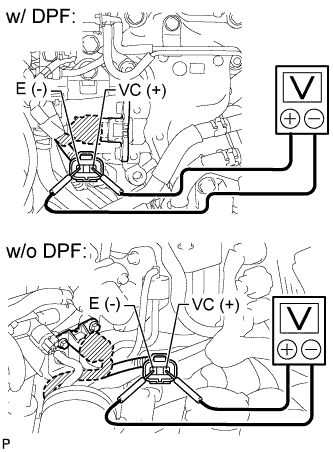
Turn the ignition switch to ON.
-
Measure the voltage between terminals 3 (VC (+)) and 1 (E2 (-)) of the wire harness side connector.
Standard voltage 4.75 to 5.25 V If the result is not as specified, inspect the wire harness and ECM Click here.
-
Turn the ignition switch off.
-
Connect the pressure sensor connector.
-
-
Check the power supply.
-
Turn the ignition switch to ON.
-
Disconnect the vacuum hose from the pressure sensor.
-
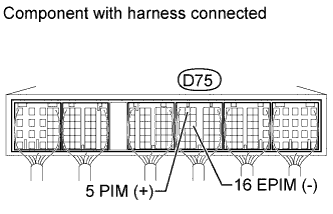
Connect a voltmeter to terminals D75-5 (PIM (+)) and D75-16 (EPIM (-)) of the ECM and measure the output voltage at standard atmospheric pressure.
-
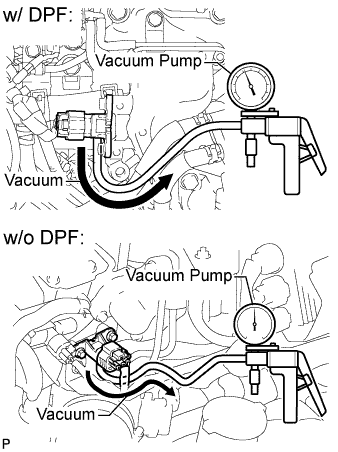
Using a vacuum pump, apply vacuum to the pressure sensor in 13.3 kPa (100 mmHg, 3.9 in.Hg) increments until the pressure reaches 40 kPa (300 mmHg, 11.8 in.Hg). Measure the decrease in voltage after each pressure decrease.
Standard Voltage Applied Vacuum Voltage Decrease 13.3 kPa (100 mmHg, 3.9 in.Hg) 0.1 to 0.2 V 26.6 kPa (199 mmHg, 7.9 in.Hg) 0.2 to 0.4 V 40 kPa (300 mmHg, 11.8 in.Hg) 0.4 to 0.6 V If the result is not as specified, replace the manifold absolute pressure sensor.
-
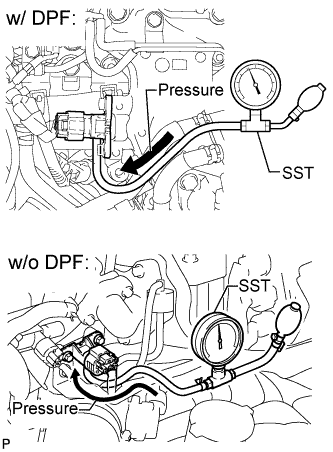
Using SST (turbocharger pressure gauge), apply pressure to the pressure sensor in 19.6 kPa (0.2 kgf/cm2, 2.8 psi) increments until the pressure reaches 98 kPa (1.00 kgf/cm2, 14.2 psi). Measure the increase in voltage after each pressure increase.
- SST
- 09992-00242
Standard Voltage Applied Pressure Voltage Increase 19.6 kPa (0.2 kgf/cm2, 2.8 psi)
0.1 to 0.3 V 39.2 kPa (0.4 kgf/cm2, 5.7 psi)
0.3 to 0.6 V 58.8 kPa (0.6 kgf/cm2, 8.5 psi)
0.6 to 0.8 V 78.5 kPa (0.8 kgf/cm2, 11.4 psi)
0.8 to 1.0 V 98 kPa (1.0 kgf/cm2, 14.2 psi)
1.0 to 1.2 V If the result is not as specified, replace the manifold absolute pressure sensor.
-
-
-
CHECK MOTOR FOR TURBOCHARGER CONTROL
CAUTION:
-
Wear protective gloves to prevent injuries and burns when checking the turbocharger.
-
The engine compartment becomes hot when the engine is running.
-
Remove the No. 1 exhaust manifold heat insulator Click here and No. 1 turbo insulator Click here.
-
Make sure that the connector is properly connected.
-
Turn the ignition switch from ON to off.
-
w/ DPF:
-
Check the DC motor's operation. Check that the motor rod stroke is as shown in A to C in the illustration below.
-
After the DC motor operates, visually check that the vane activation link contacts the fully closed stopper.
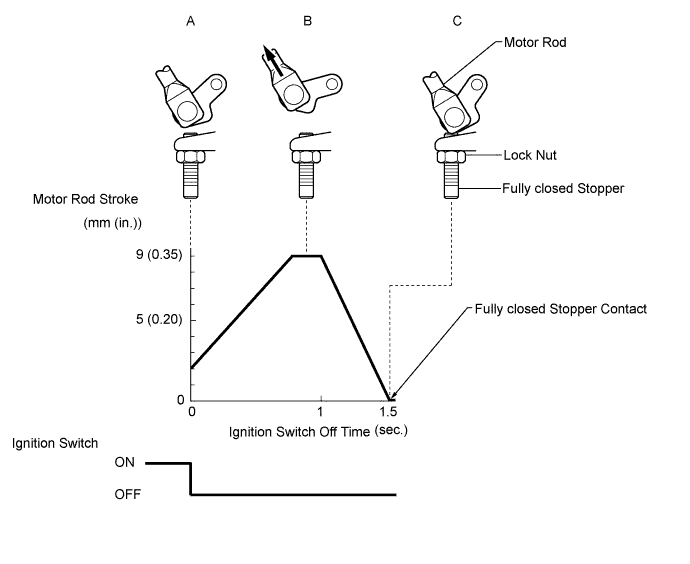
Note
Never loosen or tighten the lock nut of the fully closed stopper.
If the result is not as specified, check the ECM Click here.
-
-
w/o DPF:
-
Check the DC motor's operation. Check that the motor rod stroke is as shown in A to D in the illustration below.
-
After the DC motor operates, visually check that the vane activation link contacts the fully closed stopper.
Note
Never loosen or tighten the lock nut of the fully closed stopper.
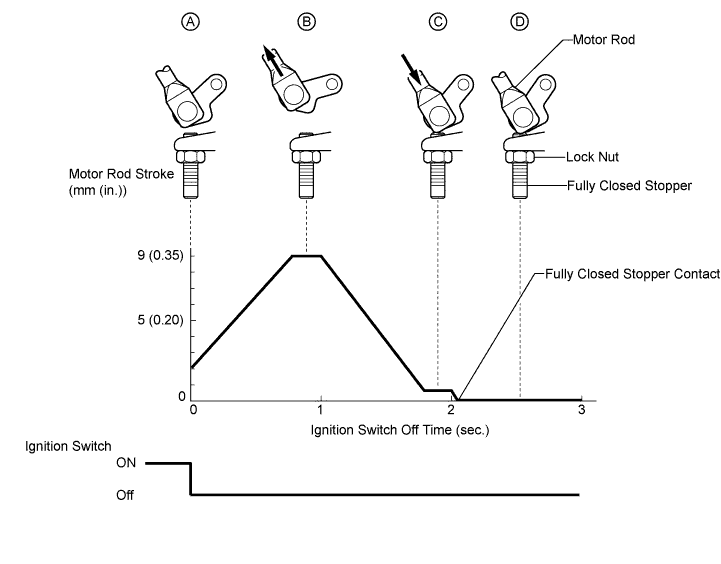
If the result is not as specified, check the ECM Click here and turbo motor driver Click here.
-
-
-
CHECK TURBO MOTOR DRIVER (w/o DPF)
-
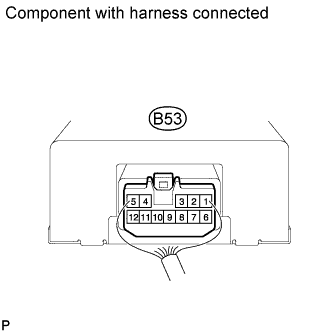
Check the voltage of the turbo motor driver.
-
Turn the ignition switch to ON.
-
Measure the voltage of the turbo motor driver.
Standard Voltage Tester Connection Specified Condition 3 (+B) - Body ground 11 to 14 V If the voltage is not as specified, refer to the following procedures Click here.
-
-
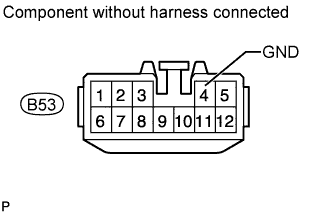
Check the resistance of the wire harness side connector.
-
Turn the ignition switch off.
-
Disconnect the turbo motor driver connector.
-
Measure the resistance of the turbo motor driver.
Standard Resistance Tester Connection Specified Condition 4 (GND) - Body ground Below 1 Ω If the resistance is not as specified, refer to the following procedures Click here.
-
-
Connect the turbo motor driver connector.
-
Check the turbo motor signal.
-
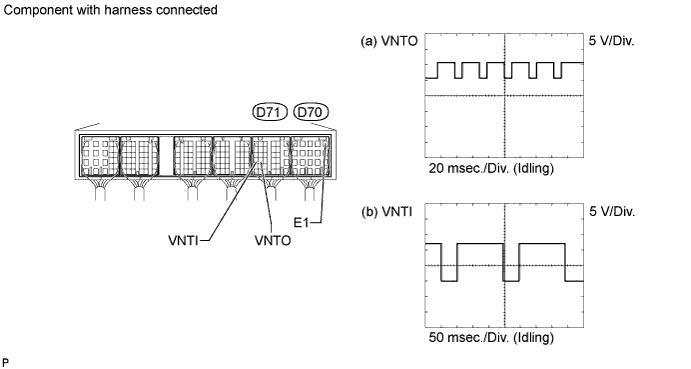
Connect an oscilloscope to the terminals of the ECM.
-
While idling the engine, check the waveform of the ECM.
Standard Condition Tester Connection Tool Setting Condition (a) D71-21 (VNTO) - D70-7 (E1)
(b) D71-22 (VNTI) - D70-7 (E1)
(a) 5 V/Div. 20 msec./Div.
(b) 5 V/Div. 50 msec./Div.
Idling with warm engine If the result is not as specified, replace the turbo motor driver.
Tech Tips
The waveform varies depending on the turbocharger operation.
-
-