ELECTRIC EGR CONTROL VALVE INSPECTION

-
INSPECT ELECTRIC EGR CONTROL VALVE ASSEMBLY
-
Inspect the vacuum regulating valve.
-
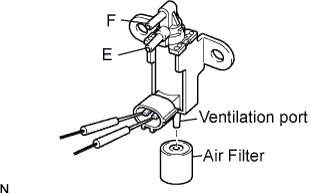
Check that there is continuity between the terminals.
Standard resistance 11 to 13 Ω (20°C) -
Apply battery voltage across the terminals, and check that air flows from each port.
Standard Measuring Condition Measuring Port Airflow No continuity E←→Ventilation port Airflows No continuity Ventilation port←→F
E←→F
Air does not flows Continuity E←→F Airflows Continuity Ventilation port←→E
Ventilation port←→F
Air does not flows
-
-
Inspect the EGR valve.
-
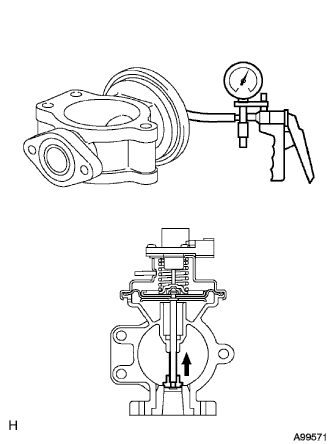
When a vacuum of 26.7 kPa (200 mmHg, 7.87 in.Hg) is applied to the diaphragm chamber, check that the shaft rises and that air flows out.
-
Maintaining the above conditions, check again that there are no leaks and that the shaft does not lower.
-
Check that the valve is not stuck and does not have heavy carbon deposits.
If the result is not as specified, replace the EGR valve.
-
-
Inspect the EGR valve position sensor.
-
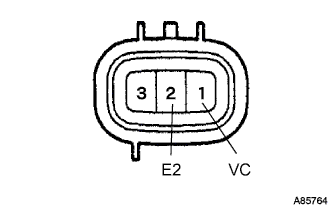
Using an ohmmeter, measure the resistance between terminals 1 (VC) and 2 (E2) of the EGR valve position sensor.
Standard resistance 4.0 to 6.0 kΩ at 20°C (68°F) If the result is not as specified, replace the EGR valve.
-
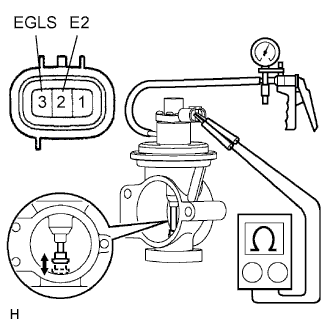
Create a vacuum in the diaphragm chamber. Measure the resistance between terminals 3 (EGLS) and (E2) of the lift sensor when the valve is fully opened and fully closed.
Standard resistance EGR Valve Condition Specified Condition Fully opened 3.9 kΩ at 20°C (68°F) Fully closed 1.0 kΩ at 20°C (68°F) Tech Tips
The resistance increases in proportion to the opening angle of the EGR valve.
If the result is not as specified, replace the EGR valve.
-
-