ECD SYSTEM Rough Idling or Excessive Engine Vibrations
DESCRIPTION
| Malfunction Condition | Main Trouble Area | Related Trouble Area |
|---|---|---|
|
|
|
Tech Tips
-
This troubleshooting procedure checks for the cause of rough idling and excessive engine vibrations.
-
Specified values in the following troubleshooting flowchart are for reference only. Variations in the Data List result values may occur depending on the measuring conditions or the vehicle's age. Do not judge the vehicle to be normal even when the Data List values indicate a standard level. There are possibly some concealed factors causing the malfunction.
-
Check that the vehicle has not been modified in any way prior to the vehicle inspection.
-
Faults and Symptoms of Common Rail Diesel Components
-
Engine Control
Glow System Main fault Open circuit, glow plug relay fault Symptoms Difficult to start, rough idle, knocking, white smoke (when cold) Data List Check the glow plug indicator light Diagnostic Point Measure the resistance of the glow plug Engine Main fault Loss of compression Symptoms Rough idle (lack of power always) Data List Injection Feedback Val
-
When an Injector Feedback Val is more than 3 mm3/st, there may be a malfunction in the corresponding cylinder.
-
-
Diesel Injection
Fuel supply pump Main fault - Symptoms Difficult to start, engine stalling, rough idle, lack of power Data List Fuel Press, Target Common Rail Pressure
-
Fuel Press is within 5000 kPa of Target Common Rail Pressure during idling with the engine warmed up (engine coolant temperature is higher than 70°C (158°F)).
-
If the fuel pressure is 20000 kPa below the target pressure, then a lack of power will be felt.
-
If the fuel pressure is below 25000 kPa, then idling will be rough.
Tech Tips
The fuel pressure changes at engine start, but is approx. 25000 kPa at engine start after the engine is warmed up.
Diagnostic Trouble Code Even if Fuel Press is below Target Common Rail Pressure, a DTC will not be stored. Fuel filter Main fault Blockage Symptoms Difficult to start, engine stalling, rough idle, lack of power Data List Fuel Press, Target Common Rail Pressure
-
Fuel Press is within 5000 kPa of Target Common Rail Pressure during idling with the engine warmed up (engine coolant temperature is higher than 70°C (158°F)).
-
If the fuel pressure is 20000 kPa below the target pressure, then a lack of power will be felt.
-
If the fuel pressure is below 25000 kPa, then idling will be rough.
Tech Tips
The fuel pressure changes at engine start, but is approx. 25000 kPa at engine start after the engine is warmed up.
Diagnostic Trouble Code Even if Fuel Press is below Target Common Rail Pressure, a DTC will not be stored. Injector Assembly Main fault Blockage Symptoms Rough idle, lack of power, black smoke, white smoke, knocking Data List Injection Feedback Val
-
When an Injector Feedback Val is more than 3 mm3/st, there may be a malfunction in the corresponding cylinder. This value can be read after idling for 1 minute.
Injector Driver Main fault Circuit fault: The fuel injector assembly does not open. Symptoms Difficult to start, rough idle, lack of power, black smoke, white smoke, knocking Data List Same as injector assembly Diagnostic Trouble Code When the injector driver has a fault, some DTCs may be stored. Fuel Pressure Sensor Main fault Open circuit, decrease in performance (foreign matter is stuck) Symptoms Difficult to start, rough idle, engine stall, lack of power Data List Fuel Press, Target Common Rail Pressure
-
Slowly raise the engine speed from idling to 3000 rpm with the vehicle stopped, and check that Fuel Press follows Target Common Rail Pressure. If the fuel pressure sensor malfunctions, the actual fuel pressure may deviate from the target fuel pressure. (However, the value may not deviate even when a malfunction is present).
Diagnostic Trouble Code When the fuel pressure sensor has a fault, some DTCs may be stored. Irregular Fuel Main fault - Symptoms Difficult to start, rough idle (especially when cold) -
-
Diesel EGR
EGR System Main fault
-
Does not move smoothly
-
Does not close completely
Symptoms
-
Rough idle
-
EGR valve stuck closed: A loud turbocharger sound.
-
EGR valve stuck open: Difficult to start (does not stall), black smoke, lack of power (if there is an excess in the quantity of EGR and there is a heavy load, when the vehicle starts moving, a lack of power will be felt).
-
-
Diesel Throttle
Diesel Throttle System Main fault Stuck, does not move smoothly Symptoms
-
Stuck closed: Lack of power, difficult to start, rough idle, engine stall, black smoke. These may occur when stuck almost fully closed.
-
Stuck open: Turbocharger sound increases. When the engine is stopped, engine vibrations may occur.
-
-
-
Data List Related to Lack of Power
-
Engine Speed
-
Intake Air
-
Coolant Temp
-
Target Common Rail Pressure
-
Fuel Press
-
Injection Feedback Val #1 (to #4)
-
Injection Volume
-
INSPECTION PROCEDURE
Note
-
After replacing the ECM, the new ECM needs registration Click here and initialization Click here.
-
After replacing the fuel supply pump, the ECM needs initialization Click here.
-
After replacing an injector assembly, the ECM needs registration Click here.
PROCEDURE
-
CHECK WIRE HARNESS AND CONNECTION IN ENGINE COMPARTMENT
-
Check the wire harness and connector connections of common rail system components.
OK The wire harnesses and connectors are connected securely. Tech Tips
The engine may have problems when there is an intermittent disconnection in a circuit related to the fuel pressure sensor, crankshaft position sensor, engine coolant temperature sensor, etc.
NG 
REPAIR OR REPLACE HARNESS AND CONNECTOR Click here
OK 
-
-
READ OUTPUT DTC (RELATING TO ENGINE)
-
Connect the intelligent tester to the DLC3.
-
Turn the ignition switch to ON and turn the tester on.
-
Enter the following menus: Powertrain / Engine and ECT / DTC.
-
Read pending DTCs.
Result Result Proceed to No DTCs are output A Engine related DTCs are output B
B 
GO TO DTC CHART Click here
A
-
-
TAKE SNAPSHOT DURING IDLING (PROCEDURE 4)
-
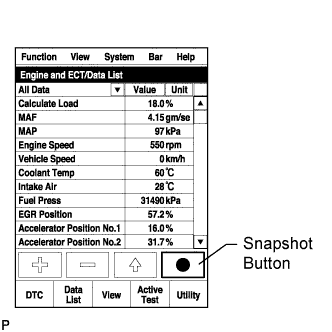
Connect the intelligent tester to the DLC3.
-
Start the engine and turn the tester on.
-
Warm up the engine (engine coolant temperature is 70°C (158°F) or higher).
-
Enter the following menus: Powertrain / Engine and ECT / Data List / All Data.
-
Take a snapshot when idling with no load after the engine is warmed up and when the problem is occurring.
Tech Tips
-
A snapshot can be used to compare vehicle data from the time of the malfunction to normal data and is very useful for troubleshooting.
-
Graphs can be displayed by transferring the stored snapshot data from the tester to a PC. Intelligent Viewer must be installed on the PC.
-
The shift lever should be in neutral and the A/C switch and all accessory switches should be off.
-
If rough idling occurs when the A/C switch is on, take another snapshot with the A/C switch on.
-
Take a snapshot when the problem is occurring, such as when the engine is cold. However, if the problem does not reoccur, it is acceptable to only take a snapshot after the engine is warmed up.
-
NEXT
-
-
CHECK WHITE SMOKE
-
Start the engine.
-
Fully depress the accelerator pedal, and then release it.
-
Check whether white smoke is emitted when racing the engine.
Note
Be sure not to check for white smoke indoors.
Tech Tips
Depending on whether there is oil mixed with the fuel, or whether there is unburned fuel present, the smell of the exhaust gas differs. When oil is mixed in, the exhaust gas smells like burning oil.
Result Result Proceed to White smoke is not emitted A White smoke is emitted B
B
CHECK AND REPAIR ENGINE ASSEMBLY Click here
A
-
-
CHECK DATA LIST (ENGINE SPEED)
-
Check engine speed in the snapshot taken in procedure 4 when the engine was idling.
Result Result Proceed to Change in engine speed coincides with air conditioning system operation B Except above A
B
CHECK AIR CONDITIONING SYSTEM Click here
A
-
-
CHECK DATA LIST (INJECTION FEEDBACK VAL #1 TO #4 AND INJECTION VOLUME)
-
Check Injection Feedback Val # in the snapshot taken in procedure 4 when the engine was idling.
Result Result Proceed to Injection Feedback Val for at least one cylinder is more than +3 mm3/st and engine vibration is abnormally large
A Except above B Tech Tips
-
When there is a problem with the operation of an injector assembly due to foreign matter in the inside of the injector assembly, etc., the fuel injection volume decreases. As a result, the ECM gives instructions to increase the fuel injection volume, which causes Injection Feedback Val to increase.
-
The ECM controls the system so that the sum of Injection Feedback Val for all of the cylinders is approximately 0 mm3/st. Even if the value of Injection Feedback Val for a cylinder is less than -3.0 mm3/st, as long as the value of Injection Feedback Val for each of the other cylinders is 3.0 mm3/st or less, the injector assemblies are not malfunctioning.
-
B
CHECK DATA LIST (FUEL PRESS AND TARGET COMMON RAIL PRESSURE) Click here
A
-
-
INSPECT INJECTOR COMPENSATION CODE
-
Read the injector compensation code Click here.
OK Compensation codes stored in the ECM match compensation codes of the installed injector assemblies.
NG
PERFORM ECM INITIALIZATION AND REGISTER INJECTOR COMPENSATION CODE Click here
OK
-
-
PERFORM ACTIVE TEST USING INTELLIGENT TESTER (CONTROL THE CYLINDER #1 TO #4 FUEL CUT)
Tech Tips
Use this Active Test to determine the malfunctioning cylinder.
-
Connect the intelligent tester to the DLC3.
-
Start the engine and turn the tester on.
-
Enter the following menus: Powertrain / Engine and ECT / Active Test / Control the Cylinder #1 to #4 Fuel Cut.
Tech Tips
-
If the engine idle speed does not change when an injector assembly is disabled, the cylinder being tested is malfunctioning.
-
If the cylinder being tested is normal, there will be a significant change in idle speed when the fuel injection is stopped for that cylinder.
-
NEXT
-
-
REPLACE INJECTOR ASSEMBLY OF MALFUNCTIONING CYLINDER
-
Replace the injector assembly of the malfunctioning cylinder Click here.
Note
-
When replacing the injector assembly for a cylinder, always be sure to use a new injection pipe.
-
Follow the procedure in the repair manual and temporarily install the injection pipes and nozzle leakage pipe, and then correctly position the injector assemblies. After that, tighten parts according to the torque specifications.
-
If the installation procedure is not performed correctly, injector assemblies may become out of position, which may cause the injector assemblies to deteriorate, resulting in malfunctions.
-
If an injector assembly deteriorates and malfunctions, other problems such as knocking, rough idle, etc. may occur.
-
If an injector assembly becomes out of position, it is possible that the seal between the injector assembly and injection pipe may become incomplete, resulting in a fuel leak.
-
NEXT
-
-
CLEAN FUEL FILTER CASE AND REPLACE FUEL FILTER
-
Clean the fuel filter case and replace the fuel filter.
Tech Tips
Be sure to clean the inside of the fuel filter case as the fuel injectors may not operate properly if the fuel filter is installed with foreign matter remaining inside the fuel filter case.
NEXT
-
-
BLEED AIR FROM FUEL SYSTEM
-
Bleed the air from the fuel system Click here.
NEXT
-
-
PERFORM ECM INITIALIZATION AND REGISTER INJECTOR COMPENSATION CODE
-
Perform the ECM initialization.
-
Connect terminals 13 (TC) and 4 (CG) of the DLC3.
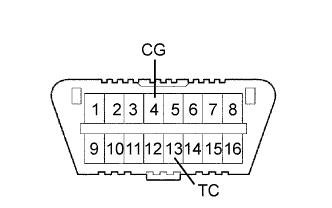
-
Turn the ignition switch to ON for 50 minutes or more.
Note
-
Perform ECM initialization only when the injectors for all the cylinders have been replaced.
-
It is necessary to wait for 50 minutes or more. Otherwise, ECM initialization is not completed.
-
-
Turn the ignition switch off.
-
Disconnect terminals 13 (TC) and 4 (CG).
-
-
Register the injector compensation code Click here.
NEXT
CONFIRM WHETHER MALFUNCTION HAS BEEN SUCCESSFULLY REPAIRED Click here
-
-
REPAIR OR REPLACE HARNESS AND CONNECTOR
-
Repair or replace the harness or connector.
NEXT
CONFIRM WHETHER MALFUNCTION HAS BEEN SUCCESSFULLY REPAIRED Click here
-
-
CHECK AND REPAIR ENGINE ASSEMBLY
-
Check the following items and repair the malfunctioning part if necessary.
-
Check cylinder compression pressure Click here.
-
NEXT
CONFIRM WHETHER MALFUNCTION HAS BEEN SUCCESSFULLY REPAIRED Click here
-
-
CHECK AIR CONDITIONING SYSTEM
-
Check the air conditioning system.
Tech Tips
-
Be sure to check the air conditioning hoses and pipes.
-
Check the refrigerant pressure Click here.
-
NEXT
CONFIRM WHETHER MALFUNCTION HAS BEEN SUCCESSFULLY REPAIRED Click here
-
-
CHECK DATA LIST (FUEL PRESS AND TARGET COMMON RAIL PRESSURE)
-
Check engine speed in the snapshot taken in procedure 4 when the engine was idling after having been warmed up.
Result Result Proceed to Fuel Press is more than 5000 kPa from Target Common Rail Pressure A Except above B
B
REMOVE DEPOSIT (ELECTRIC EGR CONTROL VALVE ASSEMBLY) Click here
A
-
-
CHECK IF FUEL IS BEING SUPPLIED TO FUEL SUPPLY PUMP
-
Disconnect the inlet hose from the fuel supply pump.
-
Operate the priming pump and check that fuel is being supplied to the fuel supply pump.
OK Fuel is properly supplied to the fuel supply pump when the priming pump is operated. Tech Tips
-
When there is a lack of fuel, the fuel pressure drops.
-
Inspect for fuel filter clogging.
-
-
Reconnect the inlet hose.
NG
CHECK AND REPAIR OR REPLACE CLOGGED FUEL PIPE (INCLUDING FROZEN FUEL) (FUEL TANK - FUEL SUPPLY PUMP) Click here
OK
-
-
REPLACE SUCTION CONTROL VALVE
-
Replace the suction control valve Click here.
NEXT
-
-
BLEED AIR FROM FUEL SYSTEM
-
Bleed the air from the fuel system Click here.
NEXT
-
-
PERFORM FUEL SUPPLY PUMP INITIALIZATION
-
Perform fuel supply pump initialization Click here.
NEXT
CONFIRM WHETHER MALFUNCTION HAS BEEN SUCCESSFULLY REPAIRED Click here
-
-
CHECK AND REPAIR OR REPLACE CLOGGED FUEL PIPE (INCLUDING FROZEN FUEL) (FUEL TANK - FUEL SUPPLY PUMP)
-
Check and repair or replace the clogged fuel pipe.
NEXT
-
-
BLEED AIR FROM FUEL SYSTEM
-
Bleed the air from the fuel system Click here.
NEXT
CONFIRM WHETHER MALFUNCTION HAS BEEN SUCCESSFULLY REPAIRED Click here
-
-
REMOVE DEPOSIT (ELECTRIC EGR CONTROL VALVE ASSEMBLY)
-
Remove the electric EGR control valve assembly Click here.
-
Visually check the electric EGR control valve assembly for deposits.
If there are deposits, clean the electric EGR control valve assembly.
Tech Tips
-
If the EGR valve does not open properly or is stuck closed, the amount of intake air increases and combustion sounds and engine vibration may increase.
-
If the EGR valve does not operate due to clogging or disconnection of the vacuum hose, repair the hose.
-
If the EGR valve does not close properly or is stuck open, EGR becomes excessive and combustion becomes unstable. Also, there may be a lack of power. In this case, clean the electric EGR control valve assembly.
-
When cleaning the electric vacuum regulating valve assembly, use a piece of cloth soaked with non-residue solvent. Spraying the solvent directly onto these parts or soaking the parts in solvent may damage the parts.
-
-
Reinstall the electric EGR control valve assembly Click here.
NEXT
-
-
CHECK AND REPLACE ENGINE MOUNTING INSULATOR
-
Check the following items and repair or replace the malfunctioning part if necessary.
-
Check that the engine mounting insulators are installed correctly.
-
Check that the engine mounting insulators are not twisted.
-
Check that deformation of an engine mounting insulator is not causing the engine to contact the vehicle body.
-
NEXT
-
-
CONFIRM WHETHER MALFUNCTION HAS BEEN SUCCESSFULLY REPAIRED
NEXT 
END