ECD SYSTEM, Diagnostic DTC:P1290/22, P1292/22, P1293/22

| DTC Code | DTC Name |
|---|---|
| P1290/22 | Engine Coolant Temperature Circuit |
| P1292/22 | Short in Engine Coolant Temperature Circuit |
| P1293/22 | Open in Engine Coolant Temperature Circuit |
DESCRIPTION
A thermistor is built into the engine coolant temperature (radiator) sensor, of which the resistance value varies according to the radiator side engine coolant temperature.
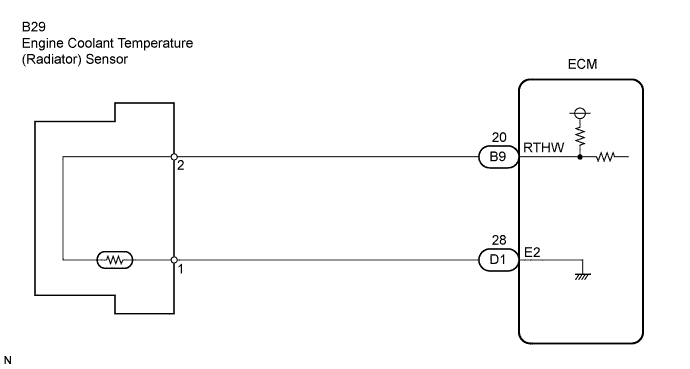
The structure of the sensor and its connection to the ECM are the same as those of the Intake Air Temperature (IAT) sensor.
Tech Tips
When either of DTCs P1290/22, P1292/22 or P1293/22 are set, the ECM enters fail-safe mode. During fail-safe mode, the radiator side engine coolant temperature is estimated to be 80°C (176°F) by the ECM and the radiator fan motors are operated until the pass condition is detected. Fail-safe mode continues until a pass condition is detected.
| DTC No. | DTC Detection Conditions | Trouble Areas |
|---|---|---|
| P1290/22 | Open or short in engine coolant temperature (radiator) sensor circuit for 3 seconds (1 trip detection logic) |
|
| P1292/22 | Short in engine coolant temperature (radiator) sensor circuit for 3 seconds (1 trip detection logic) |
|
| P1293/22 | Open in engine coolant temperature (radiator) sensor circuit for 3 seconds (1 trip detection logic) |
|
MONITOR DESCRIPTION
The engine coolant temperature (radiator) sensor is used to monitor the radiator side engine coolant temperature. The engine coolant temperature (radiator) sensor has a thermistor with a resistance that varies according to the temperature of the engine coolant. When the coolant temperature is low, the resistance in the thermistor increases. When the temperature is high, the resistance drops. These variations in resistance are reflected in the output voltage from the sensor. The ECM monitors the sensor voltage and uses this value to calculate the radiator side engine coolant temperature. When the sensor output voltage deviates from the normal operating range, the ECM interprets this as a fault in the engine coolant temperature (radiator) sensor and sets a DTC.
Example:
If the sensor output voltage is -40°C (-40°F) for 0.5 seconds or more, the ECM determines that there is an open in the engine coolant temperature (radiator) sensor circuit, and sets DTC P1293/22. Conversely, if the voltage output is 140°C (284°F) for 0.5 seconds or more, the ECM determines that there is a short in the sensor circuit, and sets DTC P1292/22.
If the malfunction is not repaired successfully, a DTC is set 0.5 seconds after the engine is next started.
WIRING DIAGRAM
INSPECTION PROCEDURE
Tech Tips
-
If other DTCs relating to different systems that have terminal E2 as the ground terminal are output simultaneously, terminal E2 may have an open circuit.
-
Read freeze frame data using an intelligent tester. The ECM records vehicle and driving condition information as freeze frame data the moment a DTC is stored. When troubleshooting, freeze frame data can be helpful in determining whether the vehicle was running or stopped, whether the engine was warmed up or not, whether the air-fuel ratio was lean or rich, as well as other data recorded at the time of a malfunction.
PROCEDURE
-
INSPECT ENGINE COOLANT TEMPERATURE SENSOR (ENGINE COOLANT TEMPERATURE (RADIATOR) SENSOR)
-
Inspect the engine coolant temperature (radiator) sensor Click here.
NG 
REPLACE ENGINE COOLANT TEMPERATURE SENSOR (ENGINE COOLANT TEMPERATURE (RADIATOR) SENSOR)
OK 
-
-
CHECK HARNESS AND CONNECTOR (ENGINE COOLANT TEMPERATURE (RADIATOR) SENSOR - ECM)
-
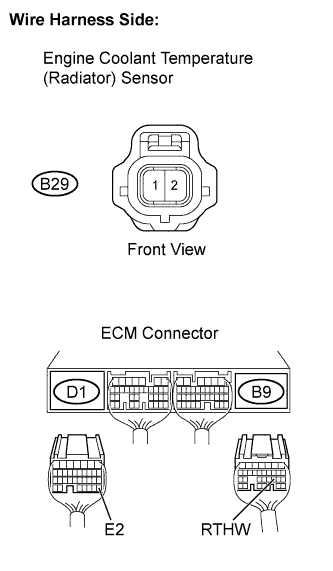
Disconnect the B9 and D1 ECM connectors.
-
Disconnect the B29 engine coolant temperature (radiator) sensor connector.
-
Check the resistance.
Standard resistance (Check for open) Tester Connection Specified Condition RTHW (B9-20) - B29-2 Below 1 Ω E2 (D1-28) - B29-1 Below 1 Ω Standard resistance (Check for short) Tester Connection Specified Condition RTHW (B9-20) or B29-2 - E2 (D1-28) or B29-1 10 kΩ or higher RTHW (B9-20) or B29-2 - Body ground 10 kΩ or higher -
Reconnect the ECM connectors.
-
Reconnect the engine coolant temperature (radiator) sensor connector.
NG
REPAIR OR REPLACE HARNESS OR CONNECTOR
OK 
REPLACE ECM
-