SFI SYSTEM (w/o Secondary Air Injection System), Diagnostic DTC:P0351/14, P0352/15, P0353/14, P0354/15

| DTC Code | DTC Name |
|---|---|
| P0351/14 | Ignition Coil "A" Primary / Secondary Circuit |
| P0352/15 | Ignition Coil "B" Primary / Secondary Circuit |
| P0353/14 | Ignition Coil "C" Primary / Secondary Circuit |
| P0354/15 | Ignition Coil "D" Primary / Secondary Circuit |
DESCRIPTION
Tech Tips
-
These DTCs indicate malfunctions relating to the primary circuit.
-
If DTC P0351 is set, check the No.1 ignition coil with igniter circuit.
-
If DTC P0352 is set, check the No.2 ignition coil with igniter circuit.
-
If DTC P0353 is set, check the No.3 ignition coil with igniter circuit.
-
If DTC P0354 is set, check the No.4 ignition coil with igniter circuit.
A Direct Ignition System (DIS) is used on this vehicle.
The DIS is a 1-cylinder ignition system in which each cylinder is ignited by one ignition coil and one spark plug is connected to the end of each secondary wiring. A powerful voltage, generated in the secondary wiring, is applied directly to each spark plug. The sparks of the spark plugs pass from the center electrodes to the ground electrodes.
The ECM determines the ignition timing and transmits the ignition (IGT) signals to each cylinder. Using the IGT signal, the ECM turns the power transistor inside the igniter on and off. The power transistor, in turn, switches on and off the current to the primary coil. When the current to the primary coil is cut off, a powerful voltage is generated in the secondary coil. This voltage is applied to the spark plugs, causing them to spark inside the cylinders. As the ECM cuts the current to the primary coil, the igniter sends back an ignition confirmation (IGF) signal to the ECM, for each cylinder ignition.
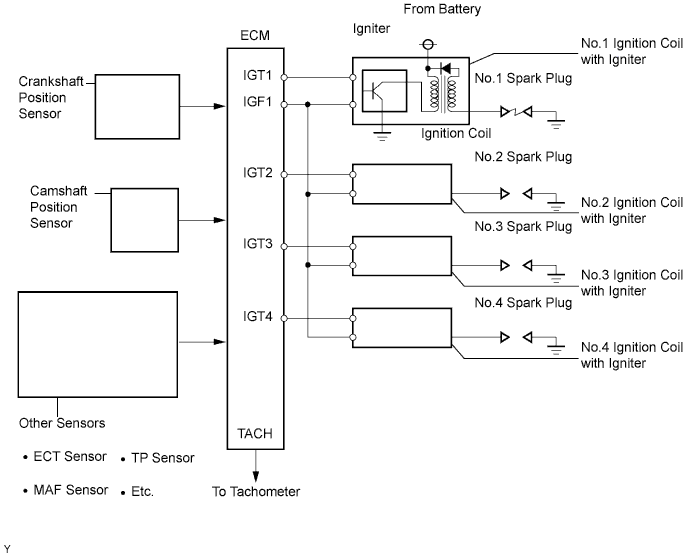
| DTC No. | DTC Detection Conditions | Trouble Areas |
|---|---|---|
| P0351/14 P0352/15 P0353/14 P0354/15 |
No IGF signal to ECM while engine running (1 trip detection logic) |
|
While cranking or idling, check the waveform between terminals IGT (1 to 4) and E1, and IGF1 and E1 of the ECM connector.
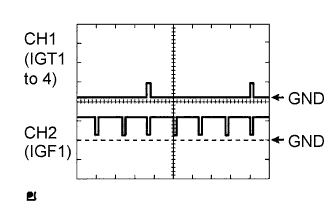
| Items | Contents |
| Terminals | CH1: IGT1, IGT2, IGT3, IGT4 - E1 CH:2 IGF1 - E1 |
| Equipment Settings | 2 V/Division, 20 ms/Division |
| Conditions | Cranking or idling |
MONITOR DESCRIPTION
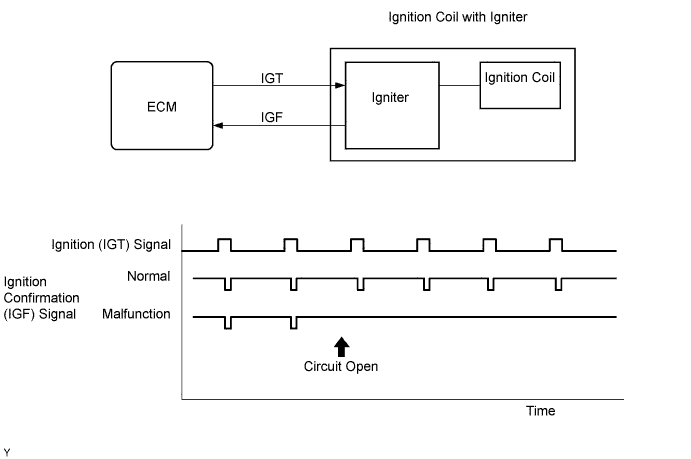
If the ECM does not receive any IGF signals despite transmitting the IGT signal, it interprets this as a fault in the igniter and sets a DTC.
If the malfunction is not repaired successfully, a DTC is set 1second after the engine is next started.
WIRING DIAGRAM
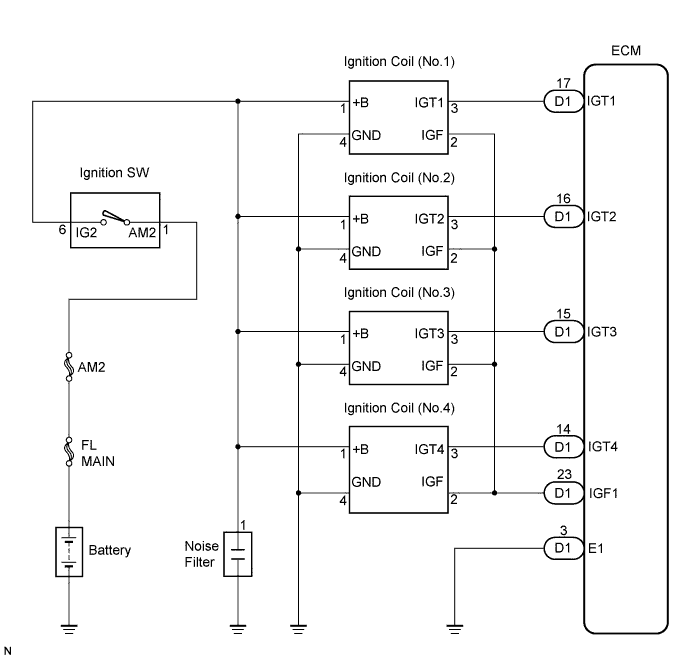
INSPECTION PROCEDURE
Tech Tips
Read freeze frame data using an intelligent tester. The ECM records vehicle and driving condition information as freeze frame data the moment a DTC is stored. When troubleshooting, freeze frame data can be helpful in determining whether the vehicle was running or stopped, whether the engine was warmed up or not, whether the air-fuel ratio was lean or rich, as well as other data recorded at the time of a malfunction.
PROCEDURE
-
CHECK WHETHER DTC OUTPUT RECURS (DTC P0351/14, P0352/15, P0353/14 OR P0354/15)
-
Connect an intelligent tester to the DLC3.
-
Turn the ignition switch to the ON position.
-
Turn the tester ON.
-
Clear DTCs Click here.
-
Shuffle the ignition coils with igniters (among No.1 to No.4 cylinders).
Note
Do not shuffle the connectors.
-
Perform a simulation test.
-
Check DTCs displayed on the tester.
Result Display (DTC Output) Proceed To Same DTC output A Other ignition coil DTC output B
B 
REPLACE IGNITION COIL ASSEMBLY
A 
-
-
INSPECT ECM (IGT1, IGT2, IGT3, IGT4 AND IGF1 SIGNAL)
-
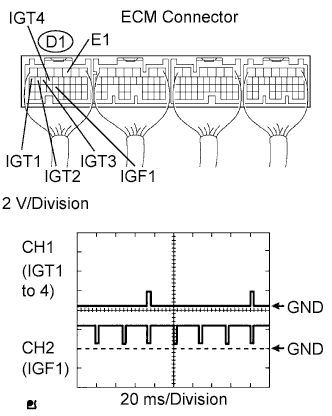
Inspect the ECM using an oscilloscope.
-
While cranking or idling, check the waveform between the terminals of the D1 ECM connector.
Standard Tester Connections Specified Conditions IGT1 (D1-17) - E1 (D1-3) Correct waveform shown in the illustration appears IGT2 (D1-16) - E1 (D1-3) Correct waveform shown in the illustration appears IGT3 (D1-15) - E1 (D1-3) Correct waveform shown in the illustration appears IGT4 (D1-14) - E1 (D1-3) Correct waveform shown in the illustration appears IGF1 (D1-23) - E1 (D1-3) Correct waveform shown in the illustration appears
NG
REPLACE ECM
OK
-
-
CHECK HARNESS AND CONNECTOR (IGNITION COIL ASSEMBLY - ECM)
-
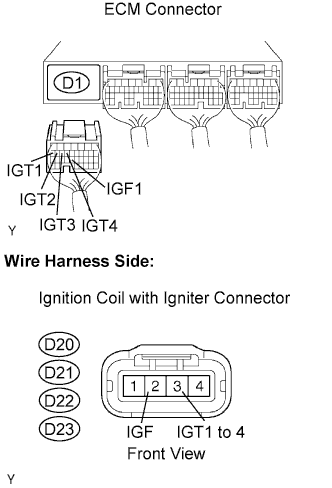
Disconnect the ignition coil with igniter connector.
-
Disconnect the D1 ECM connector.
-
Measure the resistance.
Resistance (Check for open) Tester Connections Specified Conditions IGF (D20-2) - IGF1 (D1-23) Below 1 Ω IGF (D21-2) - IGF1 (D1-23) Below 1 Ω IGF (D22-2) - IGF1 (D1-23) Below 1 Ω IGF (D23-2) - IGF1 (D1-23) Below 1 Ω Resistance (Check for open) Tester Connections Specified Conditions IGT1 (D20-3) - IGT1 (D1-17) Below 1 Ω IGT2 (D21-3) - IGT2 (D1-16) Below 1 Ω IGT3 (D22-3) - IGT3 (D1-15) Below 1 Ω IGT4 (D23-3) - IGT4 (D1-14) Below 1 Ω Resistance (Check for short) Tester Connections Specified Conditions IGF (D20-2) or IGF1 (D1-23) - Body ground 10 kΩ or higher IGF (D21-2) or IGF1 (D1-23) - Body ground 10 kΩ or higher IGF (D22-2) or IGF1 (D1-23) - Body ground 10 kΩ or higher IGF (D23-2) or IGF1 (D1-23) - Body ground 10 kΩ or higher Resistance (Check for short) Tester Connections Specified Conditions IGT1 (D20-3) or IGT1 (D1-17) - Body ground 10 kΩ or higher IGT2 (D21-3) or IGT2 (D1-16) - Body ground 10 kΩ or higher IGT3 (D22-3) or IGT3 (D1-15) - Body ground 10 kΩ or higher IGT4 (D23-3) or IGT4 (D1-14) - Body ground 10 kΩ or higher -
Reconnect the ECM connector.
-
Reconnect the ignition coil with igniter connector.
NG
REPAIR OR REPLACE HARNESS OR CONNECTOR
OK
-
-
INSPECT IGNITION COIL ASSEMBLY (POWER SOURCE)
-
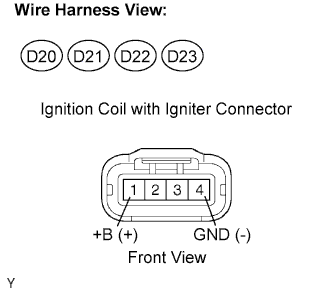
Disconnect the ignition coil with igniter connector.
-
Measure the resistance.
Resistance (Check for open) Tester Connections Specified Conditions GND (D20-4) - Body ground Below 1 Ω GND (D21-4) - Body ground Below 1 Ω GND (D22-4) - Body ground Below 1 Ω GND (D23-4) - Body ground Below 1 Ω -
Turn the ignition switch to the ON position.
-
Measure the voltage between the terminals of the wire harness side connector.
Voltage Tester Connections Specified Conditions +B (D20-1) - GND (D20-4) 9 to 14 V +B (D21-1) - GND (D21-4) 9 to 14 V +B (D22-1) - GND (D22-4) 9 to 14 V +B (D23-1) - GND (D23-4) 9 to 14 V -
Reconnect the ignition coil with igniter connector.
NG 
CHECK HARNESS AND CONNECTOR (IGNITION COIL ASSEMBLY - IGNITION SWITCH) Click here
OK 
REPLACE IGNITION COIL ASSEMBLY
-
-
CHECK HARNESS AND CONNECTOR (IGNITION COIL ASSEMBLY - IGNITION SWITCH)
-
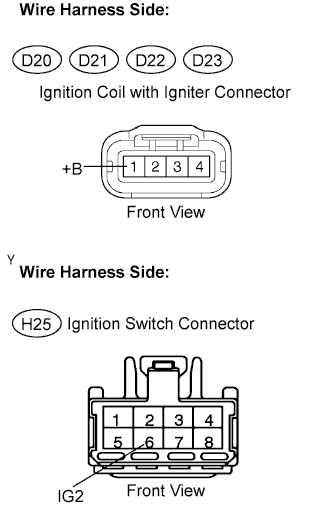
Disconnect the ignition coil with igniter connector.
-
Disconnect the H25 ignition switch connector.
-
Measure the resistance.
Resistance (Check for open) Tester Connections Specified Conditions +B (D20-1) - IG2 (H25-6) Below 1 Ω +B (D21-1) - IG2 (H25-6) Below 1 Ω +B (D22-1) - IG2 (H25-6) Below 1 Ω +B (D23-1) - IG2 (H25-6) Below 1 Ω Resistance (Check for short) Tester Connections Specified Conditions +B (D20-1) or IG2 (H25-6) - Body ground 10 kΩ or higher +B (D21-1) or IG2 (H25-6) - Body ground 10 kΩ or higher +B (D22-1) or IG2 (H25-6) - Body ground 10 kΩ or higher +B (D23-1) or IG2 (H25-6) - Body ground 10 kΩ or higher -
Reconnect the ignition coil with igniter connector.
-
Reconnect the ignition switch connector.
NG
REPAIR OR REPLACE HARNESS OR CONNECTOR
OK
REPLACE IGNITION COIL ASSEMBLY
-