SFI SYSTEM (w/o Secondary Air Injection System), Diagnostic DTC:P0011/59, P0012/59

| DTC Code | DTC Name |
|---|---|
| P0011/59 | Camshaft Position "A" - Timing Over-Advanced or System Performance (Bank 1) |
| P0012/59 | Camshaft Position "A" - Timing Over-Retarded (Bank 1) |
DESCRIPTION
Tech Tips
If DTC P0011 or P0012 is present, check the VVT (Variable Valve Timing) system.
Refer to DTC P0010 Click here.
| DTC No. | DTC Detection Conditions | Trouble Areas |
|---|---|---|
| P0011/59 |
|
|
| P0012/59 |
|
|
MONITOR DESCRIPTION
The ECM optimizes the intake valve timing using the VVT (Variable Valve Timing) system to control the intake camshaft. The VVT system includes the ECM, the Oil Control Valve (OCV) and the VVT controller. The ECM sends a target duty-cycle control signal to the OCV. This control signal regulates the oil pressure supplied to the VVT controller. The VVT controller can advance or retard the intake camshaft.
If the difference between the target and actual intake valve timings is large, and changes in actual intake valve timing are small, the ECM interprets this as the VVT controller stuck malfunction and sets a DTC.
-
Example:
-
A DTC is set when the following conditions (1), (2) and (3) are met:
-
The difference between the target and actual intake valve timings is more than 5°CA (Crankshaft Angle) and the condition continues for more than 4.5 seconds.
-
It takes 5 seconds or more to change the valve timing by 5°CA.
-
After above conditions (1) and (2) are met, the OCV is forcibly activated 63 times or more.
-
DTC P0011 (Advanced Cam Timing) is subject to 1 trip detection logic.
-
DTC P0012 (Retarded Cam Timing) is subject to 2 trip detection logic.
-
These DTCs indicate that the VVT controller cannot operate properly due to OCV malfunctions or the presence of foreign objects in the OCV.
-
The monitor will not run unless the following conditions are met:
-
The engine is warm (the engine coolant temperature is 70°C [158°F] or more).
-
The vehicle has been driven at more than 64 km/h (40 mph) for 3 minutes.
-
The engine has idled for 3 minutes.
WIRING DIAGRAM
Refer to DTC P0010 Click here.
INSPECTION PROCEDURE
Note
DTC P0011 or P0012 may be set when foreign objects in the engine oil are caught in some parts of the system. The DTC will remain set even if the system returns to normal after a short time. Foreign object are filtered out by the oil filter.
Tech Tips
Read freeze frame data using an intelligent tester. The ECM records vehicle and driving condition information as freeze frame data the moment a DTC is stored. When troubleshooting, freeze frame data can be helpful in determining whether the vehicle was running or stopped, whether the engine was warmed up or not, whether the air-fuel ratio was lean or rich, as well as other data recorded at the time of a malfunction.
PROCEDURE
-
CHECK ANY OTHER DTCS OUTPUT (IN ADDITION TO DTC P0011/59 OR P0012/59)
-
Connect an intelligent tester to the DLC3.
-
Turn the ignition switch to the ON position and turn the tester ON.
-
Select the following menu items: Powertrain / Engine and ECT / DTC.
-
Read DTCs.
Result Display (DTC Output) Proceed To P0011 or P0012 A P0011 or P0012 and other DTCs B Tech Tips
If any DTCs other than P0011or P0012 are output, troubleshoot those DTCs first.
B 
GO TO DTC CHART
A 
-
-
PERFORM ACTIVE TEST USING INTELLIGENT TESTER
-
Connect the intelligent tester to the DLC3.
-
Start the engine and turn the tester ON.
-
Warm up the engine.
-
Select the following menu items: Engine and ECT / Active Test / Activate the VVT System (Bank 1).
-
Check the engine speed while operating the Oil Control Valve (OCV) using the tester.
OK Tester Operations Specified Conditions OCV OFF Normal engine speed OCV ON Engine idles roughly or stalls
(soon after OCV switched from OFF to ON)
NG 
CHECK VALVE TIMING (CHECK FOR LOOSE AND JUMPED TEETH ON TIMING CHAIN) Click here
OK
-
-
CHECK WHETHER DTC OUTPUT RECURS (DTC P0011/59 OR P0012/59)
-
Connect the intelligent tester to the DLC3.
-
Turn the ignition switch to the ON position and turn the tester ON.
-
Clear DTCs Click here.
-
Start the engine and warm it up.
-
Switch the ECM from normal mode to check mode using the tester Click here.
-
Drive the vehicle for more than 10 minutes.
-
Read DTCs using the tester.
OK No DTC output.
NG
CHECK VALVE TIMING (CHECK FOR LOOSE AND JUMPED TEETH ON TIMING CHAIN) Click here
OK 
END
-
-
CHECK VALVE TIMING (CHECK FOR LOOSE AND JUMPED TEETH ON TIMING CHAIN)
-
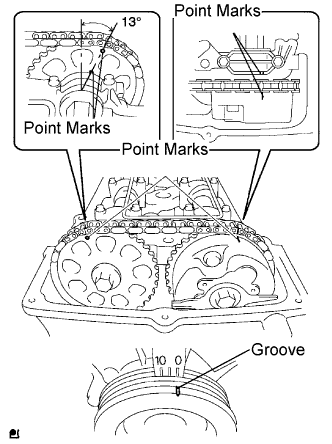
Remove the cylinder head cover Click here.
-
Turn the crankshaft pulley, and align its groove with the timing mark "0" on the timing chain cover.
-
Check that the point marks on the camshaft timing gears are as shown in the illustration.
If not, turn the crankshaft 1 revolution (360°), and align the marks as shown in the illustration.
OK Point marks on the camshaft timing gears are aligned as shown in the illustration. -
Reinstall the cylinder head cover Click here.
NG
ADJUST VALVE TIMING
OK
-
-
INSPECT CAMSHAFT TIMNG OIL CONTROL VALVE ASSEMBLY (OCV)
-
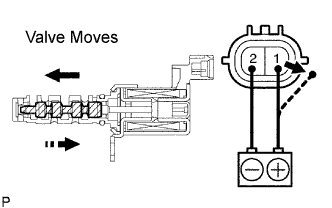
Remove the OCV.
-
Measure the resistance between the terminals of the OCV.
Resistance 6.9 to 7.9 Ω at 20°C (68°F) -
Apply the positive battery voltage to terminal 1 and negative battery voltage to terminal 2. Check the valve operation.
OK Valve moves quickly -
Reinstall the OCV.
NG
REPLACE CAMSHAFT TIMING OIL CONTROL VALVE ASSEMBLY
OK
-
-
INSPECT OIL CONTROL VALVE FILTER
-
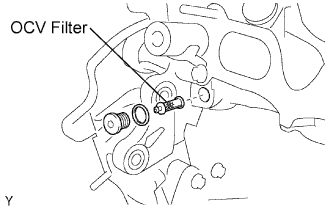
Remove the power steering pump Click here.
-
Remove the OCV filter.
-
Check that the filter is not clogged.
OK Filter is not clogged. -
Reinstall the OCV filter.
-
Reinstall the power steering pump Click here.
NG
REPLACE OIL CONTROL VALVE FILTER
OK
-
-
REPLACE CAMSHAFT TIMING GEAR ASSEMBLY
NEXT
-
CHECK DTC
-
Connect an intelligent tester to the DLC3.
-
Turn the ignition switch to the ON position.
-
Turn the tester ON.
-
Clear DTCs Click here.
-
Start the engine and warm it up.
-
Switch the ECM from normal mode to check mode using the tester Click here.
-
Drive the vehicle for more than 10 minutes.
-
Confirm that no DTC is set using the tester.
NEXT
END
-