SFI SYSTEM (w/ Secondary Air Injection System), Diagnostic DTC:P0351, P0352, P0353, P0354

| DTC Code | DTC Name |
|---|---|
| P0351 | Ignition Coil "A" Primary / Secondary Circuit |
| P0352 | Ignition Coil "B" Primary / Secondary Circuit |
| P0353 | Ignition Coil "C" Primary / Secondary Circuit |
| P0354 | Ignition Coil "D" Primary / Secondary Circuit |
DESCRIPTION
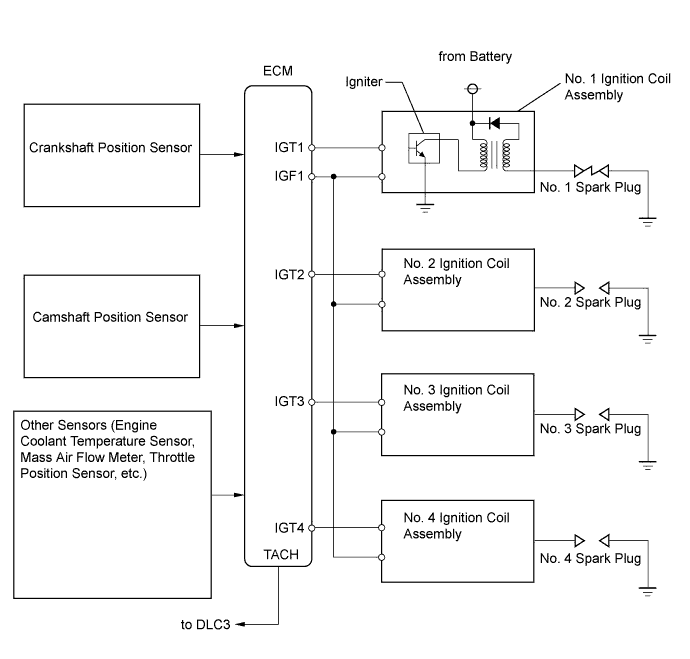
A Direct Ignition System (DIS) is used on this vehicle to enhance ignition accuracy and suppress high voltage losses.
The DIS is an ignition system in which each cylinder is ignited by one ignition coil assembly. The ECM determines the ignition timing and transmits the ignition (IGT) signals to each cylinder. Based on the IGT signals, the ECM turns the power transistor inside the igniter on and off, turning the current to the primary coil on and off. When the current to the primary coil is cut off, a voltage is generated in the secondary coil and then applied to the spark plugs, causing them to spark inside the cylinders. At the same time, the igniter sends back the ignition confirmation (IGF) signal to the ECM.
| DTC No. | DTC Detection Condition | Trouble Area |
|---|---|---|
| P0351 P0352 P0353 P0354 |
No IGF signal is sent to the ECM while the engine is running (1 trip detection logic). |
|
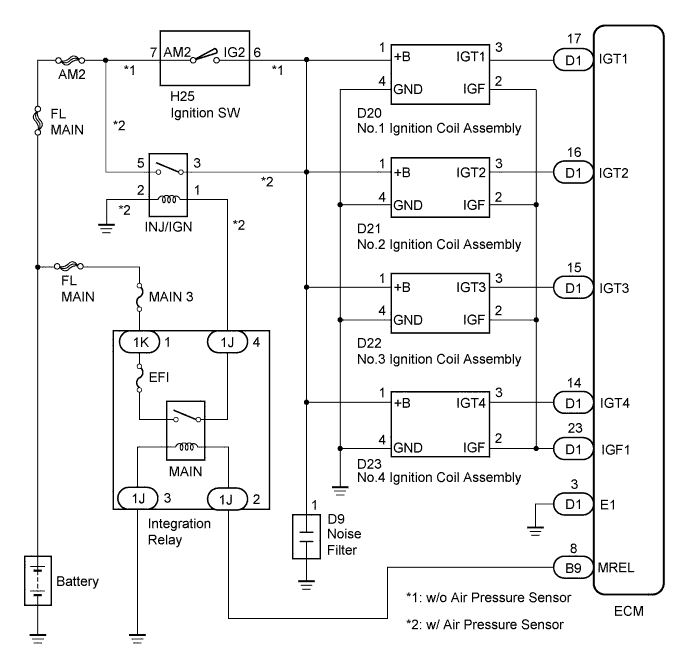
WIRING DIAGRAM
INSPECTION PROCEDURE
Tech Tips
-
The following inspection procedure is for the No. 1 cylinder. If any of the other cylinders are malfunctioning, inspect their circuits by referring to the following procedure.
-
If DTC P0351 is output, check the ignition coil assembly No. 1 circuit.
-
If DTC P0352 is output, check the ignition coil assembly No. 2 circuit.
-
If DTC P0353 is output, check the ignition coil assembly No. 3 circuit.
-
If DTC P0354 is output, check the ignition coil assembly No. 4 circuit.
-
Read freeze frame data using the intelligent tester. Freeze frame data records the engine condition when malfunctions are detected. When troubleshooting, freeze frame data can help determine if the vehicle was moving or stationary, if the engine was warmed up or not, if the air fuel ratio was lean or rich, and other data from the time the malfunction occurred.
PROCEDURE
-
CHECK DTC OUTPUT
-
Connect the intelligent tester to the DLC3.
-
Turn the ignition switch to ON.
-
Turn the tester on.
-
Enter the following menus: Powertrain / Engine and ECT / DTC.
-
Read the DTCs.
Result Result Proceed to DTC P0351, P0352, P0353 or P0354 is output A DTC P0351, P0352, P0353 and P0354 are output B
B 
CHECK HARNESS AND CONNECTOR (IGNITION COIL ASSEMBLY - BODY GROUND) Click here
A 
-
-
CHECK WHETHER DTC OUTPUT RECURS (DTC P0351, P0352, P0353 OR P0354)
-
Connect the intelligent tester to the DLC3.
-
Turn the ignition switch to ON.
-
Turn the tester on.
-
Clear the DTCs Click here.
-
Shuffle the arrangement of the ignition coil assemblies (among the No. 1 to No. 4 cylinders).
Note
Do not shuffle the connectors.
-
Perform a simulation test.
-
Check the DTCs output to the tester.
Result Result Proceed to Same DTC output A Different ignition coil assembly DTC output B
B 
REPLACE IGNITION COIL ASSEMBLY
A
-
-
CHECK IGNITION COIL ASSEMBLY (POWER SOURCE)
-
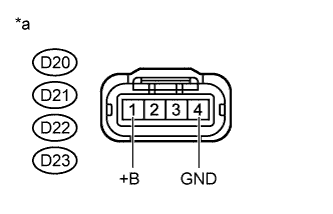
Text in Illustration *a Front view of wire harness connector
(to Ignition Coil Assembly)
Disconnect the ignition coil assembly connectors.
-
Measure the voltage according to the value(s) in the table below.
Standard Voltage Tester Connection Switch Condition Specified Condition D20-1 (+B) - D20-4 (GND) Ignition switch ON 11 to 14 V D21-1 (+B) - D21-4 (GND) Ignition switch ON 11 to 14 V D22-1 (+B) - D22-4 (GND) Ignition switch ON 11 to 14 V D23-1 (+B) - D23-4 (GND) Ignition switch ON 11 to 14 V -
Reconnect the ignition coil assembly connectors.
NG
CHECK HARNESS AND CONNECTOR (IGNITION COIL ASSEMBLY - IGNITION SWITCH) Click here
OK
-
-
CHECK HARNESS AND CONNECTOR (IGNITION COIL ASSEMBLY - ECM)
-
Disconnect the ignition coil assembly connectors.
-
Disconnect the ECM connector.
-
Measure the resistance according to the value(s) in the table below.
Standard Resistance (Check for Open) Tester Connection Condition Specified Condition D20-2 (IGF) - D1-23 (IGF1) Always Below 1 Ω D21-2 (IGF) - D1-23 (IGF1) Always Below 1 Ω D22-2 (IGF) - D1-23 (IGF1) Always Below 1 Ω D23-2 (IGF) - D1-23 (IGF1) Always Below 1 Ω Standard Resistance (Check for Short) Tester Connection Condition Specified Condition D20-2 (IGF) or D1-23 (IGF1) - Body ground Always 10 kΩ or higher D21-2 (IGF) or D1-23 (IGF1) - Body ground Always 10 kΩ or higher D22-2 (IGF) or D1-23 (IGF1) - Body ground Always 10 kΩ or higher D23-2 (IGF) or D1-23 (IGF1) - Body ground Always 10 kΩ or higher -
Reconnect the ECM connector.
-
Reconnect the ignition coil assembly connectors.
NG
REPAIR OR REPLACE HARNESS OR CONNECTOR (IGNITION COIL ASSEMBLY - ECM)
OK
-
-
CHECK HARNESS AND CONNECTOR (IGNITION COIL ASSEMBLY - ECM)
-
Disconnect the ignition coil assembly connectors.
-
Disconnect the ECM connector.
-
Measure the resistance according to the value(s) in the table below.
Standard Resistance (Check for Open) Tester Connection Condition Specified Condition D20-3 (IGT1) - D1-17 (IGT1) Always Below 1 Ω D21-3 (IGT2) - D1-16 (IGT2) Always Below 1 Ω D22-3 (IGT3) - D1-15 (IGT3) Always Below 1 Ω D23-3 (IGT4) - D1-14 (IGT4) Always Below 1 Ω Standard Resistance (Check for Short) Tester Connection Condition Specified Condition D20-3 (IGT1) or D1-17 (IGT1) - Body ground Always 10 kΩ or higher D21-3 (IGT2) or D1-16 (IGT2) - Body ground Always 10 kΩ or higher D22-3 (IGT3) or D1-15 (IGT3) - Body ground Always 10 kΩ or higher D23-3 (IGT4) or D1-14 (IGT4) - Body ground Always 10 kΩ or higher -
Reconnect the ECM connector.
-
Reconnect the ignition coil assembly connectors.
NG
REPAIR OR REPLACE HARNESS OR CONNECTOR (IGNITION COIL ASSEMBLY - ECM)
OK 
REPLACE ECM
-
-
CHECK HARNESS AND CONNECTOR (IGNITION COIL ASSEMBLY - BODY GROUND)
-
Disconnect the ignition coil assembly connectors.
-
Measure the resistance according to the value(s) in the table below.
Standard Resistance Tester Connection Condition Specified Condition D20-4 (GND) - Body ground Always Below 1 Ω D21-4 (GND) - Body ground Always Below 1 Ω D22-4 (GND) - Body ground Always Below 1 Ω D23-4 (GND) - Body ground Always Below 1 Ω Result Result Proceed to OK (w/o Air Pressure Sensor) A OK (w/ Air Pressure Sensor) B NG C -
Reconnect the ignition coil assembly connectors.
B
CHECK HARNESS AND CONNECTOR (IGNITION COIL ASSEMBLY - INJ/IGN RELAY) Click here
C
REPAIR OR REPLACE HARNESS OR CONNECTOR (IGNITION COIL ASSEMBLY - BODY GROUND)
A
-
-
CHECK HARNESS AND CONNECTOR (IGNITION COIL ASSEMBLY - IGNITION SWITCH)
-
Disconnect the ignition coil assembly connectors.
-
Disconnect the ignition switch connector.
-
Measure the resistance according to the value(s) in the table below.
Standard Resistance (Check for Open) Tester Connection Condition Specified Condition D20-1 (+B) - H25-6 (IG2) Always Below 1 Ω D21-1 (+B) - H25-6 (IG2) Always Below 1 Ω D22-1 (+B) - H25-6 (IG2) Always Below 1 Ω D23-1 (+B) - H25-6 (IG2) Always Below 1 Ω Standard Resistance (Check for Short) Tester Connection Condition Specified Condition D20-1 (+B) or H25-6 (IG2) - Body ground Always 10 kΩ or higher D21-1 (+B) or H25-6 (IG2) - Body ground Always 10 kΩ or higher D22-1 (+B) or H25-6 (IG2) - Body ground Always 10 kΩ or higher D23-1 (+B) or H25-6 (IG2) - Body ground Always 10 kΩ or higher -
Reconnect the ignition switch connector.
-
Reconnect the ignition coil assembly connectors.
NG
REPAIR OR REPLACE HARNESS OR CONNECTOR (IGNITION COIL ASSEMBLY - IGNITION SWITCH)
OK
-
-
INSPECT IGNITION SWITCH
-
Inspect the ignition switch Click here.
NG
REPLACE IGNITION SWITCH
OK
REPAIR OR REPLACE HARNESS OR CONNECTOR (IGNITION SWITCH - BATTERY)
-
-
CHECK HARNESS AND CONNECTOR (IGNITION COIL ASSEMBLY - INJ/IGN RELAY)
-
Disconnect the ignition coil assembly connectors.
-
Remove the INJ/IGN relay from the instrument panel relay block.
-
Measure the resistance according to the value(s) in the table below.
Standard Resistance (Check for Open) Tester Connection Condition Specified Condition D20-1 (+B) - INJ/IGN relay terminal 3 Always Below 1 Ω D21-1 (+B) - INJ/IGN relay terminal 3 Always Below 1 Ω D22-1 (+B) - INJ/IGN relay terminal 3 Always Below 1 Ω D23-1 (+B) - INJ/IGN relay terminal 3 Always Below 1 Ω Standard Resistance (Check for Short) Tester Connection Condition Specified Condition D20-1 (+B) or INJ/IGN relay terminal 3 - Body ground Always 10 kΩ or higher D21-1 (+B) or INJ/IGN relay terminal 3 - Body ground Always 10 kΩ or higher D22-1 (+B) or INJ/IGN relay terminal 3 - Body ground Always 10 kΩ or higher D23-1 (+B) or INJ/IGN relay terminal 3 - Body ground Always 10 kΩ or higher -
Reinstall the INJ/IGN relay.
-
Reconnect the ignition coil assembly connectors.
NG
REPAIR OR REPLACE HARNESS OR CONNECTOR
OK
-
-
INSPECT INJ/IGN RELAY
-
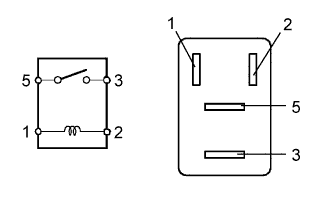
Inspect the INJ/IGN relay.
-
Measure the resistance according to the value(s) in the table below.
Standard Resistance Tester Connection Condition Specified Condition 3 - 5 Battery voltage not applied to terminals 1 and 2 10 kΩ or higher Battery voltage applied to terminals 1 and 2 Below 1 Ω
NG
REPAIR INJ/IGN RELAY
OK
-
-
CHECK HARNESS AND CONNECTOR (INJ/IGN RELAY - BATTERY)
-
Disconnect the cable from the negative (-) battery terminal.
-
Disconnect the cable from the positive (+) battery terminal.
-
Remove the INJ/IGN relay from the instrument panel relay block.
-
Measure the resistance according to the value(s) in the table below.
Standard Resistance (Check for Open) Tester Connection Condition Specified Condition positive (+) battery terminal - INJ/IGN relay terminal 5 Always Below 1 Ω Standard Resistance (Check for Short) Tester Connection Condition Specified Condition positive (+) battery terminal or INJ/IGN relay terminal 5 - Body ground Always 10 kΩ or higher -
Reinstall the INJ/IGN relay.
-
Connect the cable to the positive (+) battery terminal.
-
Connect the cable to the negative (-) battery terminal.
NG
REPAIR OR REPLACE HARNESS OR CONNECTOR
OK
-
-
CHECK HARNESS AND CONNECTOR (INJ/IGN RELAY - INTEGRATION RELAY, INJ/IGN RELAY- BODY GROUND)
-
Remove the INJ/IGN relay from the instrument panel relay block.
-
Remove the integration relay from the engine room relay block No.1
-
Measure the resistance according to the value(s) in the table below.
Standard Resistance (Check for Open) Tester Connection Condition Specified Condition INJ/IGN relay terminal 1 - 1J-4 Always Below 1 Ω INJ/IGN relay terminal 2 - Body ground Always Below 1 Ω Standard Resistance (Check for Short) Tester Connection Condition Specified Condition INJ/IGN relay terminal 1 or 1J-4 - Body ground Always 10 kΩ or higher -
Reinstall the integration relay.
-
Reinstall the INJ/IGN relay.
NG
REPAIR OR REPLACE HARNESS OR CONNECTOR
OK
CHECK ECU POWER SOURCE CIRCUIT Click here
-