AIRBAG SYSTEM PRECAUTION

CAUTION:
-
The DYNA100/150 is equipped with SRS, which comprises a driver airbag. Failure to carry out service operations in the correct sequence could cause the SRS to unexpectedly deploy during servicing, possibly leading to a serious accident. Further, if a mistake is made in servicing the SRS, it is possible that the SRS may fail to operate when required. Before performing servicing (including removal or installation of parts, inspection or replacement), be sure to read the following items carefully, then follow the correct procedures described in the repair manual.
-
Work must be started 90 seconds after the ignition switch is turned to the "LOCK" position and the negative (-) terminal cable is disconnected from the battery.
(The SRS is equipped with a back-up power source so that if work is started within 90 seconds from disconnecting the negative (-) terminal cable of the battery, the SRS may be deployed.)
-
Do not expose the horn button assembly, airbag ECU assembly or airbag sensor assembly No. 2 directly to hot air or flames.
Note
-
Malfunction symptoms of the SRS are difficult to confirm, so the DTCs become the most important source of information when troubleshooting. When troubleshooting the SRS, always inspect the DTCs before disconnecting the battery.
-
Even in cases of a minor collision where the SRS does not deploy, the horn button assembly, airbag ECU assembly and airbag sensor assembly No. 2 should be inspected Click here, Click here and Click here .
-
Before repairs, remove the airbag sensor if shocks are likely to be applied to the sensor during repairs.
-
Never use SRS parts from another vehicle. When replacing parts, replace them with new parts.
-
Never disassemble and repair the horn button assembly, airbag ECU assembly or airbag sensor assembly No. 2 in order to reuse it.
-
If the horn button assembly, airbag ECU assembly or airbag sensor assembly No. 2 has been dropped, or if there are cracks, dents or other defects in the case, bracket or connector, replace it with new one.
-
Use a volt/ohmmeter with high impedance (10kΩ/V minimum) for troubleshooting the system's electrical circuits.
-
Information labels are attached to the periphery of the SRS components. Follow the instructions on the notices.
-
After work on the SRS is completed, perform the SRS warning light check Click here.
-
When the negative (-) terminal cable is disconnected from the battery, the memory of the clock and audio system will be canceled. So before starting work, make a record of the contents memorized in the audio memory system. When work is finished, reset the audio systems as they were before and adjust the clock. To avoid erasing the memory in each memory system, never use a back- up power supply from outside the vehicle.
-
If the vehicle is equipped with a mobile communication system, refer to the precaution in the IN section.
-
SRS CONNECTORS
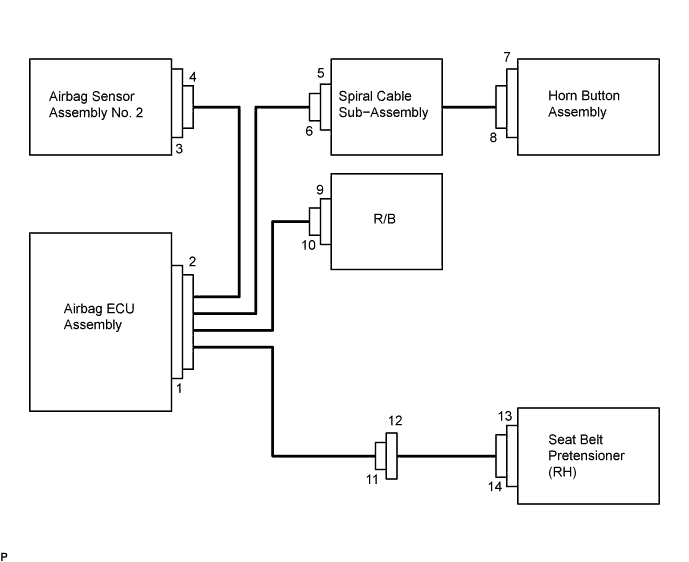
No. Item Application (1) Terminal Twin-Lock Mechanism Connectors 2, 4, 5, 6, 7, 8, 10, 11, 12, 14 (2) Airbag Activation Prevention Mechanism Connectors 2, 6, 7, 13 (3) Electrical Connection Check Mechanism Connectors 1, 2 (4) Half Connection Prevention Mechanism Connectors 4, 5, 6, 11 (5) Connector Twin-Lock Mechanism Connectors 9
-
All connectors in the SRS are colored in yellow to distinguish them from other connectors. Connectors having special functions and specifically designed for the SRS are used in the locations shown on the previous page to ensure high reliability. These connectors use durable gold-plated terminals.
-
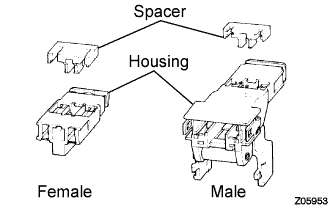
Terminal twin-lock mechanism:
Each connector has a two-piece component consisting of a housing and a spacer. This design enables the terminal to be locked securely by two locking devices (the retainer and the lance) to prevent terminals from coming out.
-
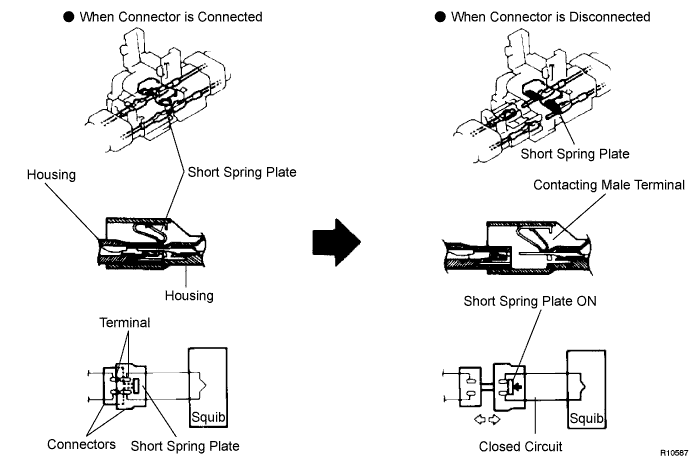
Airbag activation prevention mechanism:
Each connector contains a short spring plate. When the connector is disconnected, the short spring plate automatically connects positive (+) terminal and negative (-) terminal of the squib.
Tech Tips
The type of connector is shown in the diagram on the previous page.
-
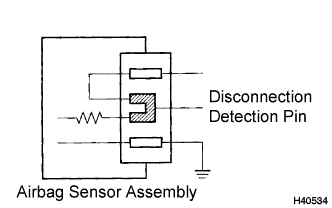
Electrical connection check mechanism:
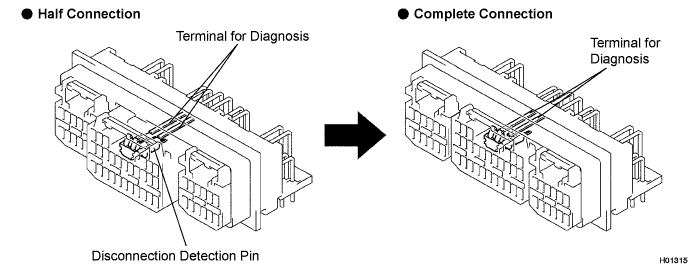
This mechanism electrically checks that connectors are connected correctly and completely. The electrical connection check mechanism is designed so that the disconnection detection pin connects with the diagnosis terminals when the connector housing lock is locked.
Tech Tips
The connectors shown in this illustration are connectors, "1", "2" and "3" in step 8.
-
Half connection prevention mechanism:
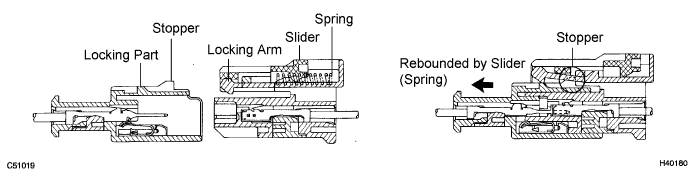
If the connector is not completely connected, the connector is disconnected due to the spring operation to the extent that no continuity exists.
-
Connector twin-lock mechanism:
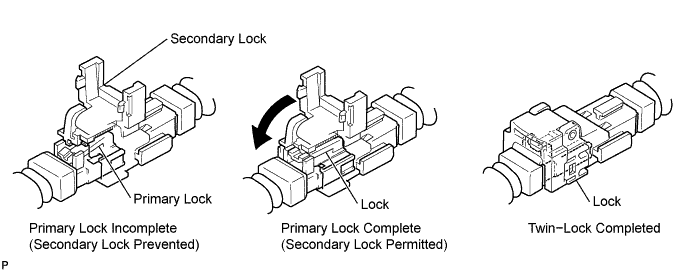
With this mechanism connectors (male and female connectors) are locked by 2 locking devices to increase the connection reliability. If the primary lock is incomplete, ribs interfere and prevent the secondary lock.
-
-
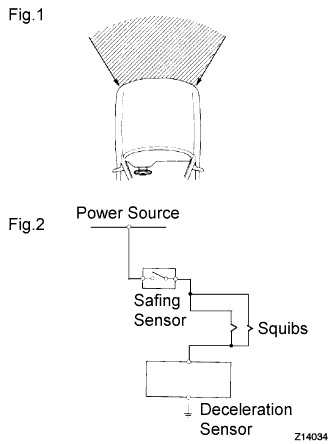
When the vehicle is involved in a frontal collision in the hatched area (Fig. 1) and the shock is larger than the predetermined level, the SRS is activated automatically. A safing sensor is designed to go on at a smaller deceleration rate than the airbag sensor. As illustrated in Fig. 2, ignition is caused when current flows to the squib, which happens when a safing sensor and the deceleration sensor go on simultaneously. When a deceleration force acts on the sensors, squib in the driver airbag ignite and generate gas. The gas discharging into the driver airbag rapidly increases the pressure inside the bag, breaking open the horn button assembly. Bag inflation then ends, and the bag deflates as the gas is discharged through discharge holes at the bag's rear or side.
-
-
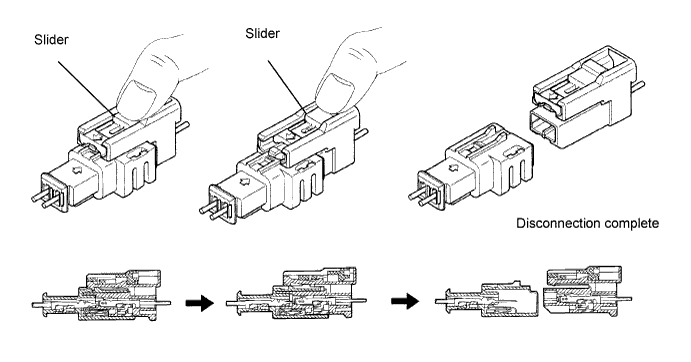
DISCONNECTION OF CONNECTORS FOR HORN BUTTON ASSEMBLY
-
Place a finger on the slider.
-
Slide the slider to release lock.
-
Disconnect the connector.
-
-
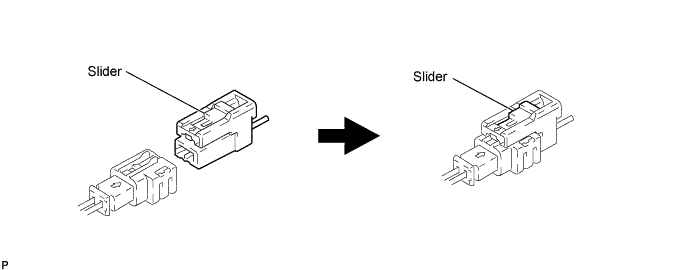
CONNECTION OF CONNECTORS FOR HORN BUTTON ASSEMBLY
-
Align a lock part of male connector and a slider of female connector in the same direction as shown in the illustration, fit in them without rubbing.
-
Be sure to insert until they are locked. After fitting in pull them slightly to check that they are locked. (When locked, make sure that the outer returns to its original position and sound at the time of fitting in can be heard.)
Tech Tips
-
As the slider slides, do not touch it.
-
Be careful not to deform the release board. If the release board is deformed, replace it with a new one.
-
-
-
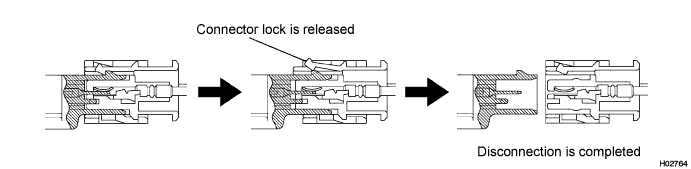
DISCONNECTION OF AIRBAG SENSOR ASSEMBLY NO. 2 CONNECTOR
-
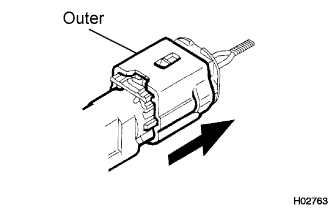
While holding both flank sides of the outer, slide the outer to the direction shown by an arrow.
-
Lock of the connectors is released, then disconnect the connectors.
Tech Tips
Be sure to hold both flank sides of the outer. If holding the top and bottom sides, it will obstruct disconnection.
-
-
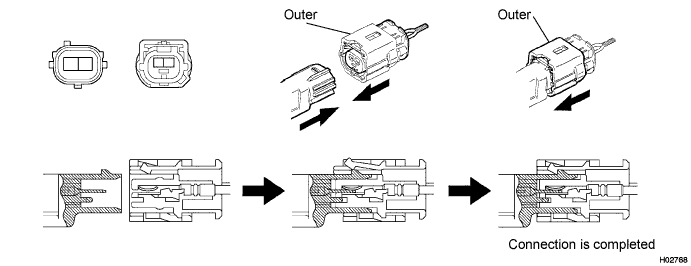
CONNECTION OF AIRBAG SENSOR ASSEMBLY NO. 2 CONNECTOR
-
Align the male connector (on the side of sensor) and female connector in the same direction as shown in the illustration and fit in them without rubbing.
-
As they are fitted in, the outer slides rearward. Press it until the outer returns to its original position again.
If fitting stops half way, connectors will separate.
-
Be sure to insert until they are locked. After fitting in, pull them slightly to check that they are locked. (When locked, make sure that the outer returns to its original position and sound at the time of fitting in can be heard.)
Tech Tips
-
Do not fit in while holding the outer.
-
When fitting in, the outer slides. Do not touch it.
-
-