CHARGING SYSTEM ON-VEHICLE INSPECTION

CAUTION:
-
Check that the battery cables are connected to the correct terminals.
-
Disconnect the battery cables when the battery is charged quickly.
-
Do not perform tests with a high voltage insulation resistance tester.
-
Never disconnect the battery while the engine is running.
-
Do not check whether the alternator generates or not, with connecting terminal F to the other terminal.
-
Check that the changing cable is tightened on terminal B of the alternator and the fuse box.
-
BATTERY ELECTROLYTE LEVEL
-
Check the electrolyte quantity of each cell.
Maintenance-Free Battery: If it is under the lower level, replace the battery. Except Maintenance-Free Battery If it is under the lower level, add distilled water.
-
-
BATTERY SPECIFIC GRAVITY (Except Maintenance-Free Battery)
-
Check the specific gravity of each cell.
Standard specific gravity 1.25 - 1.29 at 20°C (68°F) If the specific gravity is less than the specification, charge the battery.
-
-
BATTERY VOLTAGE (Maintenance-Free Battery)
-
After the vehicle has run for 20 minutes, stop the engine.
-
Turn the ignition switch ON, and operate the headlight, blower fan and defogger for 1 minute.
-
Turn the ignition switch OFF.
-
Measure the battery voltage.
Standard voltage 12.5 - 12.9 V at 20°C (68°F) If the voltage is less than specification, charge the battery.
-
-
BATTERY TERMINALS, FUSIBLE LINK AND FUSES
-
Check that the battery terminals are not loose or dirt.
If the terminals are corroded, replace the terminals.
-
Check the fusible link, H-fuses, M-fuse and fuses for continuity.
-
-
GENERATOR WIRING AND ABNORMAL NOISES
-
Check that the wiring is in good condition.
-
Check that there is no abnormal noise in the generator while the engine is running.
-
-
CHARGE WARNING LIGHT (CHARGE WARNING LIGHT CIRCUIT)
-
When the ignition switch is ON, check that the charge warning light is ON.
-
When the engine is started, check that the light goes off.
-
-
INSPECT CHARGING CIRCUIT WITHOUT LOAD
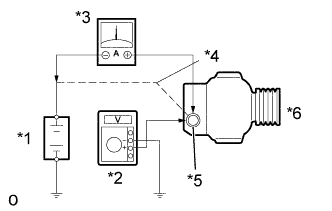
Text in Illustration *1 Battery *2 Voltmeter *3 Ammeter *4 Disconnect Wire from Terminal B *5 Terminal B *6 Generator Note
If a battery/generator tester is available, connect the tester to the charging circuit as per the manufacturer's instructions.
-
If a tester is not available, connect a voltmeter and ammeter to the charging circuit as follows:
-
Disconnect the wire from terminal B of the generator, and connect it to the negative tester probe of the ammeter.
-
Connect the positive tester probe of the ammeter to terminal B of the generator.
-
Connect the positive tester probe of the voltmeter to terminal B of the generator.
-
Ground the negative tester probe of the voltmeter.
-
-
Check the charging circuit as follows:
While the engine is running from idling to 2,000 rpm, check the reading on the ammeter and voltmeter.
Standard Value: Amperage 10 A or less Voltage 13.2 - 14.8 V If the value is not specified, check the generator.
-
-
INSPECT CHARGING CIRCUIT WITH LOAD
-
With the engine running at 2,000 rpm, turn on the high beam headlights and place the heater blower switch at "HI".
-
Check the reading on the ammeter.
Standard amperage 30 A or more If the ammeter reading is less than the standard amperage, check the generator.
Tech Tips
If the battery is fully charged, the indication will sometimes becomes less than the standard amperage.
-