ENGINE OIL COOLER (w/ DPF) INSTALLATION

Note
-
When replacing the injectors (including shuffling the injectors between the cylinders), common rail or cylinder head, it is necessary to replace the injection pipes with new ones.
-
When replacing the fuel supply pump, common rail, cylinder block, cylinder head, cylinder head gasket or timing gear case, it is necessary to replace the fuel inlet pipe with a new one.
-
After removing the injection pipes, clean them with a brush and compressed air.
-
INSTALL ENGINE OIL COOLER ASSEMBLY
-
Install 2 new gaskets and engine oil cooler to the oil cooler cover with the 4 nuts.
- Torque:
- 16 N*m { 163 kgf*cm, 12 ft.*lbf }
-
-
INSTALL OIL COOLER COVER SUB-ASSEMBLY
-
Install a new gasket and oil cooler cover to the cylinder block.
-
Install the oil cooler cover to the cylinder block with the 12 bolts.
- Torque:
- 13 N*m { 133 kgf*cm, 10 ft.*lbf }
-
Install the No. 2 vacuum transmitting pipe with the bolt and 2 nuts.
- Torque:
- 13 N*m { 133 kgf*cm, 10 ft.*lbf }
-
Connect the vinyl tube to the oil cooler cover.
-
Connect the oil pressure switch connector.
-
-
INSTALL OIL FILTER SUB-ASSEMBLY
-
Clean the oil filter installation surface.
-
Apply engine oil to the oil filter gasket.
-
Lightly screw a new oil filter to the oil cooler cover until the oil filter does not turn.
-
Using SST, tighten the oil filter an additional 3/4 turn.
- SST
- 09228-07501
- Torque:
- 17 N*m { 173 kgf*cm, 13 ft.*lbf }
-
-
INSTALL NO. 2 WATER BY-PASS HOSE
-
Install the No. 2 water by-pass hose to the oil cooler cover.
-
-
INSTALL NO. 3 WATER BY-PASS HOSE
-
Install the No. 3 water by-pass hose to the oil cooler cover.
-
-
INSTALL NO. 2 NOZZLE LEAKAGE PIPE ASSEMBLY
-
Temporarily install a new gasket and the No. 2 nozzle leakage pipe assembly with the union bolt and 3 bolts.
-
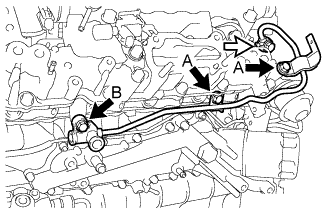
Tighten the union bolt and 3 bolts.
- Torque:
- Union bolt
- 21 N*m { 214 kgf*cm, 15 ft.*lbf }
- Bolt A
- 13 N*m { 130 kgf*cm, 9 ft.*lbf }
- Bolt B
- 21 N*m { 214 kgf*cm, 15 ft.*lbf }
Text in Illustration 
Union Bolt
-
-
INSTALL NO. 3 FUEL PIPE
-
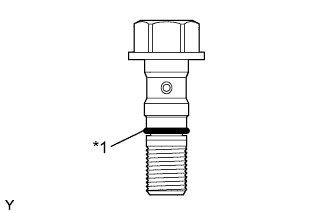
Text in Illustration *1 O-Ring Apply a light coat of fuel to the O-ring of the fuel check valve.
-
Temporarily install 3 new gaskets and the No. 3 fuel pipe with the fuel check valve, 2 union bolts and 3 bolts.
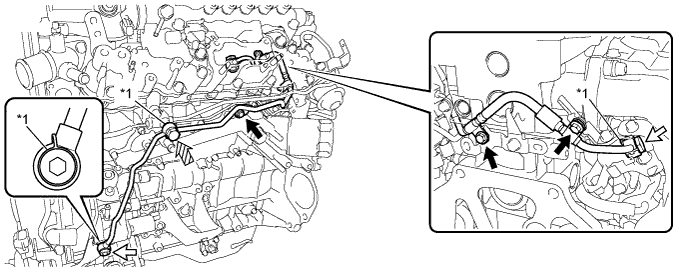
Text in Illustration *1 Gasket - - Union Bolt 
Fuel Check Valve 
Bolt - - -
Tighten the 2 bolts and fuel check valve.
- Torque:
- Bolt
- 8.0 N*m { 82 kgf*cm, 71 in.*lbf }
- Fuel check valve
- 32 N*m { 321 kgf*cm, 23 ft.*lbf }
-
Using a socket hexagon wrench, tighten the 2 union bolts and bolt.
- Torque:
- Bolt
- 8.0 N*m { 82 kgf*cm, 71 in.*lbf }
- Union bolt
- 30 N*m { 306 kgf*cm, 22 ft.*lbf }
-
-
INSTALL NO. 3 NOZZLE LEAKAGE PIPE
-
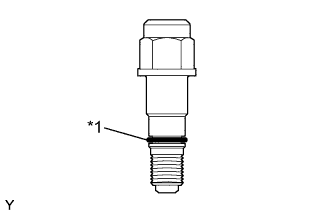
Text in Illustration *1 O-Ring Apply a light coat of fuel to the O-ring of the fuel check valve.
-
Temporarily install a new gasket and the No. 3 nozzle leakage pipe with the fuel check valve and bolt.
-
Tighten the fuel check valve and bolt.
- Torque:
- Fuel check valve
- 32 N*m { 321 kgf*cm, 23 ft.*lbf }
- Bolt
- 13 N*m { 130 kgf*cm, 9 ft.*lbf }
-
Install the No. 2 injection pipe clamp with the bolt.
- Torque:
- 6.5 N*m { 66 kgf*cm, 58 in.*lbf }
-
Connect the 3 fuel hoses.
-
-
INSTALL STARTER ASSEMBLY
-
Install the starter with the bolt and nut.
- Torque:
- 68 N*m { 693 kgf*cm, 50 ft.*lbf }
-
Install the wire harness with the nut.
- Torque:
- 9.8 N*m { 100 kgf*cm, 7 ft.*lbf }
-
Connect the connector.
-
-
INSTALL EGR COOLER ASSEMBLY
-
CONNECT CABLE TO NEGATIVE BATTERY TERMINAL
- Torque:
- 6.4 N*m { 65 kgf*cm, 57 in.*lbf }
-
BLEED AIR FROM FUEL SYSTEM
-
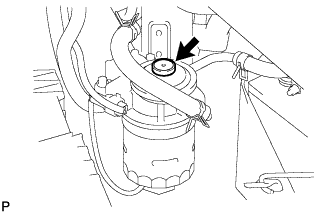
Using the hand pump, bleed air from the fuel system until pumping becomes difficult.
-
-
ADD ENGINE COOLANT
-
Pour coolant into the radiator until it overflows.
Capacity Specification Capacity w/o Heater 9.8 liters (10.3 US qts, 8.6 Imp. qts) w/ Front Heater 10.7 liters (11.3 US qts, 9.4 Imp. qts) w/ Front and Rear Heater 11.5 liters (12.2 US qts, 10.1 Imp. qts) Note
Do not substitute plain water for engine coolant.
Tech Tips
-
Use of improper coolants may damage the engine cooling system.
-
Use only Toyota Super Long Life Coolant or similar high quality ethylene glycol based non-silicate, non-amine, non-nitrite, and non-borate coolant with long-life hybrid organic acid technology (coolant with long-life hybrid organic acid technology consists of a combination of low phosphates and organic acids).
-
-
Check the coolant level inside the radiator by squeezing the inlet and outlet radiator hoses several times by hand.
If the coolant level goes down, add coolant.
-
Install the radiator cap securely.
-
Slowly pour coolant into the radiator reservoir until it reaches the FULL line.
-
Warm up the engine until the thermostat opens.
-
While the thermostat is open, circulate the coolant for several minutes.
Tech Tips
The thermostat open timing can be confirmed by pressing the inlet radiator hose by hand, and checking when the engine coolant starts to flow inside the hose.
-
-
Maintain the engine speed at 2000 to 2500 rpm.
-
Squeeze the inlet and outlet radiator hoses several times by hand while warming up the engine to bleed the air.
CAUTION:
-
Wear protective gloves.
-
Be careful as the radiator hoses are hot.
-
Keep your hands away from the fan.
When squeezing the radiator hoses:
-
-
Stop the engine and wait until the coolant cools down.
-
Remove the radiator cap and check the coolant level inside the radiator.
-
If the coolant level is below the full level, repeat the operation until the coolant level remains at the full level.
-
Check the coolant level inside the radiator reservoir tank again.
If it is below the full level, add coolant.
-
-
ADD ENGINE OIL
-
Add fresh oil and install the oil filler cap.
Engine oil Item Oil Grade Oil Viscosity (SAE) w/ DPF
-
ACEA C2
(Using engine oil other than ACEA C2 may damage catalytic converter)
-
0W-30
-
5W-30
w/o DPF
-
G-DLD1, API CF-4, CF or ACEA B1
-
5W-30
-
10W-30
-
15W-40
-
20W-50
Capacity Item Fill Amount Drain and refill with oil filter change 7.0 liters (7.4 US qts, 6.2 Imp. qts) Drain and refill without oil filter change 6.8 liters (7.2 US qts, 6.0 Imp. qts) Dry fill 7.7 liters (8.1 US qts, 6.8 Imp. qts) -
-
-
INSPECT FOR FUEL LEAK
-
Perform the Active Test.
-
Connect the intelligent tester to the DLC3.
-
Turn the ignition switch to ON.
-
Turn the intelligent tester on.
-
Enter the following menus: Powertrain / Engine and ECT / Active Test.
-
Perform the Active Test.
Intelligent Tester Display Test Part Control Range Diagnostic Note Test the Fuel Leak Pressurize the common rail interior and check for fuel leaks Stop/Start
-
Fuel pressure inside common rail pressurized to specified value and engine speed increased to 2000 rpm when ON is selected.
-
Above conditions preserved while test is ON
Tech Tips
If this Active Test is performed when the engine is cold, combustion may become unstable. However, this is not a malfunction. It is only necessary to confirm that the pressure rises to the target pressure and that there are no fuel leaks.
-
-
-
-
INSPECT FOR COOLANT LEAK
-
Remove the radiator cap.
CAUTION:
To avoid the danger of being burned, do not remove the radiator cap while the engine and radiator are still hot. Thermal expansion will cause hot engine coolant and steam to blow out from the radiator.
-
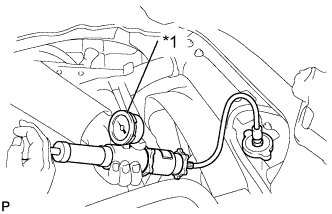
Text in Illustration *1 Radiator Cap Tester Fill the radiator with coolant and attach a radiator cap tester.
-
Warm up the engine.
-
Pump it to 118 kPa (1.2 kgf/cm2, 17.1 psi), then check that the pressure does not drop.
If the pressure drops, check the hoses, radiator and water pump for leakage. If there are no signs of external coolant leakage, check the heater core, cylinder block and head.
-
Reinstall the radiator cap.
-
-
INSPECT FOR OIL LEAK
-
Warm up the engine and inspect for oil leak.
-