RADIATOR ON-VEHICLE INSPECTION

-
RADIATOR CAP SUB-ASSEMBLY
CAUTION:
To avoid the danger or being burned, do not remove the radiator cap while the engine and radiator are still hot, as fluid and steam can be blown out under pressure.
-
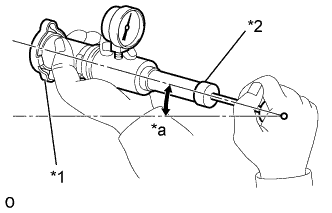
Text in Illustration *a 30°or more *1 Radiator Cap *2 Radiator Cap Tester Inspect the radiator cap.
Note
-
If the radiator cap has contaminations, always rinse it with water.
-
Before using a radiator cap tester, wet the relief valve and pressure valve with engine coolant or water.
-
When performing steps (a) and (b) below, keep the tester at an angle of over 30°above the horizontal.
-
-
Using a radiator cap tester, slowly pump the tester and check that air is coming from the vacuum valve.
Pump speed 1 push/(3 seconds or more) Note
Push the pump at a constant speed.
If air is not coming from the vacuum valve, replace the radiator cap.
-
Pump the radiator cap tester, and measure the relief valve opening pressure.
Pump speed 1 push within 1 second Note
1 push within 1 second
If air is not coming from the vacuum valve, replace the radiator cap.
-
Pump the radiator cap tester, and measure the relief valve opening pressure.
Pump speed 1 push within 1 second Note
This pump speed is for the first pump only (in order to close the vacuum valve). After this, the pump speed can be reduced.
Standerd opening pressure 93 - 123 kPa (0.95 - 1.25 kgf/cm2, 13.5 - 17.1 psi) Minimum opening pressure 78 kPa (0.8 kgf/cm2, 11.4 psi) Tech Tips
Use the tester's maximum reading as the opening pressure. If the opening pressure is less than minimum, replace the radiator cap.
-