EMISSION CONTROL SYSTEM ON-VEHICLE INSPECTION

Tech Tips
In a malfunction where the EGR system is always on, black smoke or white smoke may be output from the exhaust pipe. If this occurs, inspect the EGR system also.
Note
Always stop the engine when installing or removing the vacuum gauges, or removing the vacuum hoses.
-
INSTALL VACUUM GAUGE
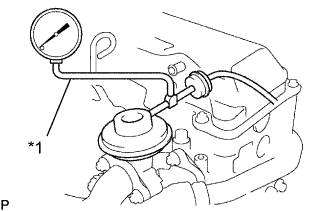
Text in Illustration *1 Vacuum Gauge Using a 3 way connector, connect a vacuum gauge to the hose between the EGR valve and E-VRV.
-
INSPECT SEATING OF EGR VALVE
Start the engine and check that the engine starts and run at idle.
-
INSPECT COLD ENGINE CONDITION
-
The coolant temperature should be below 20°C (64°F).
-
Check that the vacuum gauge indicates 0 at idle.
-
-
INSPECT HOT ENGINE CONDITION
-
Warm up the engine, the coolant temperature should be above 70°C (104°F) and below 96°C (205°F).
-
Check that the vacuum gauge indicates about more than 28.0 kPa (210 mmHg, 8.3 in.Hg) at idle.
-
Check that the vacuum gauge indicator increases about more than 28.0 kPa (210 mm Hg, 8.3 in.Hg) at 1500 rpm.
-
When the accelerator pedal is quickly depress to the full open, check that the vacuum gauge indicator drops momentarily.
-
Keep the engine speed at more than 4000 rpm.
-
Check that the vacuum gauge indicates 0.
-
When the accelerator pedal is released, check that the vacuum gauge indicator drops momentarily while the engine speed decreases from more than 4000 rpm to idle.
-
-
REMOVE VACUUM GAUGE
-
CHECK OUTPUT VACUUM WITH VACUUM GAUGE
-
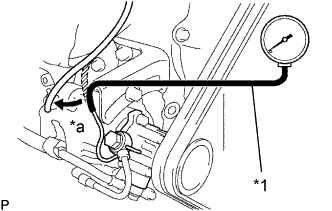
Text in Illustration *1 Vacuum Gauge *a Disconnect Connect a vacuum gauge to the output pipe.
-
Warm up the engine and check that the vacuum gauge indicates above 86.7 kPa (650 mmHg, 25.59 in.Hg).
If a problem is found, repair the vacuum pump.
-
-
INSPECT ELECTRIC EGR CONTROL VALVE ASSEMBLY
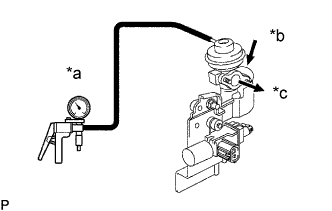
Text in Illustration *a Vacuum (26.7 kPa) *b Air IN *c Air OUT
-
Remove the EGR valve Click here.
-
When a vacuum of 26.7 kPa (200 mmHg, 7.88 in. Hg) is applied to the diaphragm chamber, check that the shaft rises up and that air flows from IN to OUT.
-
When applying more than 67 kPa (500 mmHg, 19 in. Hg) of the vacuum, check if there is any leakage of the vacuum.
-
Check the valve for sticking and heavy carbon deposits.
If a problem is found, replace it.
-
Install a new gasket and the EGR valve Click here.
-
-
INSPECT PCV SYSTEM
-
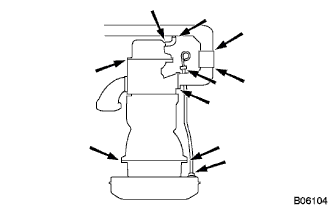
Check for cracks, leaks or damage.
-