EMISSION CONTROL SYSTEM (w/ DPF) ON-VEHICLE INSPECTION
-
SUSPEND SEATING OF EGR VALVE
-
Check that the engine starts and idles.
-
Stop the engine.
-
-
INSPECT EGR VALVE OPERATION
-
Connect the intelligent tester to the DLC3.
-
Turn the ignition switch to ON and turn the tester on.
-
Enter the following menus: Powertrain / Engine and ECT / Active Test / Control the EGR Step Position.
-
Check the Data List / Target EGR Position and Actual EGR valve pos.
OK Control Range Condition Specified Condition Active Test performed (Set EGR position to 0% → 30% → 60% → 90% → 60% → 30% → 0%) Actual EGR valve opening percentage changes according to Active Test operation If the result is not as specified, refer to DTC P042E Click here.
-
-
VISUALLY INSPECT HOSES, CONNECTIONS AND GASKETS
-
Visually check that the hoses, connections and gaskets have no cracks, leaks or damage.
Note
-
Detachment or other problems with the engine oil dipstick, filler cap, PCV hose or other components may cause the engine to run improperly.
-
Air suction caused by disconnections, looseness or cracks in the parts of the air induction system between the throttle body and cylinder head will cause engine failure or engine malfunctions.
If the result is not as specified, replace parts as necessary.
-
-
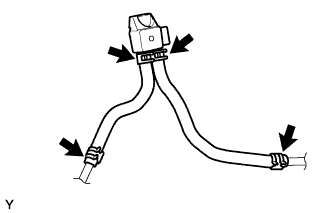
Check if the differential pressure sensor hoses are connected incorrectly, disconnected, leaking, cracked or otherwise damaged.
-
-
INSPECT VACUUM PUMP ASSEMBLY
-
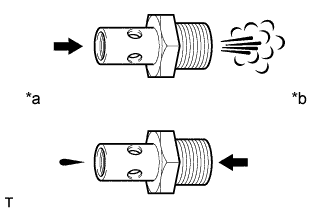
Text in Illustration *a Hose Side *b Vacuum Pump Side 
Air Check that air flows from the hose side to the vacuum pump side.
-
Check that air does not flow from the vacuum pump side to the hose side.
If necessary, replace the check valve sub-assembly.
-
-
DPF FORCIBLE REGENERATION PROCEDURE
-
Disconnect the cable from the negative (-) battery terminal or remove the EFI fuse for 1 minute or more.
Tech Tips
-
Disconnect the cable from the negative (-) battery terminal or remove the EFI fuse in order to initialize the value for the amount of particulate matter recorded by the ECM. If initialization is not performed, the Active Test cannot be performed.
-
If the MIL turns on, clear the DTCs using the intelligent tester before performing the initialization.
-
If the MIL is not illuminated, proceed to the next step, as initialization is not necessary.
-
-
Connect the intelligent tester to the DLC3.
-
Start the engine until the engine coolant temperature reaches 70°C (158°F) or higher.
-
Move the shift lever to N and set the parking brake.
-
Turn the tester on.
-
Enter the following menus: Powertrain / Engine and ECT / Active Test / Activate the DPF Rejuvenate (PM).
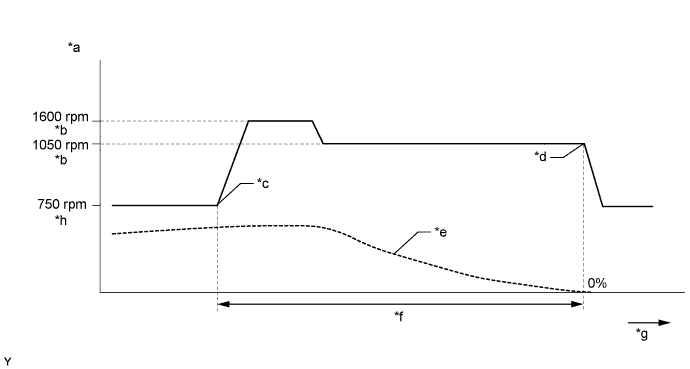
Text in Illustration *a Engine Speed *b Ambient Temperature: 25°C (77°F) *c PM Regeneration Start *d PM Regeneration Completion *e PM Volume Stored *f 15 minutes or more *g Time *h Idling CAUTION:
Before performing the Active Test, make sure that there are no combustible materials around the DPF and tailpipe.
Note
If the ambient temperature is 30°C (86°F) or higher, the DPF and surrounding area become very hot. Use a fan, etc. to cool the exhaust gas temperature sensors, air-fuel ratio sensor and surrounding areas.
Tech Tips
-
The engine speeds of 1600 rpm and 1050 rpm shown in the illustration are based on an ambient temperature of 25°C(77°F) and will vary depending on ambient temperature.
-
The engine speed increases during the Active Test and the engine speed returns to idle when the Active Test is completed.
-
The time it takes to complete the Active Test varies depending on the PM volume stored. However, it usually takes approximately 15 to 40 minutes to complete the Active Test.
-
Do not cancel the Active Test unless absolutely necessary.
-
If the Active Test needs to be canceled, depress the accelerator pedal and race the engine to cancel the process. If the Active Test is canceled, it must be performed again.
-
If the differential pressure value increases too much during the Active Test, the fail-safe function activates and the Active Test is stopped.
-
Even if the Active Test is stopped before it finishes, "Compl(complete) for DPNR/DPF Status Reju(PM)" is displayed on the intelligent tester.
-
It may not be possible to perform the Active Test when the ambient temperature is extremely low or the elevation is extremely high. In this case, perform the Active Test indoors (with the tailpipe pointed towards the outside) or drive the vehicle at a speed of approximately 60 km/h (37 mph) or more for approximately 20 minutes to perform regeneration.
-
Depending on various conditions, the Active Test may not be completed within 15 minutes. If 60 minutes elapse, the system stops the Active Test and illuminates the MIL. If this happens, disconnect the cable from the negative (-) battery terminal or remove the EFI fuse for 1 minute or more so that the MIL turns off, and then perform the Active Test again
-
-