CYLINDER BLOCK INSPECTION

Tech Tips
-
Thoroughly clean all parts to be assembled.
-
Before installing the parts, apply new engine oil to all sliding and rotating surfaces.
-
Replace all gaskets, O-rings and oil seals with new parts.
-
INSPECT OIL CHECK VALVE SUB-ASSEMBLY
-
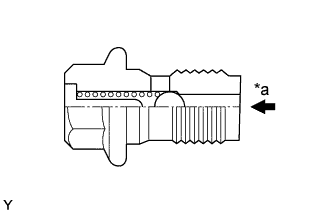
Text in Illustration *a Push Push the valve with a wooden stick to check if it is stuck.
If stuck, replace the check valve.
-
-
INSPECT SUB-ASSEMBLY OIL NOZZLE NO. 1
-
Check the oil nozzles for damage or clogging.
If necessary, replace the oil nozzle.
-
-
INSPECT CYLINDER BLOCK OIL ORIFICE
-
Check the oil orifice for damage or clogging.
If necessary, replace the oil orifice.
-
-
INSPECT CYLINDER BLOCK SUB-ASSEMBLY
-
Inspect for flatness.
-
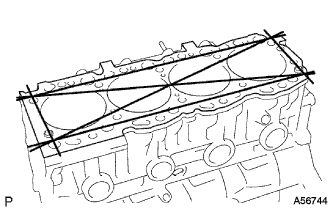
Using a precision straight edge and feeler gauge, measure the surface contacting the cylinder head cap for warpage.
Maximum warpage 0.20 mm (0.0079 in.) If warpage is greater than maximum, replace the cylinder block.
-
-
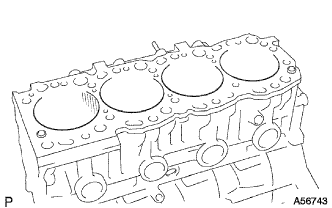
Visually check the cylinder for vertical scratches.
If deep scratches are present, rebore all the 4 cylinders. If necessary, replace the cylinder block.
-
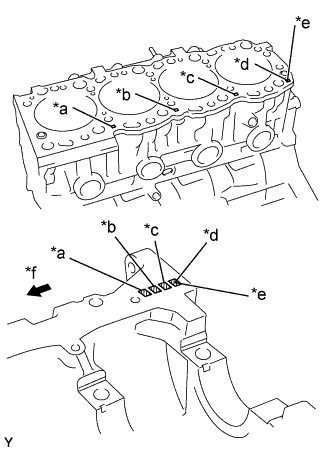
Text in Illustration *a No. 1 *b No. 2 *c No. 3 *d No. 4 *e Mark 1, 2 or 3 *f Front Inspect the cylinder bore diameter.
Tech Tips
There are 3 sizes of the standard cylinder bore diameter, marked 1, 2 and 3 accordingly. The mark is stamped on the lower left rear of the cylinder block.
-
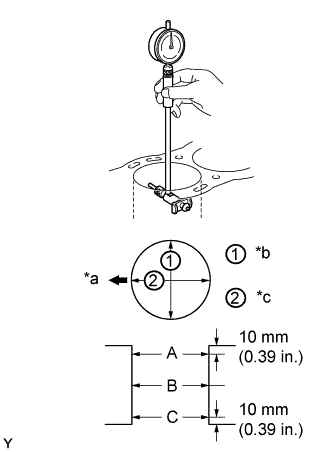
Text in Illustration *a Front *b Thrust Direction *c Axial Direction Using a cylinder gauge, measure the cylinder bore diameter at positions A, B and C in the thrust and axial directions.
Standard diameter Mark 1 99.500 - 99.510 mm (3.9173 - 3.9177 in.) Mark 2 99.510 - 99.520 mm (3.9177 - 3.9181 in.) Mark 3 99.520 - 99.530 mm (3.9181 - 3.9185 in.) Maximum diameter STD 99.73 mm (3.9264 in.) O/S 0.50 100.23 mm (3.9461 in.) If the diameter is greater than maximum, rebore all the 4 cylinders. If necessary, replace the cylinder block.
-
-
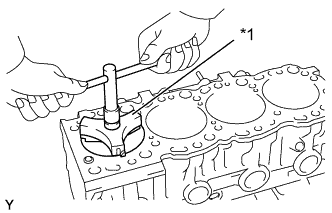
Text in Illustration *1 Ridge Reamer Remove the cylinder ridge.
If the wear is less than 0.2mm (0.008 in.), using a ridge reamer, grind the top of the cylinder.
-
-
INSPECT W/PIN PISTON SUB-ASSEMBLY
-
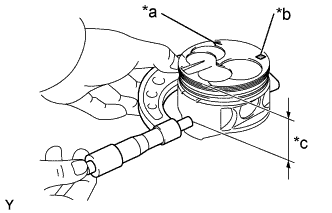
Text in Illustration *a Front Mark (Arrow) *b Size Mark *c Distance Inspect the piston oil clearance.
Tech Tips
There are 3 sizes of the standard piston diameter, marked "1", "2" and "3" accordingly. The mark is stamped on the piston top.
-
Using a micrometer, measure the piston diameter at right angles to the piston center line, the indicated distance from the piston head.
Distance 61.27 - 61.33 mm (2.4122 - 2.4146 in.) Piston diameter STD Mark 1 99.450 - 99.460 mm (3.9153 - 3.9157 in.) Mark 2 99.460 - 99.470 mm (3.9157 - 3.9161 in.) Mark 3 99.470 - 99.480 mm (3.9161 - 3.9165 in.) O/S 0.50 99.950 - 99.980 mm (3.9350 - 3.9362 in.) -
Measure the cylinder bore diameter in the thrust directions (See step 3).
-
Subtract the piston diameter measurement from the cylinder bore diameter measurement.
Standard oil clearance 0.040 - 0.060 mm (0.0016 - 0.0024 in.) Maximum oil clearance 0.13 mm (0.0051 in.) If the oil clearance is greater than maximum, replace all the 4 pistons and rebore all the 4 cylinders. If necessary, replace the cylinder block.
Tech Tips
Use a piston with the same number mark as the cylinder bore diameter marked on the cylinder block.
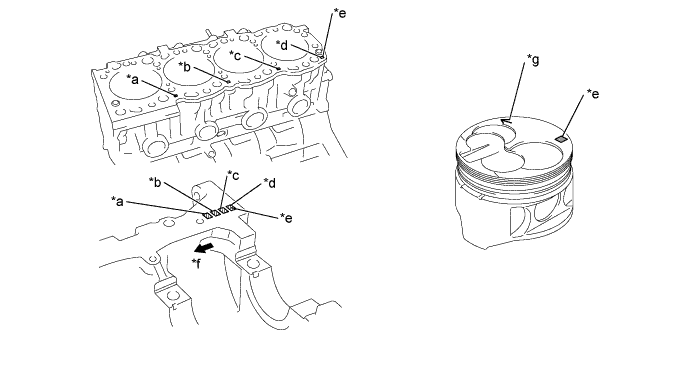
Text in Illustration *a No. 1 *b No. 2 *c No. 3 *d No. 4 *e Mark 1, 2 or 3 *f Front *g Front Mark (Arrow)
-
-
Inspect the piston pin fit.
-
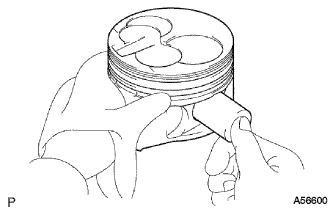
At 60°C (140°F), you should be able to push the piston pin into the piston pin hole with your thumb
If the pin can be installed at a lower temperature, replace the piston and pin as set.
-
-
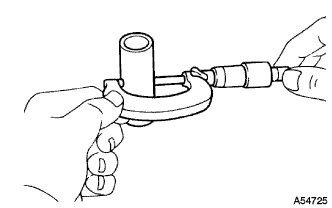
Using a micrometer, measure the piston pin diameter.
Piston pin diameter 29.000 - 29.012 mm (1.1417 - 1.1422 in.)
-
-
INSPECT PISTON RING SET
-
Inspect the piston ring groove clearance.
-
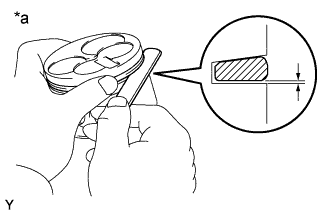
Text in Illustration *a No. 1 Ring No. 1 Ring:
Install a new piston ring to the piston. Using a feeler gauge, measure the clearance between the piston ring and the wall of the ring groove
Standard groove clearance 0.057 - 0.101 mm (0.0022 - 0.0040 in.) Maximum groove clearance 0.20 mm (0.0079 in.) If the clearance is greater than maximum, replace the piston. -
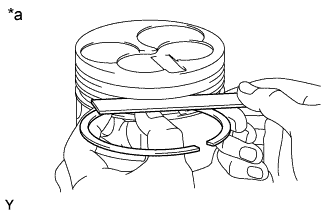
Text in Illustration *a No. 2 and Oil Rings No. 2 and Oil Rings:
Using a feeler gauge, measure the clearance between a new piston ring and the wall of the ring groove.
Standard groove clearance No. 2 0.060 - 0.100 mm (0.0024 - 0.0039 in.) Oil 0.030 - 0.070 mm (0.0012 - 0.0028 in.) Maximum groove clearance 0.20 mm (0.0079 in.) If the clearance is greater than maximum, replace the piston.
-
-
Inspect the piston ring end gap.
-
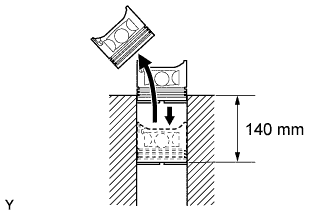
Insert the piston ring into the cylinder bore.
-
Using a piston, push the piston ring a little beyond the bottom of the ring travel, 140 mm (5.51 in.) from the top of the cylinder block.
-
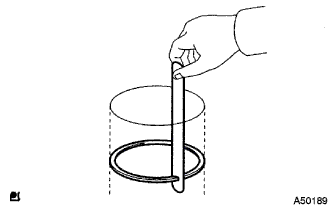
Using a feeler gauge, measure the end gap.
Standard end gap No. 1 0.350 - 0.590 mm (0.0138 - 0.0232 in.) No. 2 0.470 - 0.720 mm (0.0185 - 0.0283 in.) Oil 0.200 - 0.520 mm (0.0079 - 0.0205 in.) Maximum end gap No. 1 1.29 mm (0.0508 in.) No. 2 1.29 mm (0.0508 in.) Oil 1.22 mm (0.0480 in.) If the end gap is greater than maximum, replace the piston ring. If the end gap is greater than maximum, even with a new piston ring, rebore all the 4 cylinders or replace the cylinder block.
-
-
-
INSPECT CONNECTING ROD SUB-ASSEMBLY
-
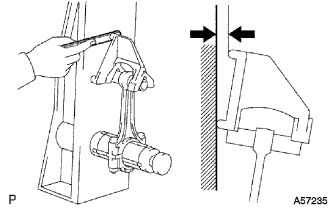
Using a rod aligner and feeler gauge, check the connecting rod alignment.
-
Check for bend.
Maximum bend 0.05 mm (0.0020 in.) per 100 mm (3.94 in.) If bend is greater than maximum, replace the connecting rod sub-assembly.
-
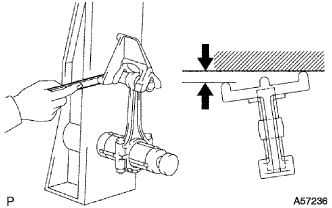
Check for twist
Maximum twist 0.15 mm (0.0059 in.) per 100 mm (3.94 in.) If twist is greater than maximum, replace the connecting rod sub-assembly.
-
-
-
INSPECT PISTON PIN OIL CLEARANCE
-
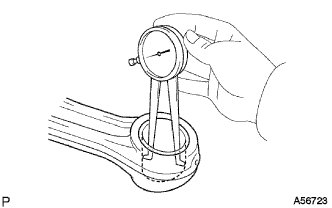
Inspect the piston pin oil clearance.
-
Using a caliper gauge, measure the inside diameter of the connecting rod bush.
Bush inside diameter 29.008 - 29.020 mm (1.1420 - 1.1425 in.) -
Subtract the piston pin diameter measurement (See step 4) from the bush inside diameter measurement.
Standard oil clearance 0.004 - 0.012 mm (0.0002 - 0.0005 in.) Maximum oil clearance 0.05 mm (0.0020 in.) If the oil clearance is greater than maximum, replace the bush.
If necessary, replace the piston and piston pin as a set.
-
-
-
INSPECT CONNECTING ROD BOLT
-
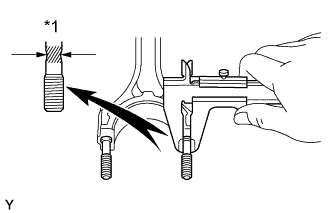
Text in Illustration *1 Compressed Bolt Using vernier calipers, measure the tension portion of the connecting rod bolt.
Standard diameter 8.400 - 8.600 mm (0.3307 - 0.3386 in.) Minimum diameter 8.20 mm (0.3228 in.) If the diameter is less than minimum, replace the bolt.
-
-
BORE CYLINDER
Tech Tips
-
Bore all the 4 cylinders for the O/S piston outside diameter.
-
Replace all the piston rings with ones to match the O/S pistons.
-
Keep 4 new O/S pistons.
O/S 0.50 piston diameter 99.950 - 99.980 mm (3.9350 - 3.9362 in.) -
Text in Illustration *a Front Mark (Arrow) *b Size Mark *c Distance Using a micrometer, measure the piston diameter at right angles to the piston pin center line, the indicated distance from the piston head.
Distance 61.27 - 61.33 mm (2.4122 - 2.4146 in.) -
Calculate the amount each cylinder is to be rebored as follows:
Size to be rebored = P + C - H P = Piston diameter C = Piston clearance: 0.040 - 0.060 mm (0.0016 - 0.0024 in.) H = Allowance for honing: 0.02mm(0.0008 in.) or less -
Bore and hone the cylinders to calculated dimensions.
Maximum honing 0.02 mm (0.0008 in.) Note
Excess honing will destroy the finished roundness.
-
-
INSPECT CRANKSHAFT
-
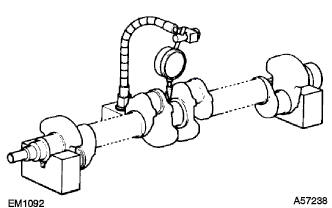
Inspect for circle runout.
-
Place the crankshaft on V-blocks.
-
Using a dial indicator, measure the circle runout at the center journal.
Maximum circle runout 0.06 mm (0.0024 in.) If the circle runout is greater than maximum, replace the crankshaft.
-
-
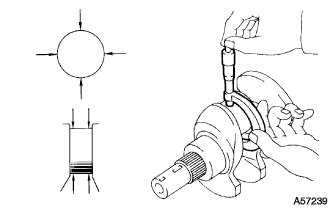
Inspect the main journals and crank pins.
-
Using a micrometer, measure the diameter of each main journal and crank pin.
Main journal diameter STD 61.985 - 62.000 mm (2.4403 - 2.4409 in.) U/S 0.25 61.745 - 61.755 mm (2.4309 - 2.4313 in.) U/S 0.50 61.495 - 61.505 mm (2.4211 - 2.4215 in.) Crank pin diameter STD 54.988 - 55.000 mm (2.1649 - 2.1654 in.) U/S 0.25 54.745 - 54.755 mm (2.1553 - 2.1557 in.) U/S 0.50 54.495 - 54.505 mm (2.1455 - 2.1459 in.) If the diameter is not as specified, check the oil clearance (See steps Click here and Click here). If necessary, grind or replace the crankshaft.
-
Check each main journal and crank pin for taper and out-of-round as shown.
Maximum taper and out-of-round 0.02 mm (0.0008 in.) If the taper and out-of-round is greater than maximum, replace the crankshaft.
-
-
If necessary, grind and hone the main journals and/or crank pins.
-
Grind and hone the main journals and/or crank pins to the finished undersized diameter (See procedure in step (b) above).
-
Install new main journal and/or crankshaft pin undersized bearing.
-
-