ECD SYSTEM (w/ EGR Cooler Bypass Valve), Diagnostic DTC:P0093
| DTC Code | DTC Name |
|---|---|
| P0093 | Fuel System Leak Detected - Large Leak |
DESCRIPTION
Tech Tips
-
If P0093 is present, refer to the "Diagnostic Trouble Code (DTC) Table for Common Rail System" Click here.
-
For more information on the common rail system, refer to the system description Click here.
| DTC No. | DTC Detection Condition | Trouble Area |
|---|---|---|
| P0093 | Fuel leaks in high-pressure areas (1 trip detection logic) |
|
Tech Tips
When DTC P0093 is set, check the internal fuel pressure of the common rail assembly by entering the following menus on the intelligent tester: Powertrain / Engine and ECT / Data List / Fuel Press.
| Reference | ||||||
|---|---|---|---|---|---|---|
|
MONITOR DESCRIPTION
P0093 (Fuel leaks in high-pressure areas):This DTC indicates that fuel leaks exist in high pressure areas in the common rail system. The ECM constantly monitors the internal fuel pressure of the common rail assembly after the engine is started. The ECM sets this DTC if the drop in the internal fuel pressure is large when injecting fuel.
In the common rail system, high-pressure fuel is always supplied to the high-pressure areas including the supply pump assembly, common rail assembly, fuel injector assembly and piping. The ECM adjusts the suction control valve opening angle to obtain the target internal fuel pressure.
If this DTC is set, the ECM enters fail-safe mode. Fail-safe mode suspends both fuel injection and supply pump operation, and then stops the engine. Before stopping the engine, the ECM permits the vehicle to be driven for 1 minute. Fail-safe mode continues until the ignition switch is turned off.
MONITOR STRATEGY
| Required sensors | Fuel pressure sensor |
| Frequency of operation | Continuous |
| Duration | 1 second |
| MIL operation | 1 driving cycle |
INSPECTION PROCEDURE
Note
-
Soon after starting the engine, visually check for fuel leaks in the fuel line.
-
After replacing the ECM, the new ECM needs registration Click here and initialization Click here.
-
After replacing the supply pump assembly, the ECM needs initialization Click here.
-
After replacing the fuel injector assembly, the ECM needs registration Click here.
Tech Tips
Read freeze frame data using the intelligent tester. Freeze frame data records the engine condition when malfunctions are detected. When troubleshooting, freeze frame data can help determine if the vehicle was running or stopped, if the engine was warmed up or not, and other data from the time the malfunction occurred.
PROCEDURE
-
CHECK FOR FUEL LEAKS (IN HIGH-PRESSURE AREAS)
-
Before starting the engine, visually check for fuel leaks from the supply pump assembly, fuel injector assembly, common rail assembly, and the fuel pipes in high-pressure areas.
OK No fuel leaks in high-pressure areas
NG 
REPAIR FUEL LEAK POINT
OK 
-
-
CHECK FOR ANY OTHER DTC OUTPUT (IN ADDITION TO DTC P0093 AND RECORD STORED AND FREEZE FRAME DATA)
-
Connect the intelligent tester to the DLC3.
-
Turn the ignition switch to ON and turn the tester on.
-
Select the following menus: Powertrain / Engine and ECT / DTC.
-
Read the DTCs and freeze frame data.
Result Display (DTC Output) Proceed to P0093 and "P0190, P0191 and/or P0193" B P0093 and "P0335 and/or P0339" C Except above A
B
GO TO FUEL PRESSURE SENSOR CIRCUIT Click here
C
GO TO CRANKSHAFT POSITION SENSOR "A" CIRCUIT Click here
A
-
-
CHECK FUEL RECEIVER GAUGE SUB-ASSEMBLY (AMOUNT OF FUEL)
-
Check if the fuel level is low.
Result Result Proceed to The indicator (fuel warning light) is illuminated A The indicator (fuel warning light) is not illuminated B
B 
CHECK FREEZE FRAME DATA (INJECTION FEEDBACK VAL #1 TO #4) Click here
A
-
-
ADD FUEL
-
Add fuel.
NEXT
-
-
CHECK WHETHER DTC OUTPUT RECURS (DTC P0093)
-
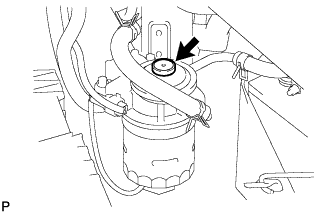
Using the hand pump mounted on the fuel filter cap, bleed the air from the fuel system. Continue pumping until the pump resistance increases.
Note
-
Hand pump pumping speed: Max. 2 strokes/sec.
-
The hand pump must be pushed with a full stroke during pumping.
-
When the fuel pressure at the supply pump inlet port reaches a saturated pressure, the hand pump resistance increases.
-
If pumping is interrupted during the air bleeding process, fuel in the fuel line may return to the fuel tank sub-assembly. Continue pumping until the hand pump resistance increases.
-
If the hand pump resistance does not increase despite consecutively pumping 200 times or more, there may be a fuel leak between the fuel tank sub-assembly and fuel filter assembly, the hand pump may be malfunctioning, or the vehicle may have run out of fuel.
-
If a large amount of air remains inside the fuel system, the common rail pressure does not rise to the pressure range necessary for normal use, and the engine cannot be started.
-
-
Start the engine.
Note
-
If a large amount of air remains inside the fuel system, the starter may need to be cranked for 10 seconds or more to start the engine.
-
Do not crank the engine continuously for more than 20 seconds. The battery may be discharged.
-
Use a fully-charged battery.
-
When the engine can be started, proceed to the next step.
-
If the engine cannot be started, bleed the air again using the hand pump until the hand pump resistance increases. Then start the engine.
-
-
Turn the ignition switch off.
-
Connect the intelligent tester to the DLC3.
-
Turn the ignition switch to ON and turn the tester on.
-
Clear DTCs Click here.
-
Start the engine. (*A)
-
Select the following menus: Powertrain / Engine and ECT / Active Test / Test the Fuel Leak. (*B)
-
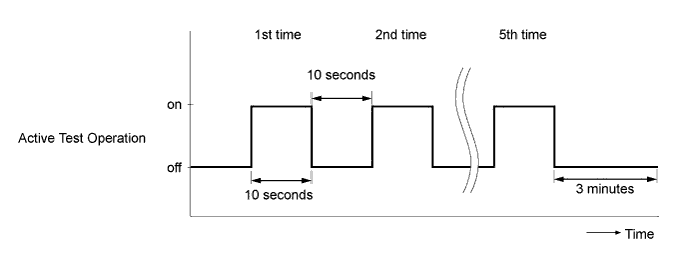
Perform the following test 5 times with on/off intervals of 10 seconds: Active Test / Test the Fuel Leak. (*C)
-
Allow the engine to idle for 3 minutes or more after performing the Active Test for the fifth time. (*D)
-
Select the following menus: Powertrain / Engine and ECT / DTC.
-
Read Current DTCs.
-
When no DTCs are output, the air bleeding is completed.
-
If any DTCs are output, proceed to the next step.
-
-
Repeat steps (*A) to (*D).
-
Clear DTCs Click here.
-
Start the engine and warm it up.
-
Confirm that the shift lever is in neutral, and securely apply the parking brake.
-
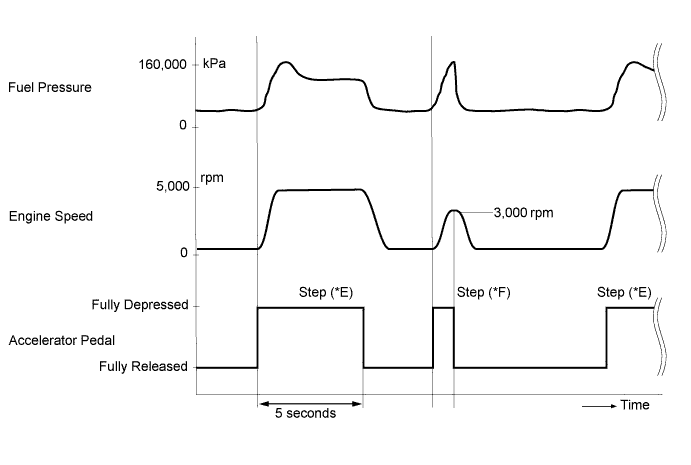
Fully depress the accelerator pedal for 5 seconds and then release it. (*E)
-
Rev the engine to 3,000 rpm and fully release the accelerator pedal immediately after the engine reaches 3,000 rpm. (*F)
-
Repeat the above procedures (*E) and (*F) 5 times.
-
Select the following menus: Powertrain / Engine and ECT / DTC.
-
Read Current DTCs.
Result Display (DTC Output) Proceed to DTC output A DTC not output B
B
DTC CAUSED BY RUNNING OUT OF FUEL
A
-
-
CHECK FREEZE FRAME DATA (INJECTION FEEDBACK VAL #1 TO #4)
-
Read the value of Injection Feedback Val #1 to #4 in the Freeze Frame Data recorded in Procedure 2.
Result Result Proceed to Injection Feedback Val for at least one cylinder is 5 mm3/st in at least 1 set of freeze frame data.
B Except above A
B
CLEAN AND REPLACE FUEL FILTER ASSEMBLY Click here
A
-
-
READ VALUE USING INTELLIGENT TESTER (FUEL PRESS)
-
Connect the intelligent tester to the DLC3.
-
Turn the ignition switch to ON and turn the tester on.
-
Clear DTCs Click here.
-
Select the following menus: Powertrain / Engine and ECT / Data List / Fuel Press.
-
Start the engine.
-
Read the Fuel Press values while cranking and idling the engine.
Result Result Proceed to The engine cannot be started or the engine can be started but Fuel Press is less than 20,000 kPa 2 seconds after the starter signal changes from off to on. B Except above A
B
REPLACE FUEL INJECTOR ASSEMBLIES OF ALL CYLINDERS Click here
A
-
-
READ VALUE USING INTELLIGENT TESTER (INJECTION FEEDBACK VAL #1 TO #4)
-
Connect the intelligent tester to the DLC3.
-
Turn the ignition switch to ON and turn the tester on.
-
Start the engine and warm it up.
-
Select the following menus: Powertrain / Engine and ECT / Data List / Injection Feedback Val #1 to #4.
-
Read values.
Standard Tester Display Engine Condition* Reference Value Injection Feedback Val #1
Injection Feedback Val #2
Injection Feedback Val #3
Injection Feedback Val #4
Idling -3.0 mm3/st to 3.0 mm3/st
Tech Tips
*: The A/C switch and all accessory switches should be off, and the engine should be fully warmed up until the engine coolant temperature reaches 70°C (158°F) or higher. Allow the engine to idle for 1 minute or more.
Result Result Proceed to Injection Feedback Val for at least one cylinder is more than 3 mm3/ st and engine vibration is abnormally large.
B Except above A
B
CLEAN AND REPLACE FUEL FILTER ASSEMBLY Click here
A
-
-
PERFORM ENGINE SPEED ACCELERATION
-
Start the engine and drive the vehicle until the engine coolant temperature reaches 60°C (140°F) or higher.
-
Stop the vehicle and allow the engine to idle.
-
Fully depress the accelerator pedal for 5 seconds and then release it.*1
-
Repeat the above procedure *1 5 times.*2
-
Check for Tachometer during procedures *1 and *2.
Result Result Proceed to Abnormalities such as engine limping and tachometer speed fluctuation are not occurring. A Except above B
B
READ VALUE USING INTELLIGENT TESTER (ENGINE SPEED) Click here
A
-
-
CLEAN AND REPLACE FUEL FILTER ASSEMBLY
-
Clean the interior of the fuel filter case.
-
If the fuel filter is obviously dirty or clogged, replace the fuel filter.
NEXT
-
-
BLEED AIR FROM FUEL SYSTEM
-
Bleed the air from the fuel system Click here.
NEXT
-
-
PERFORM ACTIVE TEST USING INTELLIGENT TESTER (TEST THE FUEL LEAK)
-
Connect the intelligent tester to the DLC3.
-
Turn the ignition switch to ON and turn the tester on.
-
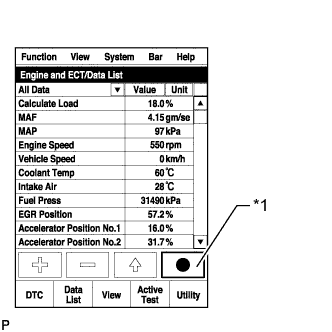
Text in Illustration *1 Snapshot Button Select the following menus: Powertrain / Engine and ECT / Active Test / Test the Fuel Leak / Data List / Fuel Press, Target Common Rail Pressure, and Target Pump SCV Current.
-
Take a snapshot with the intelligent tester during the Active Test.
Tech Tips
Detailed graphs can be displayed by transferring the stored snapshot from the tester to a PC (personal computer) with Intelligent Viewer installed.
-
Measure the difference between the target fuel pressure (Target Common Rail Pressure) and the actual fuel pressure (Fuel Press) when the Active Test / Test the Fuel Leak is performed Click here.
Tech Tips
To be fine measurements, perform the Active Test with measurements 5 times or more.
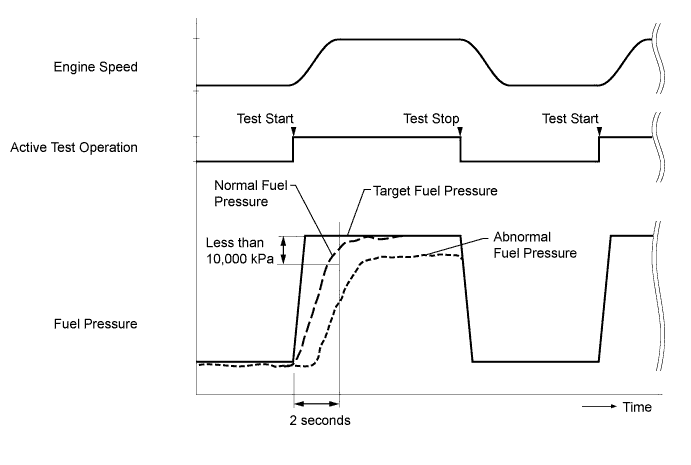
OK The difference between the target fuel pressure and the actual fuel pressure 2 seconds after the Active Test starts is less than 10,000 kPa Tech Tips
-
"Target Common Rail Pressure" is the target fuel pressure controlled by the ECM.
-
"Fuel Press" is the actual fuel pressure.
Result Result Proceed to The difference between the target fuel pressure and the actual fuel pressure 2 seconds after the Active Test starts is less than 10,000 kPa A Except above B -
B
REPLACE FUEL INJECTOR ASSEMBLIES OF ALL CYLINDERS Click here
A
-
-
PERFORM ACTIVE TEST USING INTELLIGENT TESTER (FUEL CUT FOR IDENTIFYING MALFUNCTION)
Tech Tips
Perform the Active Test below to identify the malfunctioning cylinder.
-
Connect the intelligent tester to the DLC3.
-
Start the engine and turn the tester on.
-
Select the following menus: Powertrain / Engine and ECT / Active Test / Control the Cylinder #1, #2, #3 and #4 Fuel Cut.
-
Check the four cylinders in sequence to identify any faulty cylinders by performing the power balance inspection.
Tech Tips
-
While the engine is idling, if the idling stability variation is small despite cutting off the fuel injection, the cylinder is malfunctioning.
-
With normal cylinders, the engine idles roughly when fuel injection is cut off.
-
NEXT
-
-
REPLACE FUEL INJECTOR ASSEMBLY OF MALFUNCTIONING CYLINDER
-
Replace the fuel injector assembly of the malfunctioning cylinder Click here.
NEXT
BLEED AIR FROM FUEL SYSTEM Click here
-
-
REPLACE FUEL INJECTOR ASSEMBLIES OF ALL CYLINDERS
-
Replace the fuel injector assembly Click here.
NEXT
-
-
BLEED AIR FROM FUEL SYSTEM
-
Bleed the air from the fuel system. Click here
NEXT
-
-
INJECTOR COMPENSATION CODE AND PERFORM PILOT QUANTITY LEARNING
-
Register the injector compensation code Click here.
-
Perform the fuel injector pilot quantity learning Click here.
NEXT
CHECK WHETHER DTC OUTPUT RECURS (DTC P0093) Click here
-
-
READ VALUE USING INTELLIGENT TESTER (ENGINE SPEED)
-
Connect the intelligent tester to the DLC3.
-
Turn the ignition switch to ON and turn the tester on.
-
Select the following menus: Powertrain / Engine and ECT / Data List / Engine Speed.
-
Read values while cranking and idling the engine
Standard Tester Display Engine Condition Specified Condition Engine Speed Cranking 50 to 400 rpm Idling with warm engine 700 to 800 rpm Tech Tips
The value should be the same as the actual engine speed and displayed with no interruption on the tester.
NG
REPLACE CRANKSHAFT POSITION SENSOR Click here
OK
-
-
INSPECT ECM (FUEL PRESSURE SENSOR OUTPUT VOLTAGE)
-
Connect the positive (+) probe of an oscilloscope to the fuel pressure sensor input terminal of the ECM connector and the negative (-) probe to the body ground.
-
Turn the ignition switch to ON.
-
Check for any noise in the waveform when vibration is applied to the wire harness and connectors between the fuel pressure sensor and ECM.
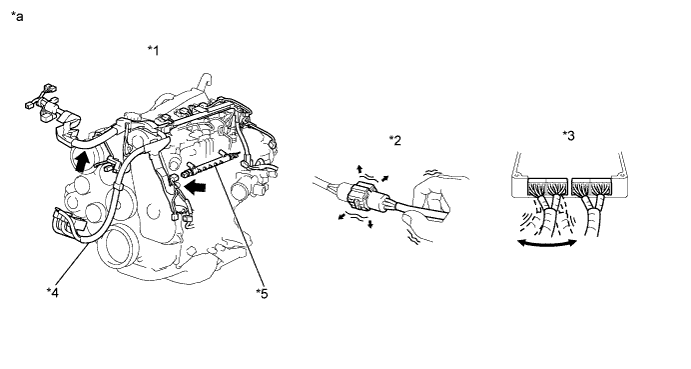
Text in Illustration *1 Engine *2 Wire to Wire *3 ECM *4 Engine Wire *5 Common Rail Assembly (Fuel Pressure Sensor) - - *a Vibration Method (Reference) - - 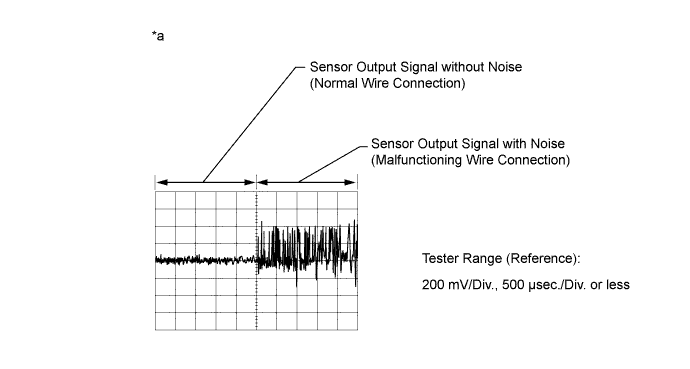
Text in Illustration *a Example - - OK No noise in the waveform Result Result Proceed to MIL comes on or noise exists in the waveform B Except above A
B
REPAIR OR REPLACE HARNESS OR CONNECTOR (ECM - FUEL PRESSURE SENSOR) Click here
A
-
-
INSPECT FUEL TEMPERATURE SENSOR (SENSOR OUTPUT)
-
Connect the intelligent tester to the DLC3.
-
Turn the ignition switch to ON and turn the tester on.
-
Select the following menus: Powertrain / Engine and ECT / Data List / Fuel Temperature.
-
Read values.
OK The value is almost the same as the actual fuel temperature Tech Tips
-
When the engine is stopped and left overnight, the fuel temperature becomes the same as the atmospheric temperature.
-
If there is a problem with the fuel temperature sensor, and a fuel temperature value lower than the actual fuel temperature is indicated, P0093 may be detected.
-
NG
REPLACE FUEL TEMPERATURE SENSOR Click here
OK
-
-
CHECK FOR INTERMITTENT PROBLEMS
-
Check for intermittent problems Click here.
NEXT
CHECK WHETHER DTC OUTPUT RECURS (DTC P0093) Click here
-
-
REPLACE CRANKSHAFT POSITION SENSOR
-
Replace the crankshaft position sensor Click here.
Tech Tips
Before replacing the crankshaft position sensor, perform a wire harness inspection and if there are any problems with the wire harness, repair or replace it.
NEXT
CHECK WHETHER DTC OUTPUT RECURS (DTC P0093) Click here
-
-
REPAIR OR REPLACE HARNESS OR CONNECTOR (ECM - FUEL PRESSURE SENSOR)
-
Repair or replace the harness or connector.
NEXT
-
-
INSPECT ECM (FUEL PRESSURE SENSOR OUTPUT VOLTAGE)
-
Connect the positive (+) probe of an oscilloscope to the fuel pressure sensor input terminal of the ECM connector and the negative (-) probe to the body ground.
-
Turn the ignition switch to ON.
-
Check for any noise in the waveform when vibration is applied to the wire harness and connectors between the fuel pressure sensor and ECM.
OK No noise in the waveform Result Result Proceed to MIL comes on or noise exists in the waveform A Except above B
B
CHECK WHETHER DTC OUTPUT RECURS (DTC P0093) Click here
A
-
-
REPLACE COMMON RAIL ASSEMBLY
-
Replace the common rail assembly Click here.
NEXT
-
-
BLEED AIR FROM FUEL SYSTEMS
-
Bleed the air from the fuel system Click here.
NEXT
CHECK WHETHER DTC OUTPUT RECURS (DTC P0093) Click here
-
-
REPLACE FUEL TEMPERATURE SENSOR
-
Replace the fuel temperature sensor Click here.
NEXT
-
-
CHECK WHETHER DTC OUTPUT RECURS (DTC P0093)
-
Connect the intelligent tester to the DLC3.
-
Turn the ignition switch to ON and turn the tester on.
-
Select the following menus: Powertrain / Engine and ECT / DTC.
-
Clear DTCs Click here.
-
Start the engine and warm it up.
-
Confirm that the shift lever is in neutral, and securely apply the parking brake.
-
Fully depress the accelerator pedal for 5 seconds and then release it. (*A)
-
Rev the engine to 3,000 rpm and fully release the accelerator pedal immediately after the engine reaches 3,000 rpm. (*B)
-
Repeat the above procedures (*A) and (*B) 5 times.
-
Select the following menus: Powertrain / Engine and ECT / DTC.
-
Read DTCs.
OK No DTCs are output
NEXT 
END
-