ECD SYSTEM (w/ DPF), Diagnostic DTC:P0617
| DTC Code | DTC Name |
|---|---|
| P0617 | Starter Relay Circuit High |
DESCRIPTION
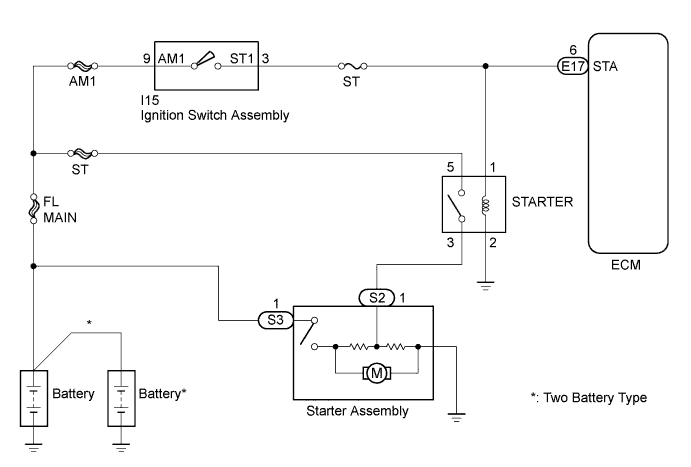
While the engine is being cranked, positive battery voltage is applied to terminal STA of the ECM.
If the ECM detects the starter control (STA) signal while the vehicle is being driven, it determines that there is a malfunction in the STA circuit. The ECM then illuminates the MIL and stores the DTC.
This monitor runs when the vehicle has been driven at 20 km/h (12.5 mph) or more for more than 20 seconds.
| DTC Detection Drive Pattern | DTC Detection Condition | Trouble Area |
|---|---|---|
| Drive the vehicle for 25 seconds or more at a speed of 20 km/h (12.5 mph) or more and an engine speed of 1000 rpm or more | Conditions (a), (b) and (c) are met for 20 seconds (1 trip detection logic): (a) Vehicle speed is more than 20 km/h (12.5 mph). (b) Engine speed is more than 1000 rpm. (c) STA signal is on. |
|
| DTC No. | Data List |
|---|---|
| P0617 | Starter Signal |
WIRING DIAGRAM
INSPECTION PROCEDURE
Note
-
Inspect the fuses of circuits related to this system before performing the following inspection procedure.
-
After replacing the ECM, the new ECM needs registration Click here and initialization Click here.
-
After replacing the fuel supply pump assembly or suction control valve, the ECM needs initialization Click here.
-
After replacing an injector assembly, the ECM needs registration Click here.
Tech Tips
-
The following troubleshooting process is based on the premise that the engine can crank normally. If the engine does not crank, proceed to Problem Symptoms Table Click here.
-
If this DTC is output, inspect the starter assembly.
-
Read freeze frame data using the intelligent tester. Freeze frame data records the engine condition when malfunctions are detected. When troubleshooting, freeze frame data can help determine if the vehicle was moving or stationary, if the engine was warmed up or not, and other data from the time the malfunction occurred.
PROCEDURE
-
READ VALUE USING INTELLIGENT TESTER (STARTER SIGNAL)
-
Connect the intelligent tester to the DLC3.
-
Turn the ignition switch to ON and turn the tester on.
-
Enter the following menus: Powertrain / Engine and ECT / Data List / Starter Signal.
-
Read the value displayed on the tester when the ignition switch is turned to ON.
OK Ignition Switch Position Starter Signal ON OFF START ON Result Result Proceed to NG A OK B
B 
CONFIRM WHETHER DTC OUTPUT RECURS Click here
A 
-
-
INSPECT IGNITION SWITCH ASSEMBLY
-
Inspect the ignition switch assembly Click here.
NG
REPLACE IGNITION SWITCH ASSEMBLY Click here
OK
-
-
CHECK HARNESS AND CONNECTOR (ECM - IGNITION SWITCH ASSEMBLY - STARTER RELAY HOLDER)
-
Disconnect the ignition switch assembly connector.
-
Disconnect the ECM connector.
-
Remove the STARTER relay from the engine room relay block.
-
Measure the resistance according to the value(s) in the table below.
Standard Resistance Tester Connection Condition Specified Condition I15-3 (ST1) or E17-6 (STA) or STARTER relay holder 1 - Body ground and other terminals Always 10 kΩ or higher
NG
REPAIR OR REPLACE HARNESS OR CONNECTOR Click here
OK
-
-
REPLACE ECM
-
Replace the ECM Click here.
NEXT
CONFIRM WHETHER DTC OUTPUT RECURS Click here
-
-
REPLACE IGNITION SWITCH ASSEMBLY
-
Replace the ignition switch assembly Click here.
NEXT
CONFIRM WHETHER DTC OUTPUT RECURS Click here
-
-
REPAIR OR REPLACE HARNESS OR CONNECTOR
-
Repair or replace the harness or connector.
NEXT
-
-
CONFIRM WHETHER DTC OUTPUT RECURS
-
Connect the intelligent tester to the DLC3.
-
Turn the ignition switch to ON and turn the tester on.
-
Clear the DTCs Click here.
-
Turn the ignition switch off.
-
Turn the ignition switch to ON.
-
Drive the vehicle for 25 seconds or more at a speed of 20 km/h (12.5 mph) or more and an engine speed of 1000 rpm or more.
CAUTION:
When performing the confirmation driving pattern, obey all speed limits and traffic laws.
-
Confirm that the DTC is not output again.
NEXT 
END
-