ECD SYSTEM (w/ DPF) PRECAUTION
-
INITIALIZATION AND REGISTRATION
Note
When replacing the ECM and/or any other components in the following chart, perform the corresponding utility items.
Tech Tips
When the ECM and one or more other components are replaced at the same time, perform the following utility items by following the instructions shown on the tester display, starting with the ECM.
Replacement Part Utility Item ECM
-
Learning Values Save Click here
-
Learning Values Write Click here
Engine assembly
-
Clear Crank Time Compensation Data Click here
-
Input Injector Compensation Code Click here
-
Pilot Quantity Learning Click here
Crankshaft position sensor plate Clear Crank Time Compensation Data Click here
Air fuel ratio sensor Clear A/F Sensor Compensation Data Click here
Fuel supply pump assembly or suction control valve Supply Pump Initialization Click here
DPF catalyst
-
Clear DPF Thermal Deterioration Data Click here
-
Learning Values Write Click here
Injector assembly
-
Input Injector Compensation Code Click here
-
Pilot Quantity Learning Click here
Tech Tips
When the ECM must be replaced, before replacing the ECM, perform the "Learning Values Save" function using the intelligent tester. Then after installing the new ECM, perform all of the initializations/registrations for the "Learning Values Write" function by following the instructions shown on the tester display.
-
-
INJECTOR COMPENSATION CODE
Tech Tips
-
Each injector assembly has different fuel injection characteristics. In order to optimize fuel injection performance, the ECM compensates for these differences by adjusting the fuel injection duration of each injector assembly according to its compensation code. Injector compensation codes are unique, 30-digit, alphanumeric values printed on the head portion of each injector assembly.
-
If an incorrect injector compensation code is input into the ECM, the engine may rattle or engine idling may become rough. In addition, engine failure may occur and the life of the engine may be shortened.
-
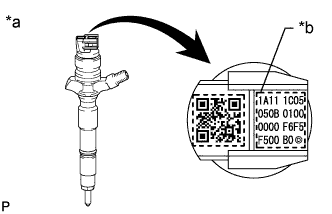
Text in Illustration *a Example *b Injector Compensation Code When an injector assembly is replaced, the injector compensation code must be input into the ECM Click here.
-
When the ECM is replaced, all of the existing injector compensation codes must be input into the new ECM Click here.
-
-
CATALYST RECORD OF DPF THERMAL DETERIORATION
Tech Tips
The ECM stores the history data of DPF catalyst thermal deterioration. This data is updated continuously and is then converted to an 8-digit code and is stored in the EEPROM. If the ECM determines that replacement of the DPF catalyst is required based on the thermal deterioration data, the DTC is stored to inform the driver.
-
When only the DPF catalyst is replaced.
-
After replacing the DPF catalyst, clear the thermal deterioration data stored in the ECM Click here.
-
-
When only the ECM is replaced.
-
After replacing the ECM, input the original thermal deterioration data stored before replacement Click here.
Note
-
Read the thermal deterioration data stored in the ECM before replacement, and store the data in the intelligent tester.
-
If the thermal deterioration data cannot be read, be sure to replace the DPF catalyst with a new one and initialize the ECM Click here.
-
-
-
After replacing both the DPF catalyst and the ECM, clear the thermal deterioration data stored in the new ECM Click here.
Tech Tips
Clearing the thermal codes is required because initialization codes are stored in a new ECM. Failure to do this will cause a DTC to be stored.
-
-
PILOT QUANTITY LEARNING
Tech Tips
-
By performing "Pilot Quantity Learning", the injection volume for each cylinder is precisely adjusted so that the engine runs smoothly. The "Pilot Quantity Learning" information is stored in the EEPROM of the ECM.
-
If an incorrect pilot quantity learning value is input into the ECM, the engine may rattle or engine idling may become rough.
-
When an injector assembly is replaced, the injector compensation code must be input to the ECM, and then pilot quantity learning must be performed Click here.
-
When the ECM is replaced, all of the existing injector pilot quantity learning values must be input into the new ECM Click here.
-
-
ENGINE DIFFICULT TO START, ENGINE STALLING, BLACK SMOKE EMITTED, ROUGH IDLING, EXCESSIVE ENGINE VIBRATION, ENGINE KNOCKING, LACK OF POWER OR HESITATION
-
Check if the customer problem is described below. If so, refer to the appropriate troubleshooting section.
-
Engine is difficult to start or stalling.
-
Black smoke is emitted.
-
There is rough idling or excessive engine vibrations.
-
There is engine knocking or rattling.
-
There is a lack of power or hesitation.
-
-
-
WHEN USING INTELLIGENT TESTER
CAUTION:
-
Observe the following items for safety reasons:
-
Read the tester's instruction books before using the tester.
-
Make sure that the tester cable is not caught on the pedals, shift lever or steering wheel when driving with the tester connected to the vehicle.
-
When driving the vehicle for testing purposes using the tester, two persons are required. One drives the vehicle and the other operates the tester.
-