ECD SYSTEM, Diagnostic DTC:P2563, P2564, P2565, P2588, P2589
| DTC Code | DTC Name |
|---|---|
| P2563 | Turbocharger/Supercharger Boost Control Position Sensor "A" Circuit Range/Performance |
| P2564 | Turbocharger/Supercharger Boost Control Position Sensor "A" Circuit Low |
| P2565 | Turbocharger/Supercharger Boost Control Position Sensor "A" Circuit High |
| P2588 | Turbocharger/Supercharger Boost Control Position Sensor "B" Circuit Low |
| P2589 | Turbocharger/Supercharger Boost Control Position Sensor "B" Circuit High |
DESCRIPTION
The variable nozzle vane type turbocharger consists primarily of a compressor wheel, turbine wheel, nozzle vane, unison ring, DC motor and nozzle vane position sensor.
The nozzle vane position sensor consists of a Hall IC and a magnetic yoke that rotates in unison with the movement of the linkage that actuates the nozzle vane. The nozzle vane position sensor converts the changes in the magnetic flux that are caused by the rotation of the DC motor (hence, the rotation of the magnetic yoke) into electric signals, and outputs them to the turbo motor driver. The turbo motor driver determines the actual nozzle vane position from the electric signals in order to calculate the target nozzle vane position.
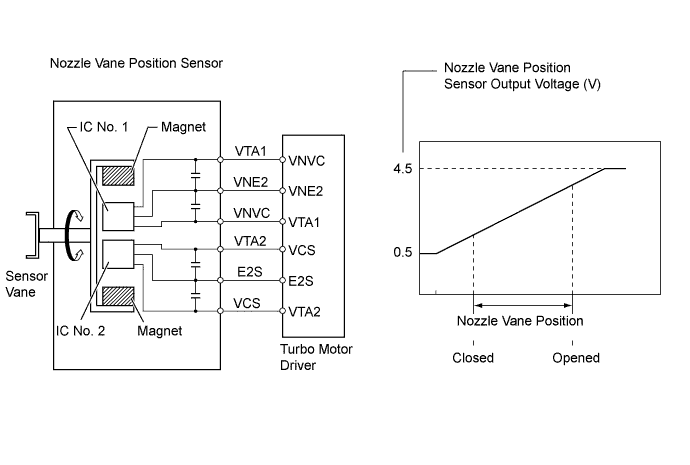
| DTC No. | DTC Detection Condition | Trouble Area |
|---|---|---|
| P2563 | Difference between VTA1 and VTA2 0.8 V or more for 0.5 seconds or more (1 trip detection logic) |
Nozzle vane position sensor (Turbocharger sub-assembly) |
| P2564 | VTA1 0.5 V or less for 0.5 seconds or more (1 trip detection logic) |
|
| P2565 | VTA1 4.5 V or more for 0.5 seconds or more (1 trip detection logic) |
|
| P2588 | VTA2 0.5 V or less for 0.5 seconds or more (1 trip detection logic) |
|
| P2589 | VTA2 4.5 V or more for 0.5 seconds or more (1 trip detection logic) |
|
WIRING DIAGRAM
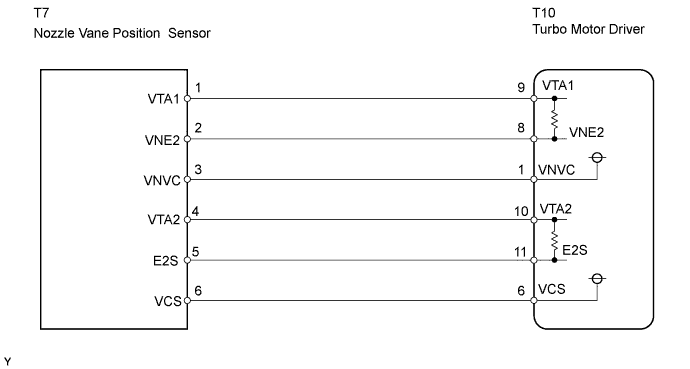
INSPECTION PROCEDURE
Tech Tips
Read freeze frame data using the intelligent tester. Freeze frame data records the engine conditions when a malfunction is detected. When troubleshooting, freeze frame data can help determine if the vehicle was running or stopped, if the engine was warmed up or not, and other data from the time the malfunction occurred.
PROCEDURE
-
CHECK ANY OTHER DTCS OUTPUT (ADDITION TO DTC P2563, P2564, P2565, P2588 AND/OR P2589)
-
Connect the intelligent tester tot the DLC3.
-
Turn the ignition switch ON and turn the tester ON.
-
Select the following menu items: Powertrain / Engine and ECT / DTC.
-
Read DTCs.
Result Display (DTC Output) Proceed To P2563, P2564, P2565, P2588 and/or P2589 A P2563, P2564, P2565, P2588 and/or P2589, and other DTCs B
B 
GO TO DTC CHART Click here
A 
-
-
CHECK HARNESS AND CONNECTOR (NOZZLE VANE POSITION SENSOR - TURBO MOTOR DRIVER)
-
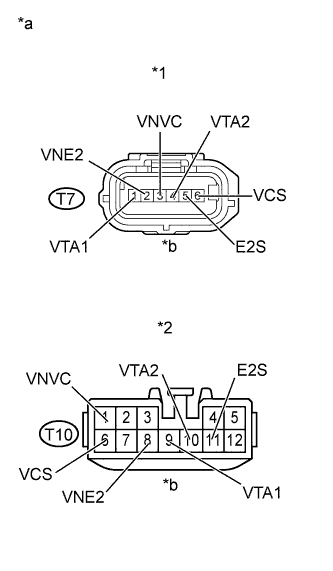
Text in Illustration *1 Nozzle Vane Position Sensor Connector *2 Turbo Motor Driver Connector *a Wire Harness Side *b Front View Disconnect the T7 nozzle vane position sensor connector.
-
Disconnect the T10 turbo motor driver connector.
-
Check the resistance.
Standard resistance (Check for open) Tester Connections Specified Conditions T7-1 (VTA1) - T10-9 (VTA1) Below 1 Ω T7-2 (VNE2) - T10-8 (VNE2) Below 1 Ω T7-3 (VNVC) - T10-1 (VNVC) Below 1 Ω T7-4 (VTA2) - T10-10 (VTA2) Below 1 Ω T7-5 (E2S) - T10-11 (E2S) Below 1 Ω T7-6 (VCS) - T10-6 (VCS) Below 1 Ω Standard resistance (Check for short) Tester Connections Specified Conditions T7-1 (VTA1) or T10-9 (VTA1) - Body ground 10 kΩ or higher T7-2 (VNE2) or T10-8 (VNE2) - Body ground 10 kΩ or higher T7-3 (VNVC) or T10-1 (VNVC) - Body ground 10 kΩ or higher T7-4 (VTA2) or T10-10 (VTA2) - Body ground 10 kΩ or higher T7-5 (E2S) or T10-11 (E2S) - Body ground 10 kΩ or higher T7-6 (VCS) or T10-6 (VCS) - Body ground 10 kΩ or higher -
Reconnect the turbo motor driver connector.
-
Reconnect the nozzle vane position sensor connector.
NG
REPAIR OR REPLACE HARNESS OR CONNECTOR
OK
-
-
INSPECT TURBO MOTOR DRIVER (VNVC AND VCS VOLTAGE)
-
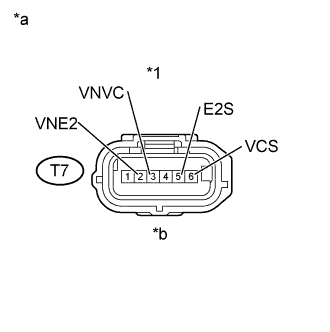
Text in Illustration *1 Nozzle Vane Position Sensor Connector *a Component Side *b Front View Disconnect the T7 nozzle vane position sensor connector.
-
Turn the ignition switch ON.
-
Measure the voltage between the terminals of the nozzle vane position sensor connector.
Standard voltage Tester Connections Specified Conditions T7-3 (VNVC) - T7-2 (VNE2) 4.5 to 5.5 V T7-6 (VCS) - T7-2 (VNE2) 4.5 to 5.5 V -
Reconnect the nozzle vane position sensor connector.
NG
REPLACE TURBO MOTOR DRIVER
OK
-
-
INSPECT TURBOCHARGER SUBASSEMBLY (NOZZLE VANE POSITION SENSOR)
-
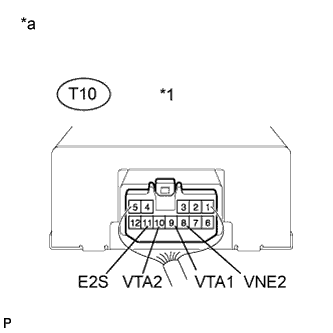
Text in Illustration *1 Turbo Motor Driver *a Component Side Turn the ignition switch to ON.
-
Measure the voltage between the terminals of the turbo motor driver connector.
Standard voltage Tester Connections Specified Conditions T10-9 (VTA1) - T10-8 (VNE2) 0.5 to 4.5 V T10-10 (VTA2) - T10-11 (E2S) 0.5 to 4.5 V -
Check the difference between the voltage values.
Result Voltage difference between VTA1 and VTA2 is within 0.8 V
NG
REPLACE TURBOCHARGER SUB-ASSEMBLY (NOZZLE VANE POSITION SENSOR) Click here
OK
-
-
REPLACE TURBO MOTOR DRIVER
NEXT
-
CHECK WHETHER DTC OUTPUT RECURS (P2564, P2565, P2588 AND/OR P2589)
-
Connect the intelligent tester to the DLC3.
-
Turn the ignition switch ON and turn the tester ON.
-
Clear DTCs Click here.
-
Start the engine.
-
Allow the engine to idle for 5 seconds.
-
Select the following menu items: Powertrain / Engine and ECT / DTC.
-
Read DTCs.
Result Display (DTC output) Proceed to P2564, P2565, P2588 and/or P2589 is output again A No output B
B
SYSTEM IS OK
A 
REPLACE TURBOCHARGER SUB-ASSEMBLY (NOZZLE VANE POSITION SENSOR) Click here
-