ECD SYSTEM, Diagnostic DTC:P0200
| DTC Code | DTC Name |
|---|---|
| P0200 | Injector Circuit / Open |
DESCRIPTION
Tech Tips
-
For more information on the injector driver (EDU), refer to the system description Click here.
-
If P0200 is present, refer to the "Diagnostic Trouble Code (DTC) Table for Common Rail System" Click here.
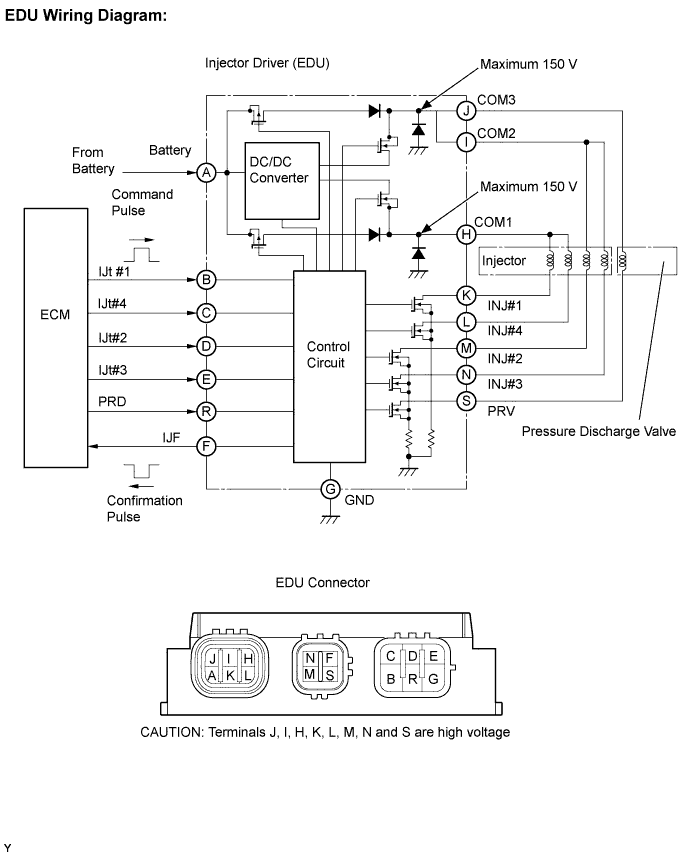
The EDU drives the injectors at high speeds. The EDU delivers high-speed drive signals under high-pressure fuel conditions using the DC/DC converter, which provides a high-voltage and quick-charging system.
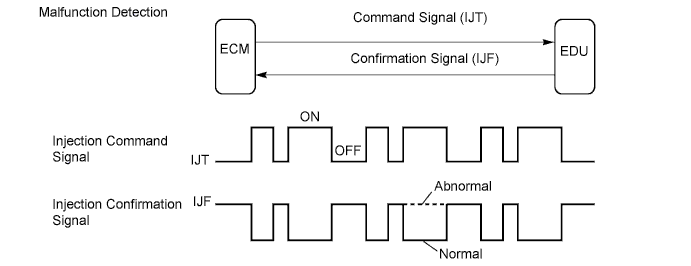
Soon after the EDU receives an injection command (IJt) signal from the ECM, the EDU responds to the command with an injector injection confirmation (IJf) signal when the current is applied to the injector.
| DTC No. | DTC Detection Condition | Trouble Area |
|---|---|---|
| P0200 | Open or short in injector driver (EDU) or injector circuit After engine is started, there is no IJf signal from EDU to ECM, despite ECM sending IJt signals to EDU (1 trip detection logic) |
|
MONITOR DESCRIPTION
-
The ECM continuously monitors both injection command (IJt) signals and injection confirmation (IJf) signals. This DTC will be set if the ECM judges that the number of IJt signals and IJf signals are inconsistent.
P0200 (Open or short in injector driver (EDU) or injector circuit):
The injectors are grounded over a Field Effect Transistor (FET) and a serial resistor. This resistor creates a voltage drop, which is monitored by the EDU (injector drive circuit), in relation to the current drawn by the injector. When the injector current becomes too high, the voltage drop over the resistor exceeds a specified level and no IJF signal for that cylinder is sent to the ECM.
P0200 refers to a malfunction in the EDU or injector circuit.
If this DTC is set, the ECM enters fail-safe mode and limits the engine power. The fail-safe mode continues until the ignition switch is turned OFF.
WIRING DIAGRAM
INSPECTION PROCEDURE
Tech Tips
-
If P0200 and P1271 are present simultaneously, there is an open in the INJF wire harness between the EDU and ECM, or there is an open in the wire harness for both injector and pressure discharge valve.
-
Read freeze frame data using the intelligent tester. Freeze frame data records the engine conditions when a malfunction is detected. When troubleshooting, freeze frame data can help determine if the vehicle was running or stopped, if the engine was warmed up or not, and other data from the time the malfunction occurred.
Note
If the ECM is replaced, the new ECM needs initialization Click here.
PROCEDURE
-
CHECK ANY OTHER DTCS OUTPUT (IN ADDITION TO DTC P0200)
-
Connect the intelligent tester to the DLC3.
-
Turn the ignition switch ON and turn the tester ON.
-
Select the following menu items: Powertrain / Engine and ECT / DTC.
-
Read DTCs.
Result Display (DTC Output) Proceed to P0200 and P1238 A P0200 B
B 
INSPECT INJECTOR ASSEMBLY Click here
A 
-
-
READ VALUE USING INTELLIGENT TESTER (COMPENSATION OF INJECTION VOLUME BETWEEN CYLINDERS)
-
Connect the intelligent tester to the DLC3.
-
Start the engine and warm it up. Turn the tester ON.
-
Select the following menu items: Powertrain / Engine and ECT / Data List / Injection Feedback Val #1, #2, #3 and #4.
-
Read the value.
Standard The compensatory injection volume is between -4.9 mm3 to 4.9 mm3 Tech Tips
-
If the injector is malfunctioning, the compensatory injection volume remains at -5.0 mm3to 5.0mm3
-
The compensatory injection volume is between -3.0 mm3and 3.0mm3
-
-
Inspect and repair the cylinder that has an improper compensation value according to the following steps.
NEXT
-
-
INSPECT INJECTOR ASSEMBLY
-
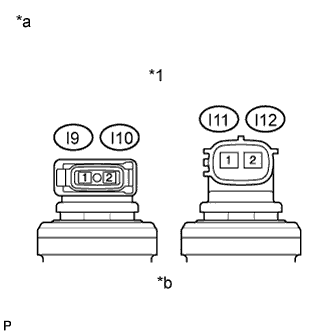
Text in Illustration *1 Injector *a Component Side *b Front View Disconnect the I9, I10, I11 and I12 injector connectors.
-
Measure the resistance of the injector.
Standard resistance Tester Connection Specified Condition 1 - 2 0.85 to 1.05 Ω at 20°C (68°F) -
Reconnect the injector connectors.
NG 
REPLACE INJECTOR ASSEMBLY
OK
-
-
CHECK HARNESS AND CONNECTOR (INJECTOR - EDU)
-
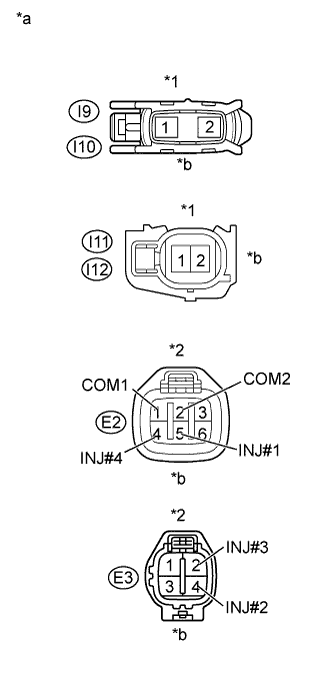
Text in Illustration *1 Injector Connector *2 EDU Connector *a Wire Harness Side *b Front View Check the wire harness between the injector and EDU (INJ terminal).
-
Disconnect the I9, I10, I11 and I12 injector connectors.
-
Disconnect the E2 and E3 EDU connectors.
-
Check the resistance.
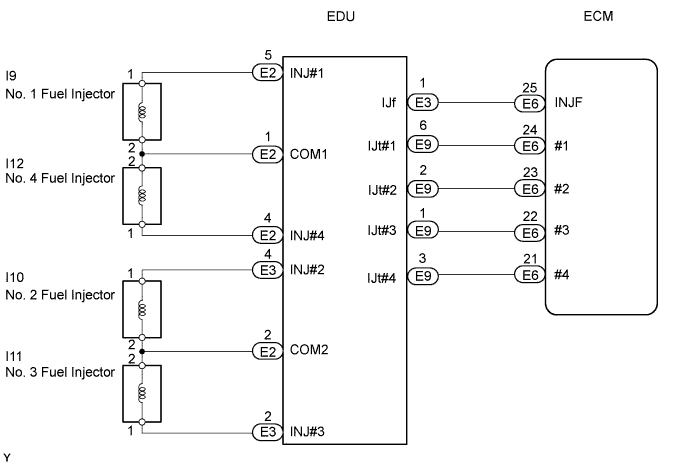
Standard resistance (Check for open) Tester Connection Specified Condition I9-2 - E2-5 (INJ#1) Below 1 Ω I10-2 - E3-4 (INJ#2) Below 1 Ω I11-1 - E3-2 (INJ#3) Below 1 Ω I12-1 - E2-4 (INJ#4) Below 1 Ω I9-1 - E2-1 (COM1) Below 1 Ω I10-1 - E2-2 (COM2) Below 1 Ω I11-2 - E2-2 (COM2) Below 1 Ω I12-2 - E2-1 (COM1) Below 1 Ω Standard resistance (Check for short) Tester Connection Specified Condition I9-2 or E2-5 (INJ#1) - Body ground 10 kΩ or higher I10-2 or E3-4 (INJ#2) - Body ground 10 kΩ or higher I11-1 or E3-2 (INJ#3) - Body ground 10 kΩ or higher I12-1 or E2-4 (INJ#4) - Body ground 10 kΩ or higher I9-1 or E2-1 (COM1) - Body ground 10 kΩ or higher I10-1 or E2-2 (COM2) - Body ground 10 kΩ or higher I11-2 or E2-2 (COM2) - Body ground 10 kΩ or higher I12-2 or E2-1 (COM1) - Body ground 10 kΩ or higher -
Reconnect the injector connectors.
-
Reconnect the E2 EDU connector.
-
NG
REPAIR OR REPLACE HARNESS OR CONNECTOR
OK
-
-
CHECK HARNESS AND CONNECTOR (EDU - ECM)
-
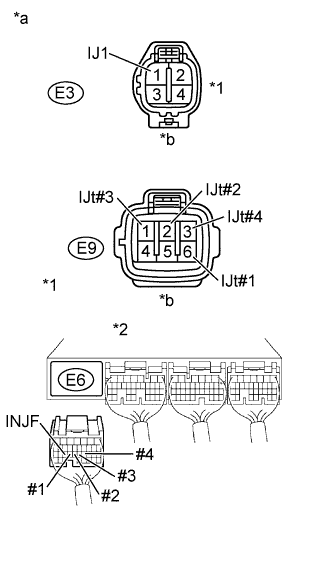
Text in Illustration *1 EDU Connector *2 ECM Connector *a Wire Harness Side *b Front View Disconnect the E3 and E9 EDU connectors.
-
Disconnect the E6 ECM connector.
-
Check the resistance.
Standard resistance (Check for open) Tester Connection Specified Condition E9-6 (IJt#1) - E6-24 (#1) Below 1 Ω E9-2 (IJt#2) - E6-23 (#2) Below 1 Ω E9-1 (IJt#3) - E6-22 (#3) Below 1 Ω E9-3 (IJt#4) - E6-21 (#4) Below 1 Ω E3-1 (IJf) - E6-25 (INJF) Below 1 Ω Standard resistance (Check for short) Tester Connection Specified Condition E9-6 (IJt#1) or E6-24 (#1) - Body ground 10 kΩ or higher E9-2 (IJt#2) or E6-23 (#2) - Body ground 10 kΩ or higher E9-1 (IJt#3) or E6-22 (#3) - Body ground 10 kΩ or higher E9-3 (IJt#4) or E6-21 (#4) - Body ground 10 kΩ or higher E3-1 (IJf) or E6-25 (INJF) - Body ground 10 kΩ or higher -
Reconnect the EDU connectors.
-
Reconnect the ECM connector.
NG
REPAIR OR REPLACE HARNESS OR CONNECTOR
OK
-
-
CHECK TERMINAL VOLTAGE (EDU POWER SOURCE)
-
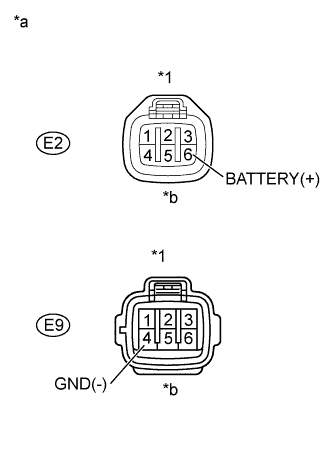
Text in Illustration *1 EDU Connector *a Wire Harness Side *b Front View Disconnect the E2 and E9 EDU connectors.
-
Turn the ignition switch ON.
-
Measure the voltage of the wire harness side connectors.
Standard voltage Tester Connection Specified Condition E2-6 (BATTERY) - E9-4 (GND) 11 to 14 V -
Reconnect the EDU connectors.
NG
CHECK INJECTOR DRIVER POWER SOURCE CIRCUIT (BATTERY - EDU)
OK
-
-
INSPECT ECM TERMINAL VOLTAGE (INJECTOR VOLTAGE)
-
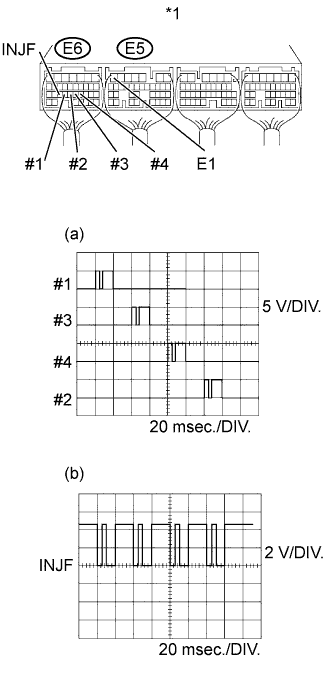
Text in Illustration *1 ECM Connector While idling the engine, check the waveform of the ECM connectors using an oscilloscope.
OK Tester Connection Specified Condition E6-24 (#1) - E5-7 (E1) Correct waveform is as shown E6-23 (#2) - E5-7 (E1) Correct waveform is as shown E6-22 (#3) - E5-7 (E1) Correct waveform is as shown E6-21 (#4) - E5-7 (E1) Correct waveform is as shown E6-25 (INJF) - E5-7 (E1) Correct waveform is as shown Tool Setting Condition (a) 5 V/DIV., 20 msec./DIV. Idling with warm engine (b) 2 V/DIV., 20 msec./DIV. Tech Tips
The waveform varies depending on the injector injection.
NG
REPLACE ECM
OK
-
-
REPLACE INJECTOR DRIVER
Replace the injector driver Click here.
NEXT
-
CHECK IF DTC OUTPUT RECURS (DTC P0200)
Tech Tips
After clearing the DTC, start the engine and let it idle for 30 seconds, and then confirm that DTC P0200 is not present again.
NEXT 
END