ECD SYSTEM, Diagnostic DTC:P1271, P1272
| DTC Code | DTC Name |
|---|---|
| P1271 | Fuel Regulator Circuit Malfunction (EDU Drive) |
| P1272 | Fuel Pressure Regulator Malfunction |
DESCRIPTION
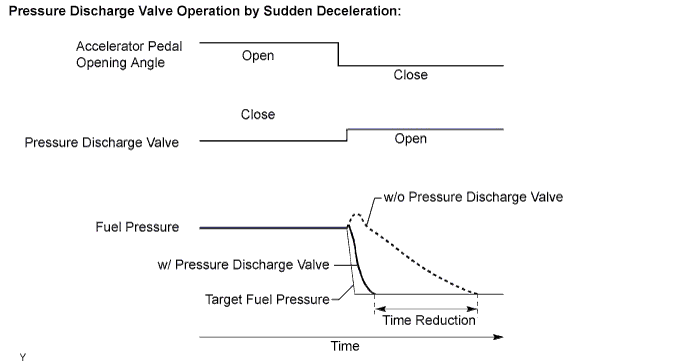
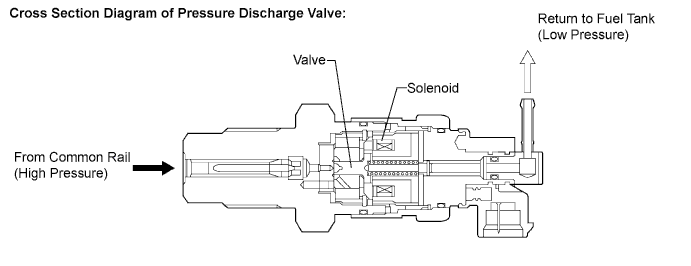
The ECM controls the internal fuel pressure of the common rail by opening and closing the pressure discharge valve. When sudden deceleration occurs, the internal fuel pressure will temporarily become higher than usual and combustion noise may result. Therefore the ECM will open the valve temporarily to discharge the excess pressure inside the common rail. Also, the pressure discharge valve opens when the ignition switch is turned OFF to allow prompt discharge of the common rail internal pressure.
Tech Tips
-
For more information on the pressure discharge valve and the common rail system Click here.
-
For more information on the EDU Click here.
-
If P1271 and/or P1272 is present, refer to the DTC chart for the fuel system Click here.
| DTC No. | DTC Detection Condition | Trouble Area |
|---|---|---|
| P1271 | Open or short in pressure discharge valve circuit. There is no valve opening confirmation (IJf) signal from EDU to ECM despite the ECM sending valve opening command (PRD) signal after the engine is started. (1 trip detection logic) |
|
| P1272 | Pressure discharge valve closed malfunction. Actual pressure decreasing rate deviates from the simulated pressure decreasing rate after the engine switch is turned OFF. (2 trip detection logic) |
|
Tech Tips
-
After confirming DTC P1271 and/or P1272, check the fuel pressure inside the common rail in the "Powertrain / Engine / Data List / Fuel Press" using the intelligent tester.
-
P1271:
After clearing the DTC, drive the vehicle at 50 km/h (31 mph) with the third gear and then decelerate by releasing the accelerator pedal. Check that P1271 is not present.
-
P1272:
After clearing the DTC, start and stop the engine twice, and then confirm that P1272 is not present.
| Standard | ||||||
|---|---|---|---|---|---|---|
|
MONITOR DESCRIPTION
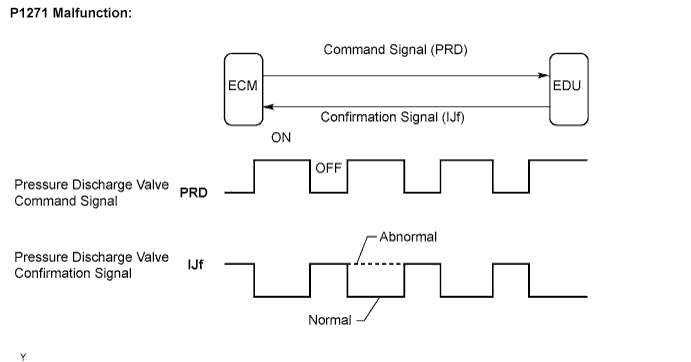
P1271 (Open or short in pressure discharge valve circuit):This DTC will be set if there is no valve opening confirmation (IJf) signal sent from the EDU to the ECM even though the ECM has commanded the EDU to open the pressure discharge valve. This DTC refers to an open or short circuit malfunction of the pressure discharge valve circuit, not a malfunction that includes a valve that is stuck open or closed.
The EDU monitors the current supplied to the pressure discharge valve to verify that the current flows into the valve. If the current exceeds the specified level, the EDU determines that the IJf signal is low. If this DTC is present, the enters the fail-safe mode and limits ECM engine power. The fail-safe mode continues until the engine switch is turned OFF.
The pressure discharge valve will open and discharge the internal fuel pressure from the common rail to the fuel tank when the engine switch is turned OFF. In this event, the ECM compares the actual drop rate of the internal fuel pressure and the target drop rate. If the ECM judges the actual drop rate is smaller than the target, the ECM then judges that the valve has stuck closed and sets this DTC. This DTC will be stored if the internal fuel pressure does not drop to the target after the engine switch has been turned OFF.
If this DTC is present, the ECM enters fail-safe mode and limits the engine power. The fail-safe mode continues until the engine switch is turned OFF.
WIRING DIAGRAM
INSPECTION PROCEDURE
Note
After replacing the ECM, the new ECM needs registration Click here and initialization Click here.
Tech Tips
-
After completing repairs, confirm that P1271 and/or P1272 does not recur.
-
If P0200 and P1271 are present simultaneously, there is an open circuit in the INJF wire harness between the EDU and ECM, or in the wire harness for both injector and pressure discharge valve.
PROCEDURE
-
CHECK DTC OUTPUT (DTC P1271 AND/OR P1272)
-
Connect the intelligent tester to the DLC3.
-
Turn the engine switch ON and turn the tester ON.
-
Select the following menu items: Powertrain / Engine and ECT / DTC.
-
Read DTCs.
Result Display (DTC output) Proceed to P1271 or P1271 and P1272 A P1272 B
B 
REPLACE COMMON RAIL ASSEMBLY Click here
A 
-
-
INSPECT COMMON RAIL ASSEMBLY (PRESSURE DISCHARGE VALVE)
-
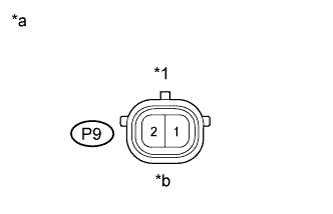
Text in Illustration *1 Pressure Discharge Valve Connector *a Component Side *b Front View Disconnect the P9 pressure discharge valve connector.
-
Measure the resistance between the terminals of the pressure discharge valve.
Standard resistance Tester Connection Condition Specified Condition 1 - 2 20°C (68°F) 0.85 to 1.05 Ω -
Reconnect the pressure discharge valve connector.
NG 
REPLACE COMMON RAIL ASSEMBLY
OK
-
-
CHECK HARNESS AND CONNECTOR (PRESSURE DISCHARGE VALVE - EDU)
-
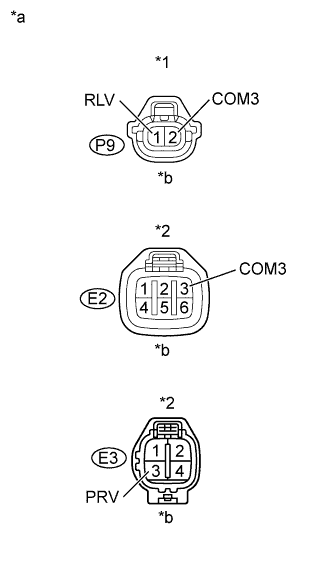
Text in Illustration *1 Pressure Discharge Valve Connector *2 EDU Connector *a Wire Harness Side *b Front View Disconnect the E2 and E3 EDU connectors.
-
Disconnect the P9 pressure discharge valve connector.
-
Check the resistance.
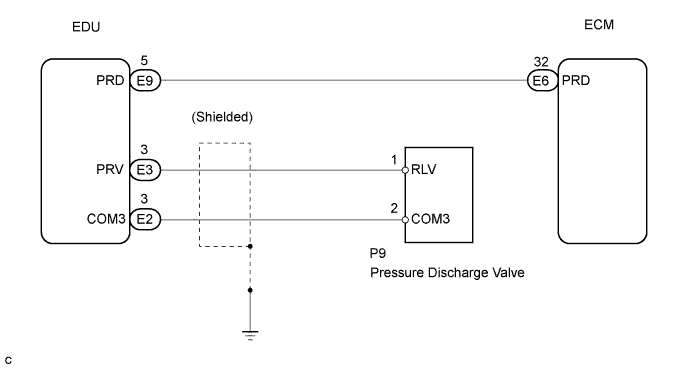
Standard resistance (Check for open) Tester Connection Specified Condition E3-3 (PRV) - P9-1 (RLV) Below 1 Ω E2-3 (COM3) - P9-2 (COM3) Below 1 Ω Standard resistance (Check for short) Tester Connection Specified Condition E3-3 (PRV) or P9-1 (RLV) - Body ground 10 kΩ or higher E2-3 (COM3) or P9-2 (COM3) - Body ground 10 kΩ or higher -
Reconnect the EDU connector.
-
Reconnect the pressure discharge valve connector.
NG
REPAIR OR REPLACE HARNESS OR CONNECTOR
OK
-
-
CHECK HARNESS AND CONNECTOR (ECM - EDU)
-
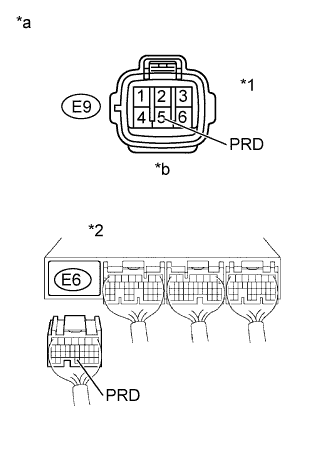
Text in Illustration *1 EDU Connector *2 ECM Connector *a Wire Harness Side *b Front View Disconnect the E9 EDU connector.
-
Disconnect the E6 ECM connector.
-
Check the resistance.
Standard resistance (Check for open) Tester Connection Specified Condition E9-5 (PRD) - E6-32 (PRD) Below 1 Ω Standard resistance (Check for short) Tester Connection Specified Condition E9-5 (PRD) or E6-32 (PRD) - Body ground 10 kΩ or higher -
Reconnect the EDU connector.
-
Reconnect the ECM connector.
NG
REPLACE COMMON RAIL ASSEMBLY
OK
-
-
INSPECT EDU (POWER SOURCE CIRCUIT)
-
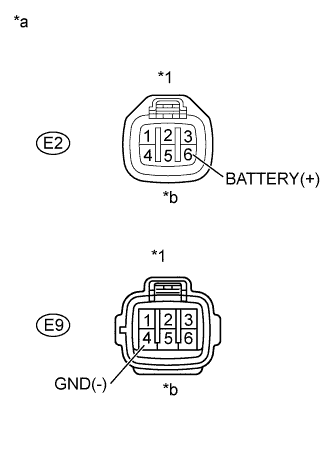
Text in Illustration *1 EDU Connector *a Wire Harness Side *b Front View Disconnect the E2 and E9 EDU connectors.
-
Turn the ignition switch ON.
-
Measure the voltage between the specified terminals of the EDU connector.
Standard voltage Tester Connection Specified Condition E2-6 (BATTERY) - E9-4 (GND) 11 to 14 V -
Reconnect the EDU connector.
NG
CHECK EDU POWER SOURCE CIRCUIT (EDU - BATTERY)
OK
-
-
INSPECT ECM (PRD VOLTAGE)
-
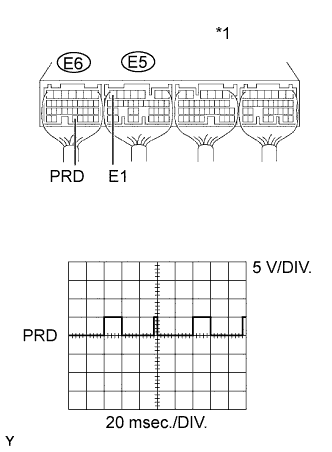
Text in Illustration *1 ECM Connector Inspect the ECM using the oscilloscope.
-
Drive the vehicle at 50 km/h (31 mph) with the third gear, and then decelerate by releasing the accelerator pedal.
-
Check the waveform between the terminals of the E5 and E6 ECM connectors.
Standard Tester Connection Specified Condition E6-32 (PRD) - E5-7 (E1) Correct waveform shown Tech Tips
Alternative inspection:
Run the engine at 2,500 rpm for 10 seconds and then decrease the engine speed to idling by completely releasing the accelerator pedal.
NG
REPLACE ECM
OK
-
-
REPLACE INJECTOR DRIVER (EDU)
NEXT
-
CHECK WHETHER DTC OUTPUT RECURS (SEE IF DTC IS OUTPUT AGAIN)
-
Connect the intelligent tester to the DLC3.
-
Turn the engine switch ON and turn the tester ON.
-
Clear DTCs Click here.
-
Start the engine.
Tech Tips
P1271:
After clearing the DTC, drive the vehicle at 50 km/h (31 mph) with the third gear and then decelerate by releasing the accelerator pedal. Confirm that DTC P1271 is not present again.
P1272:
After clearing the DTC, start and stop the engine twice, and then confirm that DTC P1272 is not present again.
-
Select the following menu items: Powertrain / Engine and ECT / DTC.
-
Read DTCs.
Result Display (DTC output) Proceed to P1271 and/or P1272 A No output B
B
SYSTEM IS OK
A 
REPLACE ECM
-
-
REPLACE COMMON RAIL ASSEMBLY
NEXT
-
CHECK WHETHER DTC OUTPUT RECURS
Tech Tips
P1271:
After clearing the DTC, drive the vehicle at 50 km/h (31 mph) with the third gear and then decelerate by releasing the accelerator pedal. Confirm that DTC P1271 is not present again.
P1272:
After clearing the DTC, start and stop the engine twice, and then confirm that DTC P1272 is not present again.
NEXT
END