REAR DIFFERENTIAL CARRIER ASSEMBLY INSPECTION

-
INSPECT CLEARANCE BETWEEN REAR DIFFERENTIAL SPIDER AND REAR DIFFERENTIAL PINION
-
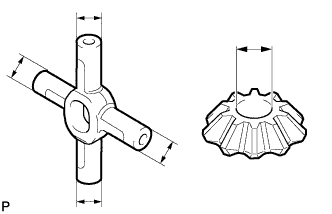
Using a micrometer, measure the outer diameter at 4 points of the rear differential spider.
-
Using a caliper gauge, measure the inner diameter of the 4 pinions.
-
Calculate the clearance by subtracting the outer diameter of the rear differential spider from the inner diameter of the rear differential pinion.
Clearance: Standard Maximum 0.140 to 0.261 mm (0.0056 to 0.0102 in.) 0.40 mm (0.0157 in.) If the clearance is more than the maximum, replace the parts.
-
-
INSPECT REAR DIFFERENTIAL SIDE GEAR THRUST WASHER AND REAR DIFFERENTIAL PINION THRUST WASHER
-
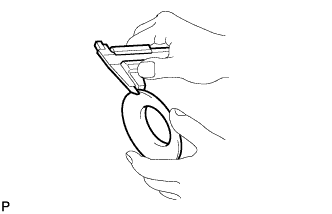
Using vernier calipers, measure the thicknesses of the rear differential side gear thrust washer and rear differential pinion thrust washer.
Thickness of side gear thrust washer: Standard Minimum 1.9 to 2.1 mm (0.0748 to 0.0826 in.) 1.7 mm (0.0669 in.) Thickness of pinion thrust washer: Standard Minimum 1.5 to 1.7 mm (0.0591 to 0.0669 in.) 1.3 mm (0.0512 in.) If the value is less than the minimum, replace the rear differential side gear thrust washer or rear differential pinion thrust washer.
-
-
INSPECT DIFFERENTIAL SIDE GEAR BACKLASH
-
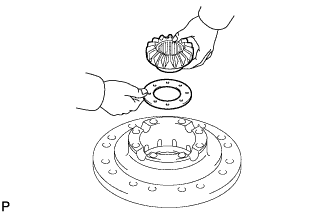
Install the rear differential side gear thrust washer and the rear differential side gear on to the differential case LH.
-
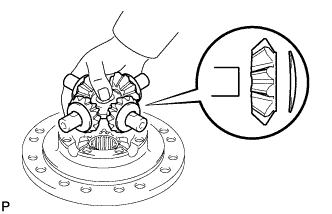
Install the 4 rear differential pinions and 4 rear differential pinion thrust washers to the rear differential spider.
-
Install the rear differential spider with the rear differential pinion facing the differential case LH.
-
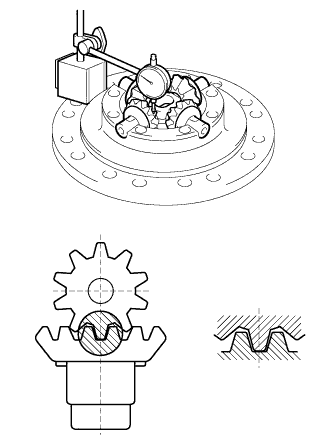
Using a dial indicator, measure the differential side gear backlash.
Backlash: Standard Maximum 0.20 to 0.60 mm (0.0079 to 0.0236 in.) 0.90 mm (0.0354 in.) If the backlash is more than the maximum, replace the parts.
Tech Tips
Measure the backlash when the rear differential side gear and the rear differential pinion are as shown in the illustration.
-
Using the same method, measure the backlash between the side gears and the differential pinions on the differential case RH side.
-
-
INSPECT CONICAL DISTANCE
-
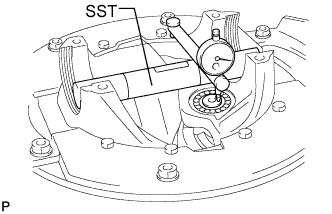
Using SST, measure the depth from the side bearing mounting surface to the drive pinion tip (this depth is called the conical distance).
- SST
- S0964-01022
Standard 27 mm (1.063 in.) Note
-
Before installing the differential drive pinion, record the machining error dimension stamped at the pinion tip and use it for calculation of the conical distance.
-
The conical distance is the standard dimension at the time of adjustment of the tooth contact of the differential drive pinion and ring gear, and the best tooth contact is obtained when setting is done with this dimension. For reasons of machining, a machining error dimension in regard to the norm dimension is stamped at the tip of the differential drive pinion, and the dimension under consideration of this machining error dimension and the norm dimension is called the standard dimension.
-
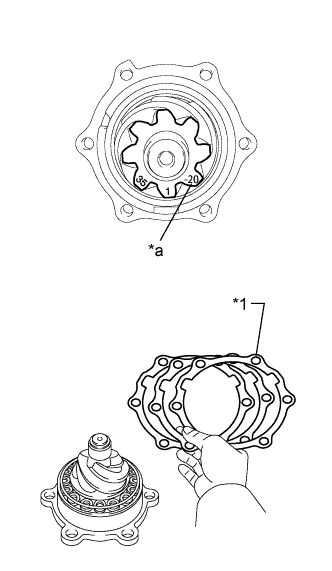
Text in Illustration *1 Drive Pinion Cage Shims *a Machining Error Dimension Adjustment is made by changing the thickness of the differential drive pinion cage shim according to the difference between the measuring value and the tightening torque (conical distance).
Standard dimension Norm dimension + machining error dimension Tech Tips
When the machining error stamp at the tip of the differential drive pinion is 39, the machining error dimension is 0.39 mm (0.153 in.) (norm dimension + machining error dimension = standard dimension [27 mm (1.063 in.)+ 0.39 mm (0.153 in.)) = 27.39 mm (1.078 in.)]).
Shim thickness Part No. Thickness 41153-37090 0.30 mm (0.0118 in.) 41153-37100 0.40 mm (0.0157 in.) 41153-37110 0.45 mm (0.0177 in.) 41153-37120 0.50 mm (0.0197 in.) -
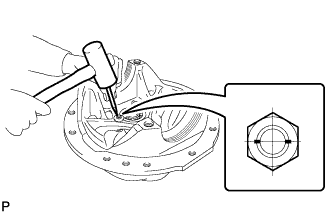
Using a punch, stake the 2 portions of the pilot bearing lock nut.
-
-
INSPECT TOOTH CONTACT BETWEEN RING GEAR AND DRIVE PINION
-
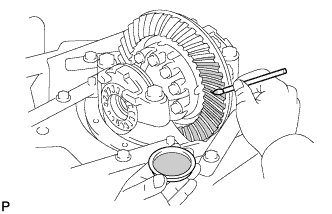
Coat 3 or 4 teeth at 3 different positions on the ring gear with prussian blue.
-
Turn the rear drive pinion companion flange sub-assembly in both directions to inspect the ring gear for proper tooth contact.
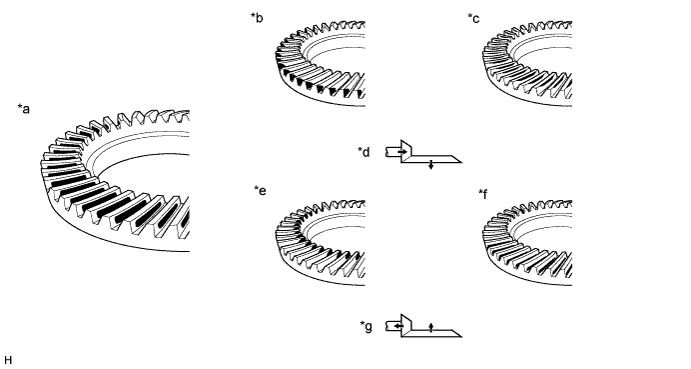
Text in Illustration *a Proper Contact *b Heel Contact *c Face Contact *d Select an adjusting washer that will shift the drive pinion closer to the ring gear (*b, *c) *e Toe Contact *f Flank Contact *g Select an adjusting washer that will shift the drive pinion away from the ring gear (*e, *f) - - If the teeth are not properly contacting, use the table below to select a proper shim (drive pinion cage shim) for correction.
Shim thickness: Part No. Thickness 41153-37090 0.30 mm (0.0118 in.) 41153-37100 0.40 mm (0.0157 in.) 41153-37110 0.45 mm (0.0177 in.) 41153-37120 0.50 mm (0.0197 in.) Tech Tips
Use one or more drive pinion cage shims for adjustment.
-
-
INSPECT DIFFERENTIAL DRIVE PINION PRELOAD
-
Apply the gear oil to the thread of the rear drive pinion nut.
-
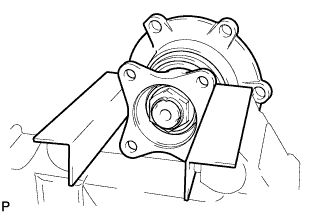
Install the rear drive pinion companion flange sub-assembly and rear drive pinion nut to the differential drive pinion. Hold the drive pinion companion flange sub-assembly in a vise with aluminum plates in between.
-
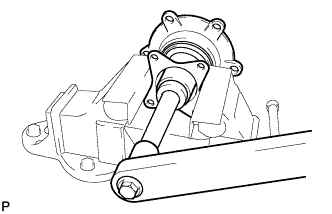
Using a 41 mm deep socket wrench, tighten the rear drive pinion nut.
- Torque:
- 435 N*m { 4437 kgf*cm, 321 ft.*lbf }
-
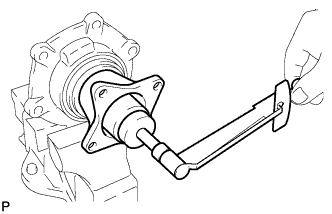
Using a torque wrench, measure the preload at the rear drive pinion nut part.
Preload: New bearing Reused bearing 1.48 to 1.96 N*m
(15 to 20 kgf*cm, 13 to 17 in.*lbf)
0.98 to 1.47 N*m
(10 to 15 kgf*cm, 9 to 13 in.*lbf)
Note
-
Do not install an oil seal before preload measurement.
-
When either of the bearings is new, use the preload for a new bearing.
-
-
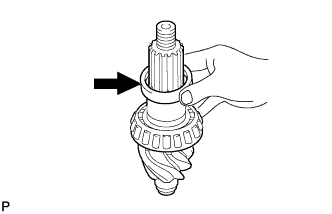
When the measured value is not within the specified range, select the rear differential drive pinion bearing spacer thickness to adjust the preload.
Spacer thickness: Part No. Thickness 41231-37420 14.400 mm (0.5669 in.) 41231-37430 14.425 mm (0.5679 in.) 41231-37440 14.450 mm (0.5689 in.) 41231-37450 14.475 mm (0.5699 in.) 41231-37460 14.500 mm (0.5709 in.) 41231-37470 14.525 mm (0.5718 in.) 41231-37480 14.550 mm (0.5728 in.) 41231-37490 14.575 mm (0.5738 in.) 41231-37500 14.600 mm (0.5748 in.) 41231-37510 14.625 mm (0.5758 in.) 41231-37520 14.650 mm (0.5768 in.) 41231-37530 14.675 mm (0.5778 in.) 41231-37540 14.700 mm (0.5787 in.) 41231-37550 14.725 mm (0.5797 in.) 41231-37560 14.750 mm (0.5807 in.) 41231-37570 14.775 mm (0.5817 in.) 41231-37580 14.800 mm (0.5827 in.) 41231-37590 14.825 mm (0.5837 in.) 41231-37600 14.850 mm (0.5846 in.) 41231-37610 14.875 mm (0.5856 in.)
-
-
INSPECT TOTAL PRELOAD
-
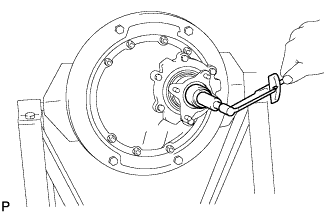
Using a 41 mm deep socket wrench and torque wrench, measure the total preload.
-
Calculate the side bearing preload by subtracting the drive pinion preload (starting torque after installing the oil seal) from the total preload. Check that the side bearing preload is within the specification.
Side bearing preload (new bearing): Reduction ratio Standard 4.625 0.32 to 0.42 N*m (3.3 to 4.2 kgf*cm, 2.9 to 3.7 in.*lbf) 4.875 0.31 to 0.40 N*m (3.2 to 4.1 kgf*cm, 2.7 to 3.5 in.*lbf) Side bearing preload (reused bearing): Reduction ratio Standard 4.625 0.22 to 0.31 N*m (2.3 to 3.1 kgf*cm, 2.0 to 2.7 in.*lbf) 4.875 0.21 to 0.30 N*m (2.1 to 3.0 kgf*cm, 1.8 to 2.6 in.*lbf) Tech Tips
-
Total preload = Drive pinion preload + Side bearing preload
-
When replacing both or either side bearings, use the standard of the side bearing preload (new bearing).
-
-
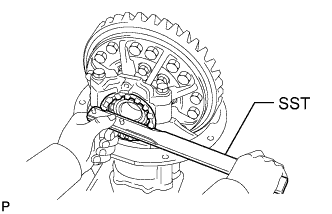
If the result is not as specified, then turn the left/right adjusting nuts using SST to adjust the preload.
- SST
- 09504-00011
Note
When adjusting with the adjusting nuts, turn them by an equal amount so that the backlash will not be incorrect.
-
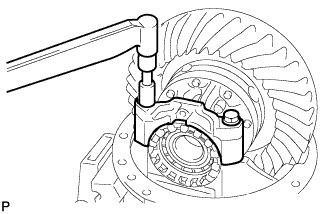
Tighten the 2 differential bearing caps with the 4 bolts.
- Torque:
- 210 N*m { 2141 kgf*cm, 155 ft.*lbf }
-
Recheck the total preload.
-
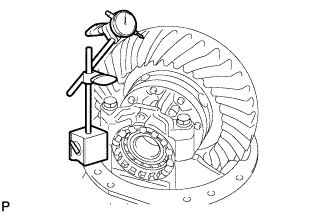
Recheck the ring gear backlash.
Backlash: Reduction ratio Standard 4.625 0.20 to 0.28 mm (0.0078 to 0.0110 in.) 4.875 0.20 to 0.28 mm (0.0078 to 0.0110 in.)
-