ENGINE OIL COOLER INSTALLATION

-
INSTALL OIL COOLER ASSEMBLY
-
Install the oil cooler assembly and 2 new gaskets to the oil cooler cover sub-assembly with the 4 nuts.
- Torque:
- 18 N*m { 184 kgf*cm, 13 ft.*lbf }
-
-
INSTALL OIL COOLER COVER SUB-ASSEMBLY
-
Install 4 new gaskets.
-
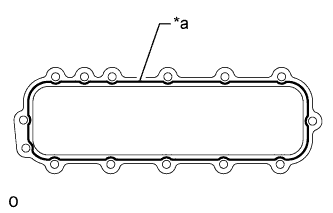
Text in Illustration *a 2.2 to 2.7 mm (0.0866 to 0.106 in.) Apply a continuous bead of seal packing (diameter 2.2 to 2.7 mm (0.0866 to 0.106 in.)) as shown in the illustration.
Seal packing Toyota Genuine Seal Packing Black, Three Bond 1207B or equivalent Note
-
Remove any oil from the contact surface.
-
Install the oil cooler cover sub-assembly within 3 minutes of applying the seal packing.
-
Do not start the engine for at least 2 hours after the installation.
-
-
Install the oil cooler cover sub-assembly with the 15 bolts.
- Torque:
- 29 N*m { 291 kgf*cm, 21 ft.*lbf }
-
-
INSTALL OIL COOLER BRACKET
-
Install the oil cooler bracket with the bolt.
- Torque:
- 29 N*m { 291 kgf*cm, 21 ft.*lbf }
-
-
INSTALL OIL FILTER SUB-ASSEMBLY
-
Clean the oil filter installation surface.
-
Apply engine oil to the oil filter gasket.
-
Lightly screw the oil filter to the engine until the oil filter does not turn by hand.
-
Using SST, tighten the oil filter an additional 2/3 turn.
- SST
- 09228-78010
-
-
INSTALL TURBOCHARGER SUB-ASSEMBLY
-
ADD ENGINE OIL
-
Add new engine oil.
Standard Oil Grade Oil Grade Oil Viscosity (SAE) API (CJ-4)
JASO (DH-2)
ACEA (E-6, E-9)
- 5W-30
- 10W-30
- 15W-40
Standard Capacity Item Specified Condition Drain and refill without oil filter change 5.2 liters (5.5 US qts, 4.6 Imp. qts) Drain and refill with oil filter change 6.5 liters (6.9 US qts, 5.7 Imp. qts) Dry fill 8.7 liters (9.2 US qts, 7.7 Imp. qts) -
Install the oil filler cap.
-
-
INSPECT FOR OIL LEAK
-
Start the engine. Make sure that there are no oil leaks from the areas that were worked on.
-
-
INSPECT ENGINE OIL LEVEL
-
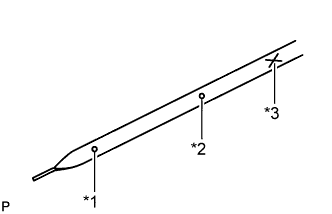
Text in Illustration *1 Low Level Mark *2 Full Level Mark *3 Full Level Mark (For Inspection) Warm up the engine, stop the engine and wait 5 minutes. The engine oil level should be between the dipstick low level mark and full level mark (for inspection). If low, check for leakage and add oil up to the full level mark.
Note
Do not fill engine oil above the full level mark.
Tech Tips
A certain amount of engine oil will be consumed while driving. In the following situations, oil consumption may increase, and engine oil may need to be refilled in between oil maintenance intervals.
-
When the engine is new, for example directly after purchasing the vehicle or after replacing the engine.
-
If low quality oil or oil of an inappropriate viscosity is used.
-
When driving at high engine speed or with a heavy load, (when towing, or), when driving while accelerating or decelerating frequently.
-
When idling for a long time, or when driving frequently through heavy traffic.
When judging the amount of oil consumption, keep in mind that the oil may have become diluted, making it difficult to judge the true level accurately.
-
-