TURBOCHARGER INSPECTION

-
CHECK TURBINE SHAFT ROTATION
-
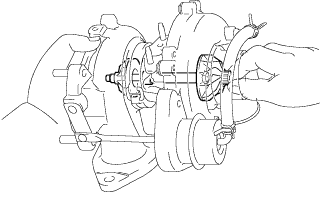
Check the turbine shaft.
-
Hold the nut on the turbine shaft with your fingers and check that there is no remarkable looseness in the radial and axial directions.
Tech Tips
If the fins of the impeller and the turbine wheel are in contact with the housing because of the looseness, replace the turbocharger assembly.
-
Turn the turbine charger with your fingers and check that it turns smoothly.
Tech Tips
If the turbine shaft does not turn smoothly, replace the turbocharger assembly.
-
-
Check the turbo housing.
-
Visually check the turbine housing and compressor housing for damage or breaks.
Tech Tips
If any damage or breaks are found in the housings, replace the turbocharger assembly.
-
Visually check the fins of the impeller and turbine wheel for damage or breaks.
-
-
-
INSPECT AXIAL PLAY OF TURBINE SHAFT
-
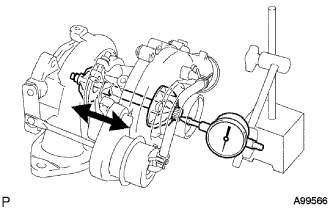
Using a dial indicator, insert the needle of the dial indicator into the exhaust side of the turbine shaft.
-
Move the turbine shaft in an axial direction and measure the axial play of the turbine shaft.
Maximum axial play 0.008 mm (0.00031 in.) If the axial play is greater than the maximum, replace the turbocharger.
-
-
INSPECT RADIAL PLAY OF TURBINE SHAFT
-
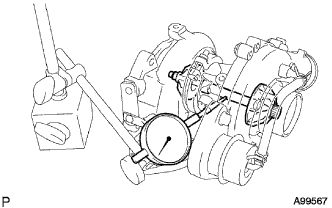
Using a dial indicator, insert the needle of the dial indicator into the oil outlet hole, and set it in the center of the turbine shaft.
-
Move the turbine shaft in a radial direction and measure the radial play of the turbine shaft.
Maximum radial play 0.11 mm (0.0043 in.) If the radial play is greater than the maximum, replace the turbocharger.
-
-
INSPECT ACTUATOR AND WASTE GATE VALVE OPERATION
-
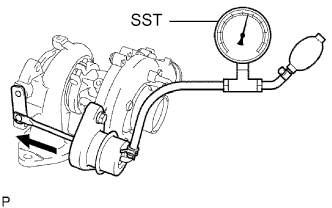
Disconnect the actuator hose from the compressor housing.
-
Using SST, apply pressure to the actuator.
- SST
- 09992-00242
Standard 114 kPa (1.16 kgf/cm2, 16.5 psi) Note
Never apply more than 147 kPa (1.50 kgf/cm2, 21.3 psi) of pressure to the actuator.
-
Check that the actuator push rod moves and that the waste gate valve opens.
If the rod does not move, replace the actuator or turbocharger.
-
Connect the actuator hose to the compressor housing.
-